
Introduction
 Open talk in Gospel Library
Ideas for Opening the Lesson
- Invite class members to briefly share what they knew about general conference before this session and what they had learned about a solemn assembly. This could help the class notice that President Oaks had introduced not only a conference session but also a sacred moment in Church governance and worship.
- Begin by asking the class why sustaining leaders matters in the restored Church. After a few responses, read the paragraph about sustaining the First Presidency and the Quorum of the Twelve Apostles by quorums and groups, and invite the class to discuss what this practice teaches about unity, order, and revelation.
- Start with the Easter setting of the talk. Ask class members how the reality that Jesus Christ is resurrected and is the head of the Church affects the way they listen to conference messages and sustain Church leaders. This could help center the lesson on the Savior rather than only on Church procedure.
- Write two phrases on the board: "solemn assembly" and "sustaining vote." Invite class members to explain what each phrase means and why each is spiritually significant. Then connect their comments to President Oaks's gratitude for members" prayers, support, and faithful service.
- Invite class members to think of a time when they felt strengthened by the prayers and support of others in a calling or responsibility. Use that as a bridge to President Oaks's expression of gratitude for members" sustaining votes, prayers, and support for Church leaders.
Topics
Welcome all to general conference
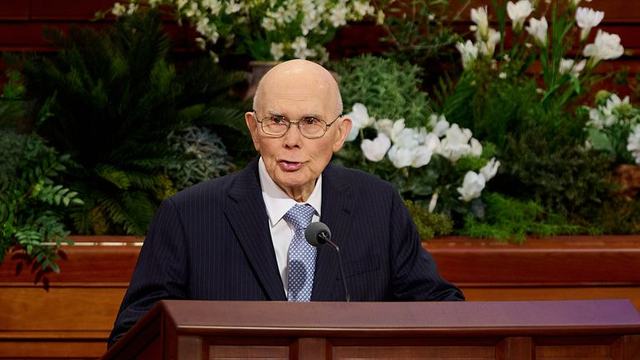
President Oaks had warmly welcomed Church members throughout the world and others who were interested in the Church’s progress and teachings. He had emphasized the global reach of the Church and the broad audience of general conference. His introduction set a tone of inclusion and gratitude.
My dear brothers and sisters, welcome to general conference. I now address members of The Church of Jesus Christ of Latter-day Saints, numbering over 17 million worldwide, and others who are interested in the remarkable progress and inspired teachings of this Church.
- What stood out to you about the way President Oaks had welcomed both Church members and interested friends?
- How can we help others feel included when they listen to or attend general conference?
- What does the worldwide nature of the Church add to your appreciation of conference messages?
- How have you seen the "remarkable progress and inspired teachings" of the Church bless people in your life or community?
- What can we do personally to invite others to hear prophetic messages with an open heart?
Recognize the uniqueness of this conference
President Oaks had explained that this conference was different because it began with a solemn assembly. He had taught that while general conferences occur twice a year, this particular gathering included a sacred and unusual element. His explanation helped listeners understand the significance of the moment.
But as many of you are not aware, the conference we convene today is different because it begins with what we call a solemn assembly.
- Why do you think President Oaks had wanted members to understand that this conference was different?
- How can understanding the setting of a prophetic message deepen our spiritual attention?
- What experiences have helped you feel that some Church gatherings are especially sacred?
- How can we prepare differently when we know a meeting or ordinance is of special significance?
- What does this reminder teach us about approaching sacred events with reverence?
Honor the sacred pattern of solemn assemblies
President Oaks had taught that solemn assemblies had been events of great significance to Church members for more than a century. He had framed the solemn assembly as part of an established sacred pattern in the Church. This underscored continuity, reverence, and the seriousness of covenant community worship.
For more than a century, this has been an event of great significance to members of the Church.
- What do you learn from the fact that solemn assemblies have been significant in the Church for more than a century?
- How does sacred tradition strengthen your faith in the Lord’s order in His Church?
- Why is it helpful to remember that some Church practices connect us with faithful Saints across generations?
- How have reverent and orderly worship experiences increased your testimony?
- What can we do to treat sacred Church practices with greater understanding and respect?
Sustain prophets and apostles in unity
President Oaks had explained that in a solemn assembly, members sustained the First Presidency and the Quorum of the Twelve Apostles by quorums and groups. He had clarified that this occurred only in the first conference after a new President and prophet of the Church had been called. His words highlighted both revealed order and the united participation of the Saints in sustaining leadership.
In a solemn assembly, we will sustain members of the First Presidency and the Quorum of the Twelve Apostles, voting by quorums and groups. We do this only in the first conference where a new President and prophet of the Church has been called.
- What does sustaining leaders by quorums and groups teach us about unity in the Church?
- How is sustaining more than just raising a hand in a meeting?
- What responsibilities come with sustaining the President of the Church and the Apostles?
- How have you tried to show support for Church leaders through your actions, prayers, or obedience?
- Why do you think the Lord uses orderly processes like this in His Church?
Value leadership callings and formal recognition
President Oaks had expressed gratitude to be among those whose leadership callings were formally recognized in that sacred setting. He had shown humility and appreciation for the opportunity to serve. His statement invited members to respect callings as sacred trusts rather than merely administrative assignments.
I am grateful to be among those whose leadership callings are formally recognized in this way and to express appreciation for your participation in this significant occasion.
- What did President Oaks's gratitude teach you about how Church leaders view their callings?
- How can we show greater respect for the sacred nature of callings in the Church?
- What has helped you see a calling as a trust from the Lord rather than just a task?
- How does formal recognition of a calling help strengthen accountability and support?
- When have you felt grateful for the participation and support of others in your own calling?
Support leaders with votes, prayers, and faith
President Oaks had thanked members for their sustaining vote, prayers, and support. He had taught that these expressions of support mattered to Church leaders. His words suggested that sustaining was active and ongoing, not symbolic only.
In advance, I express our gratitude as leaders of the Church for our members’ sustaining vote, prayers, and support.
- What are some meaningful ways we can support Church leaders beyond a sustaining vote?
- How have prayers for leaders changed your heart or strengthened your faith?
- Why is it important that sustaining include both loyalty and action?
- What can we do when we do not fully understand a decision or direction from Church leaders?
- How have you seen leaders strengthened by the faith and support of members?
Serve God’s children throughout the world
President Oaks had prayed that members would be guided and prospered as they continued serving the children of God throughout the world. He had recognized the goodness and reach of the Saints’ service. His words connected conference worship with everyday discipleship and ministering.
We also pray for you to be guided and prospered as you continue the great service you give to the children of God throughout the world.
- What does President Oaks's statement teach us about the value of members" service?
- How have you seen ordinary disciples bless "the children of God throughout the world"?
- In what ways do you need the Lord’s guidance in your current service?
- What helps you continue serving even when the work feels unnoticed or difficult?
- How can our quorum or Relief Society better serve God’s children locally and globally?
Center conference on the resurrected Lord
At Easter, President Oaks had reaffirmed testimony of the resurrected Savior and declared that Jesus Christ was the head of the Church. He had pointed listeners to the Savior as the source of authority, guidance, and blessing. This testimony gave the entire introduction its spiritual foundation.
At this Easter season, I reaffirm our testimony of the resurrected Lord and recognize that He is the head of this Church.
- Why was it important that President Oaks had centered his introduction on the resurrected Lord?
- How does knowing that Jesus Christ is the head of the Church affect the way you sustain leaders?
- What does Easter add to your understanding of conference and prophetic leadership?
- How has your testimony of the resurrected Savior influenced your trust in His Church?
- What can we do to keep the Savior at the center of our worship and service?
Seek the Savior’s blessings on conference
President Oaks had concluded by praying for the Lord’s blessings on the conference and on all who heard it. He had modeled dependence on Jesus Christ and reverence in beginning a sacred gathering. His closing prayer invited listeners to receive conference as a spiritual blessing, not merely an event.
We pray for His blessings upon this conference and upon all of you in the name of Jesus Christ, amen.
- What do you learn from President Oaks's prayer for the Lord’s blessings on conference and the members?
- How can we seek the Savior’s blessings before listening to conference or teaching from it?
- When have you felt that the Lord blessed you through a conference message?
- How does prayer prepare us to hear and apply prophetic counsel?
- What blessing from the Lord do you most hope to receive as you study this talk?
Additional Discussion Questions
- What did this brief introduction teach you about the sacred order of the Lord’s Church?
- How can we make our sustaining of leaders more active during the months between conferences?
- What role does reverence play in helping us recognize when a gathering is spiritually significant?
- How does the global nature of the Church strengthen your testimony of the Restoration?
- What can we learn from President Oaks's humility and gratitude in speaking about leadership callings?
- How can we better pray for those who lead and serve in the Church at every level?
- What does this talk suggest about the relationship between Church procedure and spiritual power?
- How can remembering that Jesus Christ is the head of the Church bring peace during times of change?
- What invitations for personal action did you hear in President Oaks's words, even though the talk was short?
- How can our class better support one another as we serve the children of God?
