
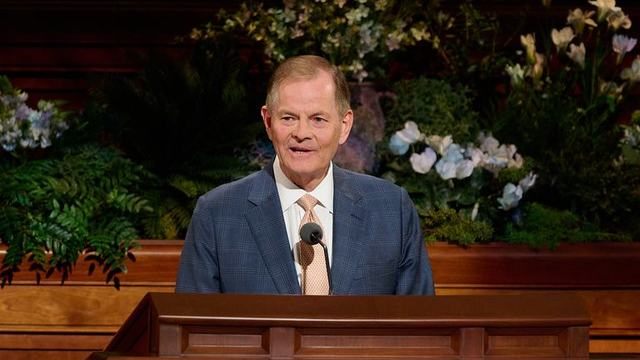
Lost Luggage, Redeemed Souls
 Open talk in Gospel Library
Contents
Before Reading
Before reading or listening to the talk, consider the following questions:
- What does the metaphor of lost luggage teach about how Heavenly Father feels about His children?
- How does Elder Stevenson describe our responsibility to care for others as stewards of God’s precious children?
- What can I learn from the examples of careful, intentional baggage handling about ministering more effectively?
- What specific roles do ministering brothers and sisters have in helping others stay on the covenant path?
- Why does Elder Stevenson place special emphasis on strengthening the rising generation?
- How can small, consistent acts of care make a spiritual difference in someone’s life?
- What does redemption mean in the context of this talk?
- How can I better help others feel remembered, nourished, and loved by God?
Topics
Recognize the worth of what is precious
Elder Stevenson begins with the familiar anxiety of lost luggage and contrasts it with the remarkable care shown at Kansai International Airport, where baggage workers treat each item as precious. He uses this example to introduce the spiritual truth that what is precious deserves deliberate, careful attention. This sets the stage for understanding how Heavenly Father views His children and how disciples should treat those entrusted to their care.
Throughout that flight, I had an anxious feeling. I hoped someone was taking care of the bag and its contents. I hoped it would not be forgotten, neglected, or lost.
Tsuyoshi Habuta, the airport chief of baggage operations, believes losing luggage should never happen “because luggage is precious to passengers.”
When you hand off your luggage at Kansai Airport, you get a sense that they are saying to you, “We have your precious belongings. We are responsible for them now. We will return them to you.”
- Why does Elder Stevenson begin with the example of lost luggage?
- What attitudes and practices helped Kansai Airport avoid losing luggage?
- How does the idea that something is precious affect the way it is treated?
- What spiritual lesson does Elder Stevenson draw from the airport example?
- Who in my life may need to feel that they are precious and not forgotten?
- What small details of care could I improve in the way I serve others?
- When have I felt anxious about something precious being entrusted to someone else, and what did that teach me?
- How can I become more deliberate and dependable in caring for people rather than tasks alone?
Trust Heavenly Father’s redeeming love for His children
Elder Stevenson reflects on the sacred trust involved in Heavenly Father sending His children into mortality. He teaches that God knows His children, claims them as His own, and has not forgotten them. Mortality is not merely a journey of logistics or survival but a divine process of redemption. Heavenly Father intends to bring His children home, and His love is personal, constant, and purposeful.
In a reverent way, I wonder what it is like for a loving Heavenly Father to send His most precious belongings, His children, away from their heavenly home, knowing they must pass through the challenges of mortality.
How beloved and precious His children are to Him.
In a much holier way, our Heavenly Father also places a claim upon us, not as a label on a handle but as a divine truth written on the heart: “You are mine. I know you. You are not alone. I have not forgotten you. I intend to bring you home.”
This is more than logistics.
This is redemption.
- What does Elder Stevenson teach about how Heavenly Father feels about His children?
- What does it mean that God places a claim upon us?
- How does the talk describe the purpose of mortality in relation to redemption?
- What truths in this section show that no one is forgotten by God?
- When have I felt that Heavenly Father knew me personally?
- How can I remember more often that I belong to God?
- What fears or discouragements could be eased by trusting that Heavenly Father intends to bring me home?
- How would my choices change if I more fully believed, “You are mine. I know you. You are not alone”?
Accept the stewardship to care for God’s children
The talk teaches that Heavenly Father’s children do not travel through mortality alone. Parents, family members, leaders, friends, and ministering brothers and sisters all serve as stewards of souls who are precious to Him. Elder Stevenson emphasizes the privilege and responsibility of helping others on their journey. Caring for others is part of participating in God’s redeeming work.
I suppose His great comfort is knowing that they do not travel alone.
Parents, family, leaders, friends, ministering brothers and sisters, you and I serve as stewards of His most precious possessions.
And how beloved and blessed are those who care for and nurture others.
May I offer two cases where I feel the Lord would be deeply pleased with those who magnify their role as thoughtful and intentional handlers of His precious cargo, His children?
- Who does Elder Stevenson identify as stewards of Heavenly Father’s children?
- Why is caring for others described as a sacred stewardship?
- What does it mean to magnify our role in caring for God’s children?
- How does this stewardship connect to the Lord’s work of redemption?
- Whom has the Lord placed in my path for me to strengthen and nurture?
- How can I be a more thoughtful and intentional steward in my family, calling, or friendships?
- What does it look like for me personally to participate in the Lord’s redeeming work?
- How have others acted as faithful stewards in my life?
Minister with Christlike care and intention
Elder Stevenson specifically highlights ministering brothers and sisters, both adults and youth, as representatives of the Lord. Ministering is not casual or optional; it is scripturally grounded and meant to help people be remembered, nourished by the word of God, strengthened, and prepared to make and keep covenants. He invites members to see ministering as Christlike caring for the Lord’s treasured possessions and to improve through small acts of kindness and spiritual attentiveness.
The first is in our role as assigned ministering brothers and sisters—adults and youth.
Please know you represent the Lord, scripturally aligned, serving those who are “numbered among the people of the church of Christ,” whose “names [are] taken, that they might be remembered and nourished by the good word of God, to keep them in the right way.”
We “are to ‘watch over’ Church members and ‘be with and strengthen them’ (Doctrine and Covenants 20:53).”
The greatest success in missionary work comes as we act in normal and natural ways; the same is true in ministering.
Consider your ministering assignment as “Christlike caring” of the Lord’s most treasured possessions, who at the end of their mortal journey can be claimed and redeemed by Him.
I invite you to implement small acts of kindness and care into your ministering, becoming better ministers of Jesus Christ.
- How does Elder Stevenson define the role of ministering brothers and sisters?
- What scriptural purposes of ministering are mentioned in the talk?
- Why is acting in normal and natural ways important in ministering?
- What are the four specific invitations Elder Stevenson gives for ministering?
- How does ministering help people remain on the covenant path?
- How do I currently view my ministering assignment, and how could I see it more as representing the Lord?
- What small act of kindness or care could I offer this week to someone I minister to?
- How can I better seek the Spirit in knowing how to help those in my care?
- In what ways can I help individuals or families prepare to make and keep sacred covenants?
- Who may need to be remembered and nourished right now?
Strengthen the rising generation in light and truth
Elder Stevenson identifies nurturing the rising generation as a universal responsibility. In perilous times, children and youth need defense, refuge, teaching, and investment. He emphasizes the eternal value of serving Primary children, youth, and young adults. As adults teach and nurture while trusting God, He can magnify those efforts and produce outcomes more beautiful than they could achieve alone.
The second is the universal charge to strengthen and nurture the rising generation, to bring up children “in light and truth.”
In the perilous times in which we live, the rising generation needs a defense and refuge from the storm.
We can contribute to this effort by investing time and teaching.
There is no greater need and no greater return on this investment than when it is made with Primary children, young men, young women, and young adults.
President Dieter F. Uchtdorf has promised that as we do our part in teaching, nurturing, and then trusting in God to work His miracles, “the result will be more beautiful and more stunning and more joyful than anything you could accomplish just by yourself.”
- Why does Elder Stevenson say the rising generation especially needs strengthening now?
- What does it mean to bring up children in light and truth?
- Why is investing time and teaching the rising generation such an important work?
- What promise from President Uchtdorf is included in this section?
- What opportunities do I have to strengthen children, youth, or young adults?
- How can I make teaching the rising generation a higher priority?
- What does “defense and refuge from the storm” look like in my home or calling?
- How have I seen God magnify efforts to teach and nurture young people?
Teach young disciples to center their lives on Jesus Christ
Elder Stevenson explains that strengthening the rising generation means helping them receive the holy name of Jesus Christ in their hearts and minds, take up His cross, walk in holiness, and look to Him for remission of sins. He urges adults to help youth develop the spiritual skill of hearing the Holy Ghost and to know, love, and emulate the Savior. Jesus Christ is presented as the true source of strength, direction, forgiveness, and discipleship.
By motivating, teaching, and encouraging our young people to receive the holy name of Jesus Christ in their hearts and minds, to joyfully take up the cross of Christ, and to walk in holiness as His disciples and emissaries.
We teach this, “that our children may know to what source they may look for a remission of their sins,” even Jesus Christ.
Inspire them to “sincerely and persistently do the spiritual work needed to develop the crucial, spiritual skill of learning how to hear the whisperings of the Holy Ghost, [giving them] all the direction [they] will ever need in [their lives].”
Teach the rising generation to know, love, and emulate their Savior, Jesus Christ.
“He is the strength of youth.”
They will respond.
- According to Elder Stevenson, what should we teach the rising generation about Jesus Christ?
- What does it mean to receive the holy name of Jesus Christ in the heart and mind?
- Why is learning to hear the Holy Ghost a crucial spiritual skill?
- What source should children and youth look to for remission of sins?
- What promise does Elder Stevenson make about how young people will respond?
- How can I help a child or young person come to know and love Jesus Christ more deeply?
- What can I do to better teach about repentance, forgiveness, and the Savior’s role?
- How can I encourage youth to seek and recognize the whisperings of the Holy Ghost?
- In what ways can I more clearly testify that Jesus Christ is the strength of youth?
- How has the Savior become a source of strength in my own life that I could share with others?
Choose to help one another return safely home
In his concluding message, Elder Stevenson teaches that unlike luggage, individuals retain agency and are responsible for their own decisions, beliefs, and actions. Even so, disciples of Jesus Christ should renew their determination to care for others. He emphasizes that all people belong to one family, all need help, and all have great worth before God. The promise of redemption is that no precious soul need be forgotten, neglected, or lost as we help one another return to Heavenly Father.
Unlike pieces of luggage, each of us is ultimately responsible for our decisions, beliefs, and actions, assisted by heavenly and earthly ministering angels.
Therefore, as disciples of Jesus Christ, we rise with renewed determination to succor and care for those with whom we come in contact.
In the end, we are all one family.
We all need help along the way.
We each possess a tag that marks us as a child of a loving Heavenly Father.
Printed upon that tag is a spiritual promise and sacred proclamation that testifies, “This precious soul has great worth to one day be redeemed by its holder,” never to be forgotten, neglected, or lost.
I rejoice in that redemption and celebrate the great privilege we have to participate in that work until that day when we safely return to the one who created and loves us with a perfect love.
- How does Elder Stevenson balance personal responsibility with the help we receive from others?
- What does he teach about our identity as children of Heavenly Father?
- Why does he say we are all one family?
- What does the promise of redemption mean in the conclusion of the talk?
- How are disciples of Jesus Christ invited to respond to these truths?
- How can I take greater responsibility for my own spiritual journey while also accepting help from others?
- Who around me may need succor and care right now?
- How does remembering that everyone is part of one family affect the way I treat others?
- What helps me remember my divine worth as a child of Heavenly Father?
- What can I do this week to help someone move closer to a safe return to God?
