
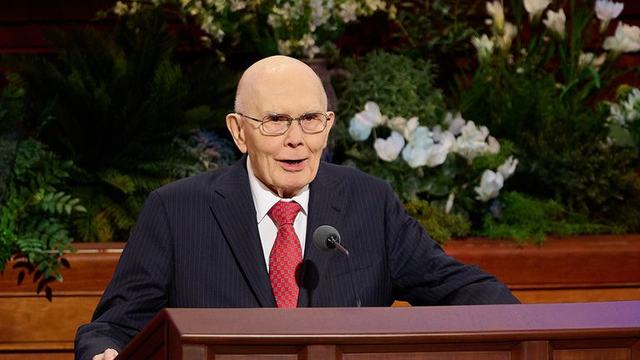
Alive in Christ
 Open talk in Gospel Library
Ideas for Opening the Lesson
- Begin by inviting class members to share one word or short phrase that stood out to them from the talk, such as “Resurrection,” “love,” “adversaries,” or “peacemakers.” After several responses, briefly note that President Oaks connected Easter doctrine with daily discipleship and relationships.
- Start with a simple question: “How does belief in the Resurrection change the way we live today?” Let a few class members respond, then explain that President Oaks taught both about the hope of the Resurrection and the way that hope should shape how we treat others.
- Read aloud the line, “Let us follow Him by forgoing contention and by using the language and methods of peacemakers.” Invite the class to listen for practical ways President Oaks said disciples of Christ could become peacemakers in families, wards, and society.
- Invite class members to think silently about a relationship that feels difficult right now. Then read the Savior’s teaching quoted in the talk: “Love your enemies.” Explain that the lesson will explore how President Oaks taught us to love without surrendering truth.
- Open by reading Alma 11:43–44 from the talk and asking, “What difference does a literal, universal resurrection make when we face weakness, grief, or uncertainty?” This can help the class begin with doctrine before moving into application.
- Share that President Oaks described a nurse whose heart changed when she saw a difficult patient as a child of God. Ask the class, “What helps us see people the way Heavenly Father sees them?” Then transition into the major themes of the talk.
Topics
Trust the universal Resurrection
President Oaks taught that the literal Resurrection of Jesus Christ was a pillar of faith and that the universal Resurrection was certain doctrine. He said this belief changed the whole perspective of mortal life because it gave strength in suffering, courage in the face of death, and hope that mortal deficiencies were temporary.
The conviction that death is not the conclusion of our identity changes the whole perspective of our mortal life.
- How did President Oaks say belief in a literal, universal Resurrection changed our perspective on mortality?
- When have you felt strength from knowing that death was not the end of identity or relationships?
- How could greater faith in the Resurrection help us face illness, aging, disability, or grief differently?
- What did President Oaks mean when he said that mortal deficiencies were only temporary?
- How can we teach the doctrine of the Resurrection in a way that brings hope to others?
- Why do you think President Oaks began an Easter message with the certainty of the Resurrection?
Let Resurrection hope shape family life
President Oaks taught that belief in the Resurrection encouraged us to fulfill family responsibilities in mortality. He said it helped us live together in love now because we anticipated joyful reunions and associations in the life to come.
Our belief in the Resurrection also encourages us to fulfill our family responsibilities in mortality.
- How did President Oaks connect belief in the Resurrection with family responsibilities?
- In what ways can eternal perspective change how we treat family members today?
- How can hope in joyful reunions help someone who is grieving or separated from loved ones?
- What family responsibilities might we take more seriously if we remembered eternal relationships more often?
- How have you seen love increase in a family when people focused on eternal truths?
- What can we do this week to live with greater anticipation of eternal family associations?
Love adversaries as children of God
President Oaks taught that the Savior’s command to love enemies applied broadly to adversaries and all who opposed us. He emphasized that all mortals were beloved children of God and that disciples should expand the circle of love beyond those who were easy to love.
Today we might say that we are commanded to love our adversaries.
- Why was the Savior’s command to love enemies so revolutionary, as President Oaks described it?
- How does thinking of adversaries as children of God change our feelings and actions?
- What makes it difficult to love those who oppose us?
- How can we show Christlike love without pretending that wrong behavior is acceptable?
- When have you seen someone respond to opposition with genuine Christian love?
- What practical steps can help us love an adversary this week?
See others through Heavenly Father’s love
President Oaks shared the experience of a nurse who had despised a patient until she felt Heavenly Father’s love for him and saw him as a child of God. He taught that this kind of spiritual change could transform us and help us see that we belong to each other as God’s children.
She saw him as a child of God.
- What do you learn from the nurse’s experience that President Oaks shared?
- Why do you think that moment became one of the great spiritual experiences of her life?
- How can the Lord help us see someone differently when our hearts are hardened?
- What experiences have helped you feel Heavenly Father’s love for someone who was hard to love?
- How would our homes and wards change if we consistently saw others as children of God?
- What can we do when we recognize feelings of contempt or resentment in ourselves?
Balance truth with Christlike love
President Oaks taught that following Christ did not mean surrendering values or covenants. He said disciples often had to balance responsibilities in a world that misunderstood both commitment to truth and expressions of love, and he urged members to live peaceably and lovingly with those who did not share their beliefs.
This does not mean surrendering our values.
- Why did President Oaks say that balancing truth and love was not easy?
- How can we remain true to covenants while showing sincere love to those with different values?
- What misunderstandings sometimes arise when disciples try to live both truth and compassion?
- How can we seek fairness for all without compromising our beliefs?
- When have you seen mutual respect grow through personal contact with someone who believed differently?
- What would it look like to be both devoted to truth and generous in love in your daily life?
Choose the language of peacemakers
President Oaks taught that followers of Christ should forgo contention and use the language and methods of peacemakers. He echoed President Nelson’s invitation to choose to be peacemakers and said the world would change if disciples gave up harsh and hurtful words in all their communications.
How it would change the world if followers of Christ would forgo harsh and hurtful words in all their communications.
- What did President Oaks teach about the connection between discipleship and peacemaking?
- How can words either create peace or increase contention?
- What are some examples of harsh communication that disciples of Christ should avoid?
- How can we respond peacefully when others speak with anger or hostility?
- What difference could peacemaking language make in families, ministering, work, or online interactions?
- What change in your communication do you feel prompted to make after studying this talk?
Practice peacemaking in daily roles
President Oaks gave many examples of peacemakers, including bishops, youth, parents, foster parents, those who reduce suffering, and those who build understanding among different peoples. He taught that peacemaking was not abstract; it was lived through service, kindness, healing relationships, and righteous care for others.
A bishop who seeks to heal a troubled marriage or resolve a personal controversy is working for peace.
- Which of President Oaks’s examples of peacemakers stood out most to you, and why?
- How can ordinary disciples become peacemakers in simple, daily ways?
- What role does service play in creating peace?
- How do parents and caregivers act as peacemakers in the home?
- How can youth become peacemakers by the choices they make?
- Who in your life has modeled practical peacemaking, and what did you learn from them?
Invite repentance to build peace
President Oaks taught that missionaries worked for peace by inviting all to repent and come unto Christ. He explained that peace in society ultimately depended on individual reformation and the mighty change of heart that came through the gospel of Jesus Christ.
By inviting all to repent and come unto Christ, our missionaries are working for peace by helping individual men and women come unto Christ and experience “a mighty change” of heart and behavior.
- How did President Oaks connect repentance with peace?
- Why is individual change necessary for society to rise above corruption, greed, and oppression?
- How have you seen repentance bring greater peace into a person’s life?
- What does it mean to think of missionary work as peacemaking?
- How can we invite others to come unto Christ in ways that are loving and respectful?
- What personal changes might help us become more peaceful disciples of Christ?
Additional Discussion Questions
- How did President Oaks connect Easter doctrine with everyday relationships?
- What phrases from the talk most helped you feel hope in Jesus Christ?
- How can remembering that all people are beloved children of God change the way we speak about them?
- What does it mean to “pour forth love” in a divided and contentious world?
- How can we avoid both contention and compromise at the same time?
- What role does personal revelation play in helping us know how to respond to difficult people?
- How can a ward or quorum become more known for peacemaking?
- What are some ways we can reduce hostility in our homes right now?
- Why do you think President Oaks ended with an invitation to avoid what is harsh and hateful?
- What is one specific action you feel impressed to take because of this talk?
