
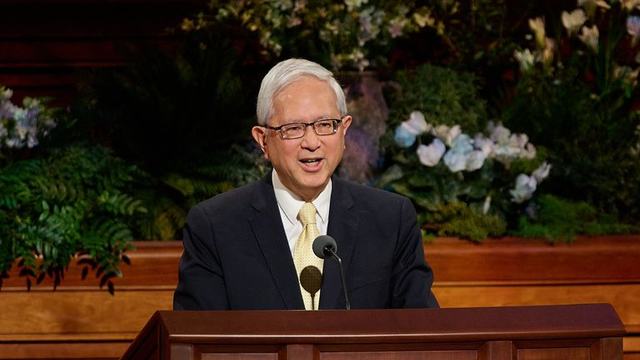
’Tis Eastertide: No One Walks Alone
 Open talk in Gospel Library
Contents
Topics
Recognize the risen Savior on the road to Emmaus
Elder Gong uses the account of the disciples traveling to Emmaus to show that Jesus Christ walks with His disciples even when they do not recognize Him at first. Their experience teaches that the resurrected Lord is present, healing, and personally involved in our journey.
As this Easter Sabbath general conference of The Church of Jesus Christ of Latter-day Saints draws to a close, we, like the disciples on the road to Emmaus, long for our Savior to abide with us, for ’tis Eastertide.
Emmaus means “hot springs,” a place of healing.
Our eyes are opened. We know Him—the resurrected Jesus Christ. Though we did not recognize Him before, He has been walking with us all along.
The Gospel of Mark testifies Jesus appeared three times on that Easter Day but was not recognized at first.Key Points:
- The road to Emmaus is a powerful Easter pattern for disciples today.
- The disciples were sad and confused, yet the Savior joined them in their sorrow.
- Jesus was not immediately recognized, showing that His presence may be real even when it is not immediately perceived.
- Emmaus as a place of healing symbolizes the healing power of Christ’s resurrection.
- The risen Lord revealed Himself in a personal and sacred way.
- When have you later realized that the Lord was helping you during a difficult time, even though you did not recognize it at first?
- Have you ever felt healing come gradually as you kept moving forward in faith?
- What experience has helped you know that Jesus Christ is truly resurrected and aware of you?
- When have sadness or confusion been replaced by spiritual understanding?
- How has the Easter story become more personal to you over time?
Let scripture and ordinances help you know Him
The talk teaches that the Savior opens our understanding through the scriptures and through sacred ordinances such as the sacrament. As we hear His word and participate in covenant worship, our hearts can burn within us and our eyes can be opened to know Him.
As we walk, the stranger opens the scriptures and expounds all things concerning Jesus Christ. Our hearts burn within us.
Our friend eats with us. He takes bread, blesses it, breaks, and gives to us. Our eyes are opened.
As He “talk[s] with us by the way,” His words in scripture can cause our hearts to burn.
As He breaks and blesses the sacramental bread, His ordinances and covenants can help us know Him.Key Points:
- Jesus Christ teaches and reveals Himself through the scriptures.
- Spiritual understanding often comes as our hearts burn within us.
- The breaking of bread on the road to Emmaus points to covenant recognition of the Savior.
- Ordinances and covenants are not symbolic only; they are revelatory and relational.
- The sacrament helps disciples remember and know Jesus Christ.
- When has a scripture passage felt as though the Savior was speaking directly to you?
- What sacrament meeting experience has deepened your testimony of Jesus Christ?
- Have you ever had your "eyes opened" to a gospel truth through an ordinance or covenant experience?
- When have you felt your heart burn within you while studying the scriptures?
- How has regular Sabbath worship changed your relationship with the Savior?
Abide with Jesus Christ through Sabbath covenants
Elder Gong teaches that each Sabbath we come to worship Jesus Christ and renew our covenant relationship with Him through the sacrament. As we take His name upon us, remember Him, and keep His commandments, He fulfills His promise to let His Spirit be with us.
Each Sabbath we invite all to come worship Jesus Christ in the community of His restored Church.
In the sacramental ordinance, we covenant that we are willing to take upon us the name of Jesus Christ, always remember Him, and keep His commandments.
He promises we can always have His Spirit to be with us.
As we witness and remember Jesus each week, we abide and walk with Him.Key Points:
- The Sabbath is a weekly opportunity to come unto Christ in His restored Church.
- The sacrament renews our willingness to take upon us the name of Christ.
- Remembering Him and keeping His commandments are central covenant responsibilities.
- The companionship of the Spirit is a promised blessing of covenant faithfulness.
- Weekly worship helps us abide with Christ in a steady, ongoing way.
- How has the sacrament helped you feel closer to the Savior during a particular season of life?
- When has the promise of always having His Spirit with you become especially meaningful?
- What does it mean to you personally to take upon yourself the name of Jesus Christ?
- How has consistent Sabbath worship strengthened you or your family?
- What experience could you share about remembering the Savior during the week after partaking of the sacrament?
Receive the Comforters and remain in His love
Drawing from John 14 and 15, Elder Gong explains that Jesus Christ promises both the Holy Ghost and His own personal abiding presence. As we love Him, keep His words, and remain connected to Him as branches to the vine, we receive strength, fruitfulness, joy, and divine companionship.
Just as the disciples on the road to Emmaus ask Jesus to abide with them, Jesus Christ promises to abide with us.
When we have a question, problem, or joy, Jesus Christ says, “I am your answer—your way, your truth, your life.”
And I will pray [unto] the Father, and he shall give you another Comforter, that he may abide with you for ever.
The Comforter, which is the Holy Ghost, whom the Father [shall] send in my name, he shall teach you all things, and bring all things to your remembrance.
The Second Comforter Jesus speaks of is Himself. Jesus promises, “I will not leave you comfortless: I will come to you.”
If a man love me, he will keep my words: and my Father will love him, and we will come unto him, and make our abode with him.
But “he that abideth in me, and I in him, the same bringeth forth much fruit,” and “your fruit should remain.”
Jesus says, “These things have I spoken unto you, that my joy might remain [or abide] in you, and that your joy might be full.”Key Points:
- Jesus Christ promises to abide with His disciples.
- The Holy Ghost is the First Comforter and teaches, reminds, and stays with us.
- Jesus Christ Himself is the Second Comforter and does not leave us comfortless.
- Love for Christ is shown by keeping His words.
- As branches need the vine, we need Christ to bear lasting spiritual fruit.
- Abiding in Christ leads to enduring joy.
- When have you felt comfort or direction from the Holy Ghost in a clear way?
- What experience has taught you that keeping the Savior’s words brings greater closeness to Him?
- When have you felt strengthened because the Lord did not leave you comfortless?
- How have you seen more spiritual fruit come into your life as you stayed connected to Christ?
- What personal experience illustrates the difference between trying to do things alone and relying on the Savior?
Sustain living prophets and seek the kingdom of God
The talk connects solemn assembly and sustaining Church leaders with a sacred pattern of covenant unity. Elder Gong teaches that as we seek first the kingdom of God and follow the Lord’s prophet willingly, obediently, and joyfully, we receive rich blessings.
We began this general conference with solemn assembly.
Solemn assemblies mark significant Church milestones or events, such as the sustaining of a new Church President.
Whether a solemn assembly occurs earlier or later, by sacred pattern and precedent, we symbolically demonstrate united commitment and support.
At this conference, in solemn assembly, we witnessed and sustained President Dallin H. Oaks as the Lord’s prophet and our prophet.
As we “seek … first the kingdom of God, and his righteousness,” we follow Jesus Christ and the Lord’s prophet willingly, obediently, joyfully.
We are richly blessed as we do so.Key Points:
- Solemn assembly is an ancient and sacred pattern in the Lord’s Church.
- It expresses united commitment and support for divinely called leaders.
- Sustaining the prophet is part of following Jesus Christ.
- Seeking first the kingdom of God shapes our priorities and discipleship.
- Obedient and joyful support of prophetic leadership brings blessings.
- When have you been blessed by following prophetic counsel, even when it required faith?
- What does sustaining the prophet mean to you beyond raising your hand?
- Have you had an experience where putting the kingdom of God first changed an important decision?
- How has the example or teaching of a living prophet strengthened your testimony of Jesus Christ?
- What personal story could illustrate joyful obedience to inspired counsel?
Choose the best spiritual part
Using a personal memory about President Dallin H. Oaks and the story of the granddaughter choosing gold pieces, Elder Gong teaches the importance of choosing what is of greatest eternal worth. He praises President Oaks as one who exemplifies choosing what is best spiritually.
Opening a large chest filled with coins, a grandfather invited his grandchildren to collect all the coins they could.
However, one granddaughter carefully chose only a few coins.
She replied, “Grandpa, all my coins are gold pieces.”
A man loved and tutored by the Lord, President Dallin H. Oaks has exemplified “good, better, best” all his life.
He chooses the best spiritual part.Key Points:
- Not all choices have equal value; some are spiritually weightier and more lasting.
- Wisdom includes recognizing eternal worth over immediate abundance.
- President Oaks is presented as an example of choosing what matters most.
- Discipleship requires prioritizing the best spiritual part.
- When have you chosen something of eternal value over something merely convenient or popular?
- What experience taught you the difference between good, better, and best?
- Who has influenced you by their example of choosing the best spiritual part?
- Have you ever sacrificed a lesser good to receive a greater spiritual blessing?
- What story from your life could show the value of focusing on what matters most?
Trust the Atonement of Jesus Christ to change everything
Elder Gong bears witness that the Atonement and Resurrection of Jesus Christ change everything. Through Him come resurrection, return to God’s presence, eternal families, healing, reconciliation, and deliverance from death.
Jesus Christ’s Atonement changes everything.
It brings literal resurrection.
It can enable our return to the presence of God and the eternal uniting of families.
We can heal, reconcile, abide in covenant belonging.
With Nephi of old, our souls delight in the covenants the Lord has made, “in his grace, and in his justice, and power, and mercy in the great and eternal plan of deliverance from death.”
This is my Easter witness:
“Jesus Christ … died, was buried, and rose again the third day, and ascended into heaven.”
“I know … my Redeemer lives,” and “while he lives, I’ll sing[,] … my Prophet, Priest, and King.”Key Points:
- The Atonement of Jesus Christ is central to all hope and redemption.
- The Resurrection is literal and universal.
- Through Christ we may return to God’s presence.
- The gospel makes eternal family relationships possible.
- Christ’s power brings healing and reconciliation now.
- Covenants connect us to the plan of deliverance from death.
- When has the Savior’s Atonement brought healing or reconciliation into your life?
- How has your testimony of the Resurrection influenced the way you face grief or uncertainty?
- What family experience has helped you cherish the doctrine of eternal families?
- When have you felt grace, mercy, or deliverance through Jesus Christ?
- What personal witness of the living Redeemer could you share in an Easter talk?
Walk with those who feel alone
The talk concludes with a loving invitation to notice and accompany those who are sad, unseen, or isolated. Because the Savior walks with us, His disciples should also make sure that no one sits alone and no one walks alone.
As we walk our dusty roads to Emmaus, He will be with us.
If you see someone walking alone and sad, will you please walk with them?
No one sits alone, and no one should walk their road to Emmaus alone or unseen.
Let us see and walk together in His love so He can abide with and in us, and we in Him, at this Eastertide and each day.Key Points:
- The Savior’s companionship should shape the way we treat others.
- Many people feel alone, misunderstood, burdened, or unseen.
- Disciples of Christ should actively notice and walk with those who are struggling.
- Belonging in the covenant community should be visible and practical.
- Ministering in love helps all of us abide more fully in Christ.
- When has someone walked with you in a lonely or painful time?
- Have you ever felt prompted to notice someone who seemed unseen or left out?
- What experience could you share about ministering to someone who was carrying a burden?
- How have you seen small acts of inclusion bless a ward or family?
- When have you felt the Savior’s love by helping someone else feel less alone?
