
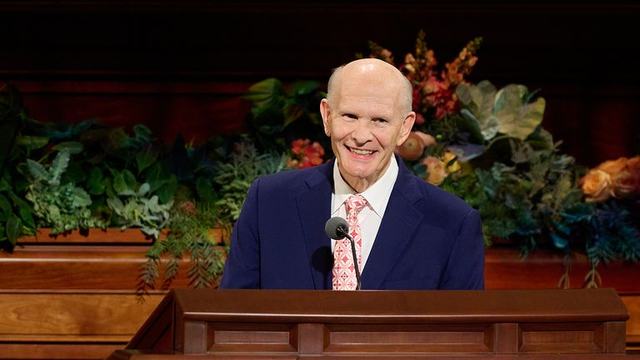
“How Long Will It Be Ere They Believe Me?”
 Open talk in Gospel Library
Ideas for Opening the Lesson
- Write “cold oatmeal” on the board and briefly share Elder Renlund’s account of Mr. Martin. Ask: “How do everyday frustrations sometimes crowd out our awareness of larger blessings?” Acknowledge that suffering is real and that the lesson invites a broader perspective rather than dismissing anyone’s difficulties.
- Display the question “How long will it be ere they believe me?” Invite class members to silently consider what helps them trust the Lord and what makes trust difficult. Explain that Elder Renlund invites us to remember God’s mercy and recognize that His promises apply personally to us.
- Draw an asterisk beside the words “God’s promises apply to me.” Share Linda’s description of imagining an exception that excludes her from promised blessings. Invite class members to consider silently whether they place a similar asterisk beside any of God’s promises, then introduce the talk’s invitation to erase it.
- Read John 16:33 as quoted in the talk. Ask class members to identify what Jesus promises and what He does not promise about life’s difficulties. Use their observations to introduce the distinction between freedom from tribulation and peace through Jesus Christ.
- Invite class members to privately list two or three ways they recognize the Lord’s goodness in their lives. Allow a few volunteers to share, without expecting anyone to disclose sensitive experiences. Connect this exercise to Elder Renlund’s teaching that remembering God’s mercy strengthens our ability to trust His promises.
Topics
Remember God’s Mercy Beyond Today’s Frustrations
Elder Renlund uses Mr. Martin’s frustration with hospital food to illustrate how immediate difficulties can obscure larger blessings and future possibilities. He invites us to remember the Lord’s goodness and mercy so that we see our circumstances within a bigger picture. This perspective strengthens trust without requiring us to pretend that our challenges are insignificant.
As we reflect on the great things the Lord has already done and remember His goodness and mercy, we are better positioned to grasp the bigger picture and to rely on His promises to us. We can trust Him.
- What does the image of “cold oatmeal” help us recognize about the way we respond to daily frustrations?
- How can we acknowledge genuine hardship while also remembering the Lord’s goodness?
- What experience in your life reminds you of God’s mercy when present circumstances feel overwhelming?
- How does the Book of Mormon help us remember the bigger picture of God’s dealings with His children?
- What simple practice can you begin or strengthen this week to remember the Lord’s blessings more consistently?
Trust God’s Covenants When Challenges Loom
The children of Israel receive miraculous help yet repeatedly allow new challenges to erode their trust in God and His prophet. Elder Renlund uses their experience to invite us to believe the Lord’s assurances of covenant faithfulness. Remembering His help gives us reasons to trust Him when the way forward seems intimidating.
How often the Lord reassured the children of Israel, and reassures us, of His constancy, declaring, “I will never break my covenant with you.”
- What do you recognize about human nature in the children of Israel’s response to new challenges?
- Why can a difficult situation make earlier evidence of God’s care feel less convincing?
- What does the Lord’s declaration “I will never break my covenant with you” teach us about His character?
- What experience helps you trust the Lord when you cannot see how a challenge resolves?
- What does choosing to trust God look like in your current circumstances?
Find Peace and Joy Through Jesus Christ
Jesus Christ promises peace in Him while acknowledging that tribulation remains part of mortal life. Elder Renlund teaches that the Savior overcomes the world and that we do not need to do so ourselves. Centering our faith on Him and living in a covenant relationship with Him allow us to experience spiritual peace and joy amid difficulty.
When our faith is centered on Jesus Christ, He promises spiritual peace no matter our circumstances. We can experience joy in our here and now because of Him and through our covenant relationship with Him.
- What difference do you see between peace in Jesus Christ and a life without problems?
- How does the Savior’s declaration “I have overcome the world” change the way you approach a burden?
- What helps you center your faith on Jesus Christ rather than on a particular outcome?
- What experience helps you understand how peace or joy can coexist with sorrow or uncertainty?
- What part of your covenant relationship with the Savior can you nurture this week to draw closer to Him?
Place Your Hope in the Redeemer’s Righteousness
Elder Renlund explains that our hope rests on Jesus Christ’s faithfulness and righteousness rather than on our own. Lehi’s testimony to Jacob shows that even a good and faithful person receives redemption through the Redeemer. This teaching directs our confidence toward the Savior instead of treating personal righteousness as the source of salvation.
Faith in Jesus Christ frees us from uncertainty because our hope rests on His faithfulness and righteousness, not on our own.
- What does Lehi’s testimony to Jacob teach us about the source of redemption?
- How does placing hope in Christ’s righteousness differ from placing hope in our own performance?
- How does this teaching encourage faithful effort without making that effort the source of our redemption?
- When you feel discouraged by your shortcomings, what helps you turn toward the Savior rather than away from Him?
- How can you make your worship, repentance, or scripture study more focused on Jesus Christ’s faithfulness?
Receive God’s Promises as Personally Yours
Linda’s imagined asterisk illustrates the belief that God’s blessings apply to everyone except oneself. Elder Renlund rejects that assumption and teaches that no one is excluded from God’s richest blessings by a personal exception. He invites each of us to rely on God’s promises rather than assume that we fall outside their reach.
Neither are you, brothers and sisters; there is no asterisk excluding you from God’s richest blessings. If you think there is, take out a big eraser and obliterate that asterisk. You can rely on God’s promises.
- Why is it sometimes easier to believe God’s promises apply to others than to ourselves?
- What does Linda’s realization help you understand about your own relationship with God?
- How can we distinguish humbly recognizing our need for repentance from wrongly assuming that God excludes us?
- Which promise in the scriptures gives you particular hope, and what helps you receive it personally?
- What thought or habit can you change this week to stop placing an asterisk beside God’s promises?
Trust the Savior’s Ample Power to Redeem
Elder Renlund teaches that every human circumstance lies within the Savior’s redemptive reach. Jesus Christ’s power to save and exalt is both profoundly personal and infinite. His ample provision gives each of us reason to trust that our needs and circumstances do not exceed His ability to redeem us.
The power of the Messiah to save and exalt is profoundly intimate and infinite beyond human comprehension; there is more than enough to cover any breach, need, or deficit for all of us, for each of us.
- What does the phrase “ample provision” teach you about the Savior’s power and care?
- How does it help to know that the Savior understands individual circumstances as well as possessing infinite power?
- What concern becomes easier to bring to the Savior when you remember that it lies within His redemptive reach?
- What experience or scripture strengthens your confidence that Jesus Christ can help people whose circumstances seem especially difficult?
- How can this teaching change the way we minister to someone who feels beyond hope?
Additional Discussion Questions
- What central invitation do you hear in Elder Renlund’s talk, and how can you respond to it this week?
- How do remembering the Lord’s mercy and trusting His future promises reinforce each other?
- What helps you remain faithful when the timing or manner of a promised blessing is unclear?
- How can we discuss “cold oatmeal” in a way that encourages gratitude without minimizing another person’s suffering?
- What does this talk teach you about God’s character that strengthens your willingness to trust Him?
- How can families or ministering companions help one another remember evidence of the Lord’s care?
- How does confidence in the Savior’s righteousness affect the way we respond to mistakes and seek repentance?
- What connection do you see between believing that God’s promises apply to you and finding joy in your covenant relationship with Christ?
- Which passage from the talk can serve as a reminder when daily frustrations narrow your perspective?
- What specific action can you take because of this lesson, and how can you keep that invitation in mind during the week?
