
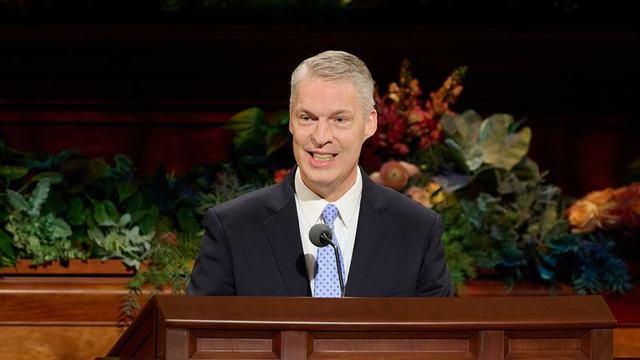
The Infinite Power of God in Our Covenants
 Open talk in Gospel Library
Ideas for Opening the Lesson
- Write on the board: “No time or effort is ever wasted in reading the Book of Mormon.” Invite class members to consider why Elder Morgan makes this statement even though he remembers very few words from his mother's reading. Ask how this teaching encourages consistent scripture study without requiring immediate, visible results.
- Invite class members to silently think of someone whose faith influences their lives. Ask volunteers to share what that person's example teaches them about Jesus Christ. Introduce Elder Morgan's message that covenant faithfulness can bless generations beyond the person who makes the covenant.
- Write two phrases on the board: “Respect agency” and “Trust God's covenant power.” Invite class members to discuss why both principles matter when someone they love struggles with faith. Explain that Elder Morgan teaches hope in God's promises without suggesting that covenants override another person's choices.
- Read Elder Morgan's statement: “Your story, your family’s story, is not all written.” Allow a moment for quiet reflection, then ask what this statement teaches about hope and patience. Let participants know they can discuss the principles without sharing sensitive family circumstances.
- Invite class members to identify promises or descriptions of God's power as they briefly scan the talk. Gather several responses on the board, such as “infinite,” “eternal,” and “generational.” Ask which description most strengthens their confidence in Jesus Christ and why.
Topics
Read the Book of Mormon with Consistent Faith
Elder Morgan describes his mother's daily reading of the Book of Mormon as a powerful expression of her testimony. Although he remembers few specific words, her example communicates that the book matters and that she knows it is true. He teaches that scripture reading is never wasted effort, even when its influence is not immediately apparent.
The lesson I learned is this: No time or effort is ever wasted in reading the Book of Mormon. Not for you, not for your children, not for your family, not for anyone.
- What does Elder Morgan's experience teach us about the influence of consistent scripture reading when listeners seem inattentive?
- How does our approach to the Book of Mormon communicate our testimony to others?
- What helps you continue reading when you do not notice immediate spiritual results?
- What experiences illustrate the quiet influence of the Book of Mormon in your life or home?
- What realistic change can you make this week to give the Book of Mormon a more consistent place in your life?
Seek Truth and Nurture a Personal Testimony
Elder Morgan expresses gratitude for his religious upbringing while describing his sincere search for the Lord's Church. His account illustrates how good influences and personal seeking contribute to a testimony that sustains him amid questions and family disappointment. His experience invites class members to value their spiritual foundations while continuing to seek truth.
All of this led me to sincerely seek the truth. So, for two months I attended both my family’s congregation, and secretly—hiding between the accordion doors of the overflow—I attended a congregation of The Church of Jesus Christ of Latter-day Saints. I can’t fully express the gratitude I have for my upbringing and the knowledge I had received; even so, I came to know that this is the Lord’s Church.
- What does sincere truth-seeking look like in our lives today?
- How can we express gratitude for the good in our upbringing while continuing to grow in gospel understanding?
- What practices help you nurture a personal testimony rather than rely only on someone else's faith?
- How can we respond with love when a person's spiritual search creates questions or disappointment within a family?
- What experiences strengthen your conviction that God helps those who sincerely seek Him?
Bless Future Generations Through Covenant Faithfulness
Elder Morgan recognizes the influence of his ancestors" temple covenants in his own spiritual journey. He teaches that covenants bless more than the people who make them and can affect generations of posterity. He also explicitly affirms that parents" and grandparents" faithfulness does not override their descendants" agency.
Though the covenant faithfulness of parents and grandparents does not alter the agency of children or grandchildren, there is a discernible impact of those covenants on all our posterity.
- How does the possibility of blessing future generations change the way you view your covenants today?
- Why is Elder Morgan's statement about agency essential to understanding his message?
- What examples of covenant faithfulness in others inspire your own discipleship?
- How can we offer spiritual encouragement to family members while respecting their choices?
- Whether or not we know of covenant-keeping ancestors, how can our faithfulness begin or strengthen a legacy of discipleship?
Trust God's Covenants Across Time and Distance
Elder Morgan teaches that God's covenant power extends across generations, time, and space. He points to the Lord's covenant with Enos as an example of a promise whose fulfillment spans more than 2,000 years. This perspective encourages trust in God's promises without imposing our preferred timetable.
Covenants with God are filled with incalculable power. They do not bless just the maker of the covenant but are generational in their impact. We are all the intended beneficiaries of countless covenants! Like the great binding power of gravity that stretches across the universe, covenants with God stretch over all time and all space.
- What does the example of the Lord's covenant with Enos teach us about God's timetable?
- How does Elder Morgan's comparison between covenant power and gravity help you understand his message?
- What helps you trust God's promises when their fulfillment is not yet visible?
- How does an eternal perspective influence the way we respond to present family concerns?
- What can you do to remember God's promises more often during periods of waiting?
Find Hope in Christ's Infinite Atonement
Elder Morgan assures listeners that neither they nor their loved ones are beyond the reach of divine love. He identifies the Atonement of Jesus Christ as the fulfillment of God's greatest promise: that Jesus Christ is our Savior and Redeemer. The infinite and eternal reach of that promise provides hope when distance from God feels overwhelming.
The Atonement of Jesus Christ is the fulfillment of the greatest promise God made—that Jesus Christ would be our Savior and Redeemer. The power and reach of that covenant is infinite and eternal.
- How does knowing that Christ's Atonement is infinite change the way we view ourselves and others?
- What thoughts or fears does Elder Morgan's assurance about divine love help us challenge?
- How can we communicate hope in Jesus Christ without minimizing someone's pain or struggle?
- What experiences help you recognize the Savior's love and redeeming power in your life?
- What step toward Jesus Christ can you take when you feel distant, discouraged, or unworthy?
Keep Covenants and Trust God While Waiting
Elder Morgan acknowledges the anguish of praying for a struggling child and assures listeners that God hears their prayers. He encourages them to keep their covenants, act faithfully within their power, and trust God's timing and manner of answering. His closing testimony invites continued hope because an individual's or family's story remains unfinished.
Some may be crying out right now, with words like “O, God, where art Thou? My child is struggling.” Take comfort; God hears you and will answer your prayers in His own time and in His own way.
- What does it mean to keep our covenants while a loved one's circumstances remain unresolved?
- How can we distinguish between what lies within our power and what we need to entrust to God?
- What helps you act faithfully without trying to control another person's spiritual journey?
- How can an elders quorum or Relief Society support people who carry ongoing family concerns?
- What does the statement “Your story, your family’s story, is not all written” invite you to believe or do today?
Additional Discussion Questions
- Which teaching in this talk most strengthens your trust in Heavenly Father and Jesus Christ, and why?
- How do scripture study, personal testimony, and covenant keeping reinforce one another?
- What does President Oaks's statement that covenants “do not ‘take a day off’” invite us to reconsider about daily discipleship?
- How can we maintain hope in covenant promises without assuming a particular outcome or timetable for someone else's choices?
- What does this talk teach us about spiritual influences that we cannot immediately see?
- How can gratitude for those who influence our faith motivate us to bless someone else?
- How does centering our hope on Jesus Christ differ from centering it on our ability to fix a family situation?
- What can our quorum or Relief Society do to help each person feel valued, regardless of family circumstances or religious background?
- How can we combine patient trust in God with meaningful action today?
- What specific invitation from this talk do you feel prompted to act on this week, and what helps you follow through?
