
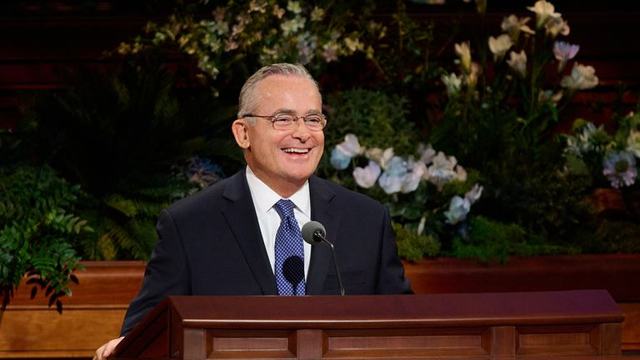
About His Business
 Open talk in Gospel Library
Ideas for Opening the Lesson
- Invite class members to think of the first calling they received in the Church or a calling that stretched them. Ask a few to briefly share how they felt at the time and what they later learned. Then introduce Elder Kearon’s message that the Lord often used callings to help His children grow.
- Begin by asking the class, “What does it mean to truly sustain someone?” Let members share short answers, then read Elder Kearon’s statement that common consent was not a mere formality but a voluntary, personal commitment to support the Lord’s servants. This can help set the tone for a discussion about unity, service, and discipleship.
- Display the phrase “About His Father’s business” and ask the class what they think it means in everyday ward life. After a few responses, explain that Elder Kearon taught that every calling could become the Lord’s work when embraced with humility and willingness.
- Read Elder Kearon’s humorous account of being called as assistant ward clerk and ask, “Why do callings sometimes surprise us?” This can help class members relate personally to the talk and open discussion about trusting the Lord when assignments do not seem like an obvious fit.
- Invite class members to silently consider someone who has sustained, trained, or encouraged them in a calling. Ask a few to share what that support meant. Then connect their experiences to Elder Kearon’s teaching that raised hands, prayers, patience, and faith helped build bridges of unity.
Topics
Accept stretching callings with faith
Elder Kearon described how his early callings did not feel natural to him, especially his calling as assistant ward clerk. He said that over time he came to see purpose and power in each calling and recognized that inspired leaders had extended assignments that stretched him without overwhelming him. He taught that the Lord often used callings to help disciples grow.
My bishop kept a loving eye on me and eventually shared that he had felt prompted by the Lord to extend callings which would be stretching for me but, he trusted, not overwhelming.
- When have you received a calling or responsibility that felt stretching or unexpected?
- What did Elder Kearon’s experience teach about trusting the Lord when a calling does not seem like a natural fit?
- How have you seen growth come from doing something in the Church that you initially felt unprepared to do?
- Why do you think the Lord sometimes called people to serve in ways that stretched them?
- What can help us respond with faith instead of fear when we are invited to serve?
- How can we help others who feel inadequate in a new calling?
- What have you learned about the difference between being stretched and being overwhelmed?
Sustain others through common consent
Elder Kearon taught that common consent was a sacred expression of agency, unity, and faith. He said it was more than raising a hand in a meeting; it was a personal commitment to support the Lord’s called servants with prayers, love, patience, and faith. He emphasized that sustaining built important bridges of unity even when members did not always agree or feel everything was being done perfectly.
Common consent is not a mere formality but a beautiful mix of our agency, unity, and faith.
- What stood out to you in Elder Kearon’s description of common consent?
- How is sustaining someone more than simply raising a hand in church?
- What are practical ways we can sustain leaders and teachers during the week?
- How can prayer for those who serve change our attitude toward them?
- Why is it important to sustain people even though they are imperfect?
- How have you felt strengthened by the support of others in a calling?
- What can a ward or branch do to make sustaining feel more meaningful and real?
Build unity while serving imperfectly
Elder Kearon said that serving together in the Church gave members the opportunity to develop Christlike attributes with people who may be very different from them. He taught that faith was fortified and the body of Christ was bonded together as members served and sustained one another. He also testified that the Lord worked through imperfect servants who were striving to discern His will.
I came to understand why everyone serves one another in a ward or branch: it affords us all the opportunity to pursue Christ and His virtues—such as charity, humility, meekness, forgiveness, and love—with people who may be very different to us.
- How has serving with people who are different from you helped you grow spiritually?
- Which Christlike attributes did Elder Kearon highlight, and why do they matter in ward service?
- What does it mean to you that the Lord worked through imperfect servants?
- How can remembering our own imperfections help us be more patient with others who serve?
- When have you seen unity increase because members chose to serve and sustain each other?
- How does Church service help bind the body of Christ together?
- What changes could we make to serve with more charity, humility, or forgiveness?
Trust the Lord through changing callings
Elder Kearon acknowledged that callings varied widely. Some were highly stretching, some seemed quiet or unseen, and some changes in service deeply affected individuals or families. He taught that such moments required faith and trust in the Lord, and he also noted that leaders should be sensitive to exceptional circumstances when someone could not serve for a time.
When callings change in ways that deeply impact you or your family, it can require great faith and trust in the Lord while you adjust.
- Why can changes in callings sometimes be emotionally difficult?
- What did Elder Kearon teach about trusting the Lord when service changes unexpectedly?
- How can quiet or unseen service be just as meaningful as visible service?
- What can leaders and members do to show sensitivity when someone is unable to serve for a time?
- How have you seen the Lord bless someone during a season of changed or limited service?
- What helps us avoid comparing callings or measuring importance by visibility?
- How can families support one another when a calling brings significant adjustments?
See service as a blessing
Elder Kearon asked whether service could sometimes feel inconvenient or whether members could become reluctant, then testified that in the Lord’s economy they always came out ahead. He pointed to the first Apostles, who left their nets to follow the Savior, as an example of faithful response to a difficult and incomprehensible call. He taught that service was a choice, an offering to God, and a blessing.
I have learned over and over again that—whatever our offering—in the Lord’s economy we always come out ahead.
- What do you think Elder Kearon meant by saying that in the Lord’s economy we always come out ahead?
- How have you been blessed by serving even when it was inconvenient?
- Why is it helpful to think of service as an offering to God?
- What can we learn from the Apostles leaving their nets to follow Jesus?
- How can we respond when we begin to feel jaded, tired, or reluctant in service?
- What blessings from service are not always visible right away?
- How does the Lord help us when we keep serving despite weakness or discouragement?
Let callings expand your faith
Elder Kearon taught that callings had a foundational role in the expansion of faith, alongside prayer, scripture study, and worship. He said that callings were tailor-made for growth as disciples humbled themselves, looked outward, and served others. He emphasized that what mattered most to the Lord was not where someone served but how they served.
Callings from the Lord are tailor-made for our growth, as we humble ourselves, look outward, and learn that, indeed, when we are in the service of our fellow beings, we are in fact in the service of our God.
- How can a calling become a means of increasing faith rather than just completing tasks?
- Why do you think Elder Kearon placed callings alongside prayer, scripture study, and worship in developing faith?
- What does it mean that callings are tailor-made for our growth?
- How does looking outward change the way we experience service?
- Why did Elder Kearon say it was not where we serve but how that matters to the Lord?
- What have you learned about God through serving other people?
- How can we approach our current opportunities to serve with more humility and purpose?
Sustain the prophet with confidence and prayer
Elder Kearon connected the principle of common consent to the solemn assembly in which the Church sustained President Dallin H. Oaks as prophet, seer, and revelator. He emphasized the sacredness of that moment and taught that members signified their willingness to uphold the Lord’s chosen servant with confidence, faith, and prayers. He also highlighted the humility of prophetic service and the great weight of such a calling.
We have signified our willingness to uphold President Oaks with our confidence, faith, and prayers.
- What did Elder Kearon teach about the meaning of sustaining the prophet?
- How can we actively uphold the prophet with confidence, faith, and prayers?
- Why is a solemn assembly both solemn and joyful?
- What impressed you about Elder Kearon’s description of prophetic service?
- How does sustaining the prophet strengthen our own discipleship?
- What can we do to make our sustaining more than a moment in a meeting?
- How have you felt blessed as you have followed and prayed for the Lord’s prophet?
Join the Savior in His business
At the close of the talk, Elder Kearon referred to the young Jesus being about His Father’s business and taught that disciples could do the same. He said that every calling became the Lord’s business when embraced with humility, willingness, and a desire to bless His children. He testified that members were not merely filling assignments but joining the Savior in His redeeming work, and that life was better when they were about His business.
We are not merely filling an assignment when we respond to an inspired call but joining the Saviour of the world in His infinite, redeeming work.
- What does it mean to you to be about the Father’s business in your current season of life?
- How does seeing a calling as the Savior’s work change the way we approach it?
- Why is humility essential in making any calling the Lord’s business?
- How can even simple acts of service become part of the Savior’s redeeming work?
- What did Elder Kearon mean when he said, “Life is better—everything is better—when we are about His business”?
- How have you felt closer to Jesus Christ through serving in the Church?
- What is one way you could be more wholehearted in the Lord’s work right now?
Additional Discussion Questions
- What part of Elder Kearon’s personal story felt most relatable to you, and why?
- How can a ward or branch create the kind of welcoming and encouraging culture Elder Kearon described after his baptism?
- What role does gratitude play in the way we accept and fulfill callings?
- How can we better train and mentor others the way the ward clerk helped Elder Kearon?
- What can we learn from leaders who prayerfully seek inspiration for callings?
- How can we avoid judging whether a calling seems like an obvious fit for someone?
- In what ways can sustaining and serving deepen relationships within a ward or branch?
- How can we help new members understand the purpose and blessing of callings and sustaining?
- What does wholehearted devotion to the Lord’s work look like in ordinary ward life?
- After studying this talk, what is one change you feel prompted to make in the way you sustain, serve, or respond to the Lord’s work?
