
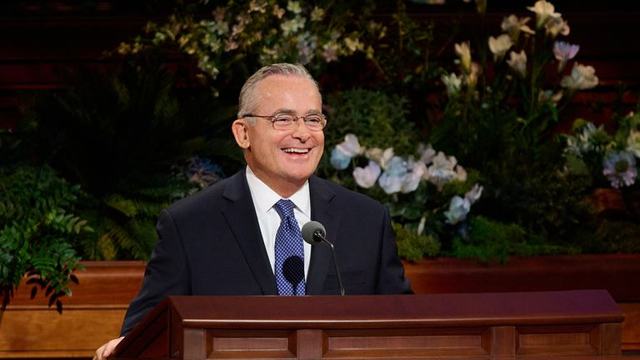
About His Business
 Open talk in Gospel Library
Contents
Topics
Welcome New Disciples into the Household of Faith
Elder Kearon begins with his baptism and early experiences of being welcomed and sustained by a ward family. He shows how simple acts of warmth and support can strengthen new members and help them feel that they belong in the Church of Jesus Christ.
I looked into those smiling faces, and I felt as if they were cheering me on, genuinely thrilled that I had discovered faith in Jesus Christ and a desire to follow Him.
Comfortingly, I saw those same raised hands and smiling faces surrounding me in the congregation, reassuring me that these new friends would support me with their goodwill, patience, and faith.
The ward clerk I was to be “assisting” came straight to me at the end of the meeting and said, “Come on, Patrick. I’ll show you how this works.”Key Points:
- Feeling welcomed in the Church can deeply influence a new member’s faith and sense of belonging.
- Sustaining is not only formal; it can be felt through smiles, patience, encouragement, and practical help.
- Members strengthen one another when they actively help others learn and grow in their callings.
- A ward family can become a source of reassurance and faith for those who are new or inexperienced.
- When have you felt especially welcomed or included at church?
- Have you ever helped a new member, youth, or recently called person feel more comfortable in the ward?
- What experience taught you that small acts of kindness can strengthen someone’s faith?
- Can you share a time when someone patiently showed you how to serve or participate in the Church?
Sustain One Another through Common Consent
The talk teaches that common consent is a sacred expression of agency, unity, and faith. Sustaining others is a personal commitment to support the Lord’s servants with prayer, love, patience, and trust, even when we do not fully understand or agree with everything.
Common consent is not a mere formality but a beautiful mix of our agency, unity, and faith.
It is a voluntary, personal commitment to support, uphold, and help the Lord’s called servants in their responsibility.
Will we always agree with those we are invited to sustain? Will we always think they are doing a good job and serving as the Saviour would? Perhaps not, and we might be right, but as we pray for them and they for us, important bridges of unity are built.
We sustain each other with our prayers, our love, our patience, and our faith.Key Points:
- Common consent is a meaningful covenant-like act, not an empty routine.
- Sustaining means choosing to support those who are called to serve.
- Members may not always agree with leaders or teachers, but prayer and charity build unity.
- Sustaining includes practical and spiritual support, not just raising a hand.
- Agency is honored in the process of sustaining.
- What does raising your hand to sustain someone mean to you personally?
- Can you think of a time when you supported a leader or teacher through prayer or patience?
- Have you ever learned something important by sustaining someone whose calling surprised you?
- When have you felt strengthened by the support of others in a responsibility you carried?
Let Callings Stretch and Refine You
Elder Kearon explains that inspired callings often stretch us beyond what feels natural, but they are given for our growth. Whether visible or quiet, familiar or uncomfortable, callings can shape discipleship and help us become more like Christ.
The reaction in my mind was, “Assistant ward clerk? Well, that is not me!”
My bishop kept a loving eye on me and eventually shared that he had felt prompted by the Lord to extend callings which would be stretching for me but, he trusted, not overwhelming.
I came to see purpose and power in each calling I received, and with hindsight, the bishop’s inspiration came to make sense to me.
Some callings are highly stretching, while others may leave us wondering, “Isn’t there more I could be asked to do?”
You might serve in a very visible role for a time, only later to be called to quiet, unseen service—or to support those with less experience.Key Points:
- Callings may not initially seem like a natural fit, but they can still be inspired.
- The Lord often uses callings to stretch us without overwhelming us.
- Both prominent and quiet forms of service are valuable in the Lord’s work.
- Changes in callings can require faith and trust, especially when they affect family life.
- Looking back often reveals the wisdom of inspired leaders and the Lord’s guidance.
- Have you ever received a calling that felt outside your comfort zone?
- What calling or assignment helped you grow in an unexpected way?
- Can you share a time when you later understood why the Lord may have wanted you in a certain role?
- Have you learned something from serving in a quiet or unseen way?
Trust the Lord in Seasons of Service and Limitation
The talk acknowledges that not everyone can accept or continue in a calling at every moment. Elder Kearon teaches that wise leaders should be sensitive, and that the Lord can help individuals know when the time is right to serve again.
I also acknowledge that there are those who, owing to exceptional circumstances, are unable to respond to a calling at a given time.
Careful leaders will be sensitive to this, and through prayer, the Lord can help you know when the time is right for you to serve again.Key Points:
- There are legitimate circumstances that may limit a person’s ability to serve in a calling.
- Leaders should exercise sensitivity, prayer, and discernment.
- Members can seek the Lord’s guidance about when and how to serve.
- Temporary inability to serve does not diminish a person’s worth or discipleship.
- Have you ever experienced a season when you wanted to serve but were limited by circumstances?
- Can you share a time when a leader showed Christlike sensitivity to you or your family?
- What have you learned about trusting the Lord’s timing in service?
- How have you seen the Lord make a way for service at the right time?
Offer Your Whole Soul in the Service of God
Elder Kearon teaches that service is a willing offering to God that blesses both those who serve and those who are served. In the Lord’s economy, sacrifice in service always brings spiritual gain.
Is it sometimes inconvenient to serve in a calling that asks something of us? Might we become jaded or reluctant? I have learned over and over again that—whatever our offering—in the Lord’s economy we always come out ahead.
Our service is a choice, an offering to God, and a blessing.
There was nothing half-hearted about those friends I talked about. They were living their faith at full speed, and it was contagious.
I could see the joy that came to them from their whole-souled devotion.Key Points:
- Service can be inconvenient, but it is always spiritually rewarding.
- The Lord blesses those who offer themselves willingly in His work.
- Wholehearted devotion to the gospel influences and inspires others.
- Serving with energy and faith can create joy and spiritual momentum.
- When have you sacrificed to serve and later realized you received more than you gave?
- Can you share an experience when someone’s wholehearted service inspired you?
- What has helped you move from reluctance to joy in a calling or assignment?
- How has serving blessed your faith, family, or testimony?
Follow the Savior Even When the Call Is Inconvenient
Using the example of the first Apostles, Elder Kearon shows that discipleship often requires immediate faith and willingness. Even devoted disciples need reminders to continue serving and feeding the Lord’s sheep.
When the Saviour called Peter, Andrew, James, and John to follow Him, they instantly dropped their nets.
If a call were ever inconvenient or incomprehensible, it must have been this one on the shore of Galilee, yet with faith they followed.
Well, even with all they saw, felt, and experienced, those first Apostles needed the Lord’s gentle reminding and His repeated invitation to feed His sheep.Key Points:
- The Savior’s invitations may interrupt our plans and comfort.
- Faithful disciples respond even when they do not fully understand.
- Even strong disciples can become discouraged or weary and need renewed direction.
- The Lord continues to invite His followers to care for His sheep.
- Have you ever felt prompted to act or serve when it was inconvenient?
- What experience taught you to trust the Lord before you understood the outcome?
- Can you share a time when the Lord gently reminded you to keep serving?
- When have you felt joy in helping care for one of the Savior’s sheep?
Grow Faith by Serving Fellow Beings
The talk emphasizes that callings are foundational to spiritual growth. As members humble themselves, look outward, and serve others, their faith expands and they learn that serving people is serving God.
Have we also come to see our callings as having a foundational role in the expansion of our faith?
Callings from the Lord are tailor-made for our growth, as we humble ourselves, look outward, and learn that, indeed, when we are in the service of our fellow beings, we are in fact in the service of our God.
It really isn’t where we serve but how that matters to the Lord.
I came to understand why everyone serves one another in a ward or branch: it affords us all the opportunity to pursue Christ and His virtues—such as charity, humility, meekness, forgiveness, and love—with people who may be very different to us.
I clearly saw how faith is fortified and the body of Christ bonded together.Key Points:
- Callings are a key means by which the Lord expands faith.
- Service teaches Christlike attributes such as charity, humility, meekness, forgiveness, and love.
- Serving people who are different from us helps unite the body of Christ.
- The spiritual value of a calling depends more on how we serve than where we serve.
- Serving fellow beings is service to God.
- How has a calling helped your testimony or faith grow?
- What Christlike quality have you developed through serving others in the Church?
- Can you share an experience serving someone very different from you that changed your heart?
- When have you learned that the spirit in which you serve matters more than the visibility of the role?
Sustain the Lord’s Prophet in Solemn Assembly
Elder Kearon connects the principle of sustaining to the sacred act of sustaining President Dallin H. Oaks as the Lord’s prophet. He teaches that solemn assembly is a holy opportunity for the whole Church to unite in faith, confidence, and prayer.
We have had the sacred opportunity to come together to raise our hands in support of President Dallin H. Oaks, to sustain him as the Lord’s prophet, seer, and revelator.
This is a call he didn’t seek or aspire to.
Now, 42 years later, we joyfully sustain him as the Lord’s chief Apostle, as his whole soul once again responds to a call, claiming no infallibility while trusting in the Lord’s guiding hand.
Since 1880, we have called this kind of moment a solemn assembly, a sacred gathering for a holy purpose such as this.
We have signified our willingness to uphold President Oaks with our confidence, faith, and prayers.Key Points:
- Sustaining the prophet is a sacred and unifying act for the whole Church.
- Prophetic callings are not sought for personal ambition but received in humility.
- A solemn assembly is both reverent and joyful.
- Members uphold the prophet through confidence, faith, and prayer.
- The right to sustain reflects sacred order and revealed procedure in the Church.
- What does it mean to you to sustain the prophet with faith and prayer?
- Can you share a time when following prophetic counsel blessed your life?
- How have you felt unity with the worldwide Church during a sustaining vote or solemn assembly?
- What have you learned from the humility of those called to lead?
Join the Savior in the Father’s Business
The message concludes by teaching that every calling is part of the Father’s business when accepted with humility and love. Members are not merely completing tasks; they are joining Jesus Christ in His redeeming work to bless God’s children.
When 12-year-old Jesus was found by His parents teaching in the temple, He told them that He had been “about [His] Father’s business.” And we can be too.
Every calling, whatever it may be, is “His business” when embraced with a humble and willing heart and a desire to lift and comfort His children and share His good news.
We are not merely filling an assignment when we respond to an inspired call but joining the Saviour of the world in His infinite, redeeming work.
He needs you, and He needs me.
Life is better—everything is better—when we are about His business.Key Points:
- The Savior Himself modeled being about the Father’s business.
- Every calling becomes sacred when done with humility and willingness.
- Church service is participation in the redeeming work of Jesus Christ.
- The Lord invites every member to take part in His work.
- Life is richer and better when centered on the Lord’s business.
- When have you felt that your service was truly part of the Savior’s work?
- Can you share an experience when a calling helped you lift or comfort one of God’s children?
- What helps you remember that Church service is more than completing tasks?
- How has being ‘about His business’ brought greater meaning or joy to your life?
