
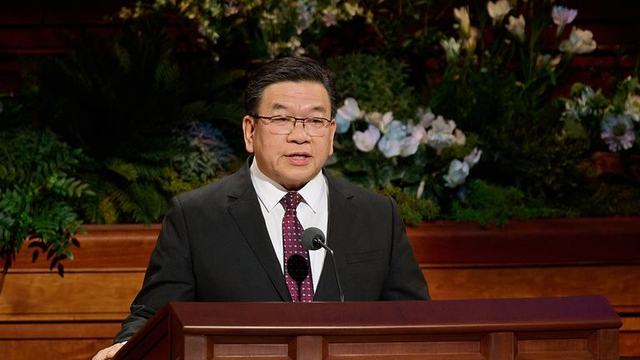
Follow the Prophet; He Knows the Way
 Open talk in Gospel Library
Contents
Before Reading
Before reading or listening to the talk, consider the following questions:
- What does it mean to follow Jesus Christ as a continuous way of life rather than an occasional practice?
- How can family, ethnic, or personal traditions sometimes conflict with gospel culture?
- What does Elder Teh teach about the relationship between keeping covenants and embracing gospel culture?
- How does the Atonement of Jesus Christ strengthen people in the middle of suffering?
- In what ways can disciples of Jesus Christ reflect His light to bless others?
- Why does Elder Teh testify that living prophets help us prepare for the future rather than merely comment on the past?
- How does following the prophet help us follow the Savior more faithfully?
Topics
Choose to follow Jesus Christ through His living prophet
Elder Teh begins by connecting the Savior’s invitation to “follow me” with the Primary song teaching, “Follow the prophet; he knows the way.” He emphasizes that discipleship is not casual or occasional but a continuous commitment. He teaches that when members follow the teachings and examples of the living prophet and other ordained leaders, they are following Jesus Christ.
To the rich young man, Jesus said, “Sell all that thou hast, and distribute unto the poor, and thou shalt have treasure in heaven: and come, follow me.”
As the Primary song goes, “Follow the prophet; he knows the way.”
“Following Christ is not a casual or occasional practice. It is a continuous commitment and way of life that should guide us at all times and in all places.”
My dear brothers and sisters, especially you, my dear young friends, when we follow their teachings and examples, we are following our Savior, Jesus Christ.
- What invitation did Jesus give to the rich young man?
- How does Elder Teh connect following the prophet with following Jesus Christ?
- According to President Oaks’s quoted counsel, how should following Christ shape a disciple’s life?
- Who does Elder Teh identify as prophets, seers, and revelators today?
- What recent prophetic counsel do I need to follow more fully?
- In what areas of my life has discipleship become casual or occasional rather than continuous?
- How can I show greater trust in the prophet’s teachings this week?
- What is one action I can take today to better align my life with the Savior through prophetic counsel?
Embrace gospel culture by keeping covenants
Elder Teh describes his family’s background in the Philippines, where family, ethnic, and religious traditions shaped daily life. After his parents joined the Church, they learned that gospel culture is rooted in the plan of salvation, God’s commandments, and the words of living prophets. As they recognized that some cherished traditions conflicted with the gospel, they had to choose whether to hold on to those traditions or keep their covenants. Elder Teh concludes that embracing gospel culture means keeping covenants.
When my parents joined the Church, little did they know that they were embracing yet another set of values and traditions—even the gospel culture, based on the plan of salvation, God’s commandments, and the words of living prophets.
Over time, as our family strived to fully embrace the gospel, my parents discovered that some of our well-loved traditions were not consistent with gospel culture.
And so began the difficult undertaking of weeding our family of traditions and cultural practices that were contrary to gospel culture.
I am so grateful that my parents exercised faith and chose to keep their covenants.
This experience taught me that embracing gospel culture simply meant keeping our covenants.
- What did Elder Teh say gospel culture is based on?
- What challenge did his parents face after joining the Church?
- What choice did his parents have to make regarding family traditions?
- How does Elder Teh define embracing gospel culture?
- Are there personal, family, or cultural habits in my life that do not fully align with the gospel?
- What covenant commitments should guide my decisions when traditions and discipleship seem to conflict?
- How have I seen blessings come from choosing gospel culture over social pressure?
- What is one tradition or practice I should reevaluate in light of the teachings of Jesus Christ and His prophets?
Repent and leave behind practices that oppose God’s commandments
Using President Oaks’s teaching, Elder Teh explains that the gospel calls people to change. Repentance includes giving up practices—whether personal, family, ethnic, or national—that are contrary to God’s commandments. The purpose of the gospel is transformation, helping people become celestial citizens. This means disciples should expect to change and should not assume every inherited tradition is meant to remain unchanged.
“The gospel of Jesus Christ challenges us to change. ‘Repent’ is its most frequent message, and repenting means giving up all of our practices—personal, family, ethnic, and national—that are contrary to the commandments of God.”
“The purpose of the gospel is to transform common creatures into celestial citizens, and that requires change.”
“The traditions or culture or way of life of a people inevitably include some practices that must be changed by those who wish to qualify for God’s choicest blessings.”
- What does President Oaks say is the gospel’s most frequent message?
- How is repentance defined in the quoted passage?
- What is the purpose of the gospel according to President Oaks?
- Why must some traditions be changed?
- What practices in my life may need to change so I can more fully qualify for God’s choicest blessings?
- How do I usually respond when the gospel challenges something familiar or comfortable?
- What does repentance look like in my current circumstances?
- How can I invite the Lord to help me change rather than merely defend old habits?
Receive strength from the Atonement of Jesus Christ in trials
Elder Teh recounts visiting a man in Japan with spreading cancer and expecting to find despair, only to meet someone bright, peaceful, and free of bitterness. He had similar experiences in Korea, where those he intended to minister to instead strengthened him. He teaches that Jesus Christ, through His Atonement, strengthens His disciples to endure suffering. Because the Savior experienced the fulness of mortal challenges, He can succor and empower His people.
What stood before me was not at all the man I had imagined. His countenance was bright and happy. There was no bitterness, and he never asked why.
My intention was to minister to others. However, at the end of my visits, it felt like I was the one being ministered to.
Jesus Christ strengthened each of these individuals to endure their trials.
“Our Savior experienced and suffered the fulness of all mortal challenges. … He therefore knows our struggles, our heartaches, our temptations, and our suffering, for He willingly experienced them all as an essential part of His Atonement.”
“And because of this, His Atonement empowers Him to succor us—to give us the strength to bear it all.”
- What surprised Elder Teh during his visit with the man in Japan?
- What did Elder Teh learn from his ministering experiences in Japan and Korea?
- How does the Savior’s Atonement qualify Him to help us in our suffering?
- What does it mean that Christ can “succor” us?
- When have I felt strengthened by Jesus Christ during a trial?
- How can I seek the Savior’s enabling power more intentionally in my current challenges?
- Have I ever been taught or strengthened by someone I went to help? What did I learn?
- What would it look like for me to face hardship with greater faith and less bitterness?
Reflect the Savior’s light through example and service
Elder Teh uses the image of sunlight reflected from a nearby building into his apartment in Hong Kong to teach that disciples can reflect the Savior’s light to others. Even if they are not the source of the light, they can help others feel His love. As people strive to follow Jesus Christ, He can use their example and service to bless others.
Upon further investigation, I learned that the sun’s rays were being reflected into our apartment by the tall building in front of us.
I was reminded that when we strive to follow the Savior, He will use us to bless others.
Through our example and service to others, they will feel the Savior’s love for them.
“Behold I am the light; I have set an example for you.”
“Hold up your light that it may shine unto the world,” adding, “Behold, I am the light which ye shall hold up—that which ye have seen me do.”
- What experience in Hong Kong led Elder Teh to think about spiritual light?
- What does reflected light teach about discipleship?
- How can example and service help others feel the Savior’s love?
- According to the quoted words of Jesus, what light are disciples to hold up?
- How can I better reflect the Savior’s light in my home, ward, school, or workplace?
- Who in my life may need to feel the Savior’s love through my service?
- What Christlike example do I want to strengthen right now?
- When have I felt someone else reflect the Savior’s light into my life?
Trust prophets as seers who help us prepare for the future
Elder Teh challenges the idea that prophets are out of touch or focused only on the past. He teaches that prophets see into the future as watchmen on a tower. Quoting Mosiah, he explains that seers know things past and future and reveal hidden things by God’s power. This supports his testimony that members should trust prophetic counsel because it comes from divinely appointed seers.
It is interesting to me that some people would think that God’s prophets live in the past and are not attuned to the times.
Everything I know of prophets is the opposite.
They actually see into the future as watchmen on a tower.
“A seer can know of things which are past, and also of things which are to come, and by them shall all things be revealed.”
- What mistaken idea about prophets does Elder Teh address?
- How does he describe prophets instead?
- What does Mosiah teach about a seer?
- Why should members trust prophetic warnings and invitations?
- Have I ever hesitated to follow prophetic counsel because I did not understand it fully?
- How can I increase my confidence that prophets are watchmen for our day?
- What prophetic counsel seems especially important for my future right now?
- How have I seen later blessings come from following a prophet’s counsel early?
Sustain the Lord’s chosen servants with faith and gratitude
Elder Teh closes with a clear testimony that President Dallin H. Oaks, his counselors, and the Quorum of the Twelve Apostles are prophets, seers, and revelators. He expresses gratitude for participating in the solemn assembly and invites all, especially the youth, to follow these leaders’ teachings and examples. His concluding witness reinforces the sacred responsibility to sustain living prophets and apostles.
I testify that we are led today by a living prophet, President Dallin H. Oaks.
He, along with the counselors in the First Presidency and the Quorum of the Twelve Apostles, are indeed prophets, seers, and revelators.
I am grateful to have participated in the solemn assembly this morning.
My dear brothers and sisters, especially you, my dear young friends, when we follow their teachings and examples, we are following our Savior, Jesus Christ.
- Whom does Elder Teh identify as the living prophet?
- What offices does he say the First Presidency and Quorum of the Twelve hold?
- What connection does he make between sustaining Church leaders and following the Savior?
- Why is his testimony at the end of the talk significant?
- How do I personally sustain the prophet and apostles beyond raising my hand in conference or sacrament meeting?
- What feelings do I have when I hear prophetic testimony, and why?
- How can I help the youth or others around me develop trust in living prophets?
- What is one way I can show gratitude for living prophets this month?
