
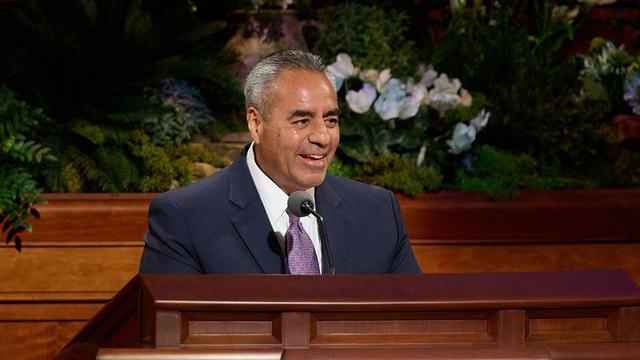
Tithing—Putting God First
 Open talk in Gospel Library
Contents
Before Reading
Before reading or listening to the talk, consider the following questions:
- What does it mean to be “double minded,” and how might putting God first help overcome that condition?
- How does the law of tithing teach disciples to choose God before competing concerns?
- What can Adam and Eve’s offering of the firstlings teach about obedience and sacrifice?
- How did Elder Becerra’s personal experience strengthen his testimony of tithing?
- What blessings—temporal and spiritual—does the speaker connect with paying tithes and offerings?
- How does honoring the law of tithing help us become more like Jesus Christ?
Topics
Avoid spiritual double-mindedness by putting God first
Elder Becerra begins with Alma’s concern that the people not remain in an “awful dilemma,” which he connects to James’s description of a “double minded” person. He teaches that spiritual conflict, wavering, and indecision can be overcome as disciples choose a clear priority: seeking God first. Tithing becomes one concrete way to demonstrate that God truly comes before all else.
“I have come having great hopes … that ye had humbled yourselves before God, and that … ye were not in the awful dilemma that our brethren were in at Zarahemla.”
“I had much desire that ye were not in the state of dilemma like your brethren.”
“A double minded man is unstable in all his ways.”
“One way to overcome double-mindedness is to learn to put God first in our lives.”
“Seek ye first the kingdom of God, and his righteousness.”
- How does Elder Becerra define the “awful dilemma” Alma described?
- What characteristics does the speaker associate with being double minded?
- According to the talk, how can disciples overcome spiritual wavering?
- Why is seeking the kingdom of God first essential to stable discipleship?
- How does tithing relate to the principle of putting God first?
- Where in my life do I feel spiritually divided or hesitant?
- What choices currently compete with putting God first?
- How can I show the Lord more clearly that He comes first in my priorities?
- What would wholehearted discipleship look like in my current circumstances?
- How has obedience helped me feel more spiritually steady?
Offer God your first and best
Using the example of Adam and Eve, Elder Becerra emphasizes that from the beginning God has taught His children to place Him first. The command to offer the firstlings of the flock shows that worship, sacrifice, and obedience are not meant to be leftovers but first offerings. He highlights that this pattern protects disciples from divided loyalty and points them to Jesus Christ, whose sacrifice the offerings symbolized.
“From the beginning of time, God has taught His children to put Him first in their lives.”
“The Lord gave Adam and Eve ‘commandments, that they should worship the Lord their God, and should offer the firstlings of their flocks, for an offering unto the Lord.’”
“And Adam was obedient unto the commandments of the Lord.”
“This thing is a similitude of the sacrifice of the Only Begotten of the Father, which is full of grace and truth.”
“Please notice that the Lord commanded Adam and Eve to offer the firstlings of their flocks. In other words, He commanded them to put God first to avoid the spiritual dilemma of double-mindedness.”
- What did the Lord command Adam and Eve to offer?
- Why is the word “firstlings” important in the speaker’s teaching?
- How does Adam’s obedience illustrate putting God first?
- What does the angel teach Adam about the meaning of sacrifice?
- How does the example of Adam and Eve connect to the law of tithing today?
- What are the “firstlings” I can offer God in my life—time, attention, means, devotion, or trust?
- Do I tend to give the Lord my first and best or only what is left over?
- How can I make my worship more intentional and obedient?
- What sacrifices have helped me remember Jesus Christ more clearly?
- How can I better connect my obedience to the Savior’s sacrifice?
Exercise faith to pay tithing in difficult circumstances
Elder Becerra shares a personal experience from early married life when he had fallen behind in paying tithes and offerings during financial hardship. After counsel that caused him to reflect on what he had of value, he chose on his own to sell his car so he could pay tithing. His story illustrates that putting God first often requires faith, sacrifice, and action before the outcome is visible.
“I am having financial difficulties in my business. I have fallen behind in my payment of tithes and offerings.”
“The only thing I had of value was a car that I needed in my efforts to grow my business.”
“However, I concluded that I should at least make an effort to sell my car.”
“I want to be clear that Elder Cutler did not ask me to sell my car. This came to me after pondering and desiring to put God first.”
“I had calculated what I needed to pay off the loan on the car and pay my tithing.”
- What challenge was Elder Becerra facing when he spoke with Elder Cutler?
- What did he identify as the only thing he had of value?
- Why is it significant that the decision to sell the car came after personal pondering?
- How does this experience show the relationship between faith and action?
- What does this story teach about obedience when the cost feels high?
- When have I had to choose obedience during uncertainty?
- What sacrifice might the Lord be inviting me to make to put Him first?
- How do I respond when commandments seem to conflict with immediate practical concerns?
- What helps me act in faith before I know the outcome?
- How can I strengthen my consistency in paying tithes and offerings?
Recognize the Lord’s hand as you honor tithing
After Elder Becerra sold his car and paid his tithing, the Lord provided an unexpected solution through a friend who offered him another vehicle arrangement. He presents this as a miracle and as evidence that God is mindful of those who choose Him first. The story teaches that while blessings may come in different forms, the Lord can guide and sustain His covenant people in both practical and personal ways.
“A few days later, he came back with a check for the amount I had requested.”
“I deposited the check and paid my tithing.”
“As I contemplated what had occurred, I realized that I did not have a car to continue with my business.”
“A friend called me and said, ‘Jorge, you like my car, don’t you?’”
“It was a miracle!”
- What happened after Elder Becerra sold his car and paid his tithing?
- Why did he describe the later development as a miracle?
- How does this experience illustrate the Lord’s awareness of individual needs?
- What does the story suggest about trusting God after an act of sacrifice?
- Does the talk teach that blessings always come in identical ways, or that God provides according to His wisdom?
- When have I seen the Lord provide after I acted in faith?
- How can I become more aware of God’s hand in my daily life?
- What miracles, large or small, have followed my obedience?
- How do I record and remember spiritual evidence that God keeps His promises?
- What current concern can I place more fully in the Lord’s hands?
Build on testimonies from prophets and family
Elder Becerra reflects on the influence of his mother’s testimony and the teachings of President Gordon B. Hinckley. His mother’s witness, formed amid the financial struggles of immigration and adjustment, gave him confidence that the Lord blesses those who pay tithing. He reinforces that prophetic counsel matters especially in hardship and that obedience to the commandment is what truly matters.
“As I reflect upon my experience, I wonder what gave me the confidence to sell my car and pay my tithing.”
“I recall one home evening when my mother bore powerful testimony of the law of tithing.”
“All we need to see is the very hand of Jehovah Himself to have any greater assurance that He is blessing us by our payment of tithing.”
“I believe they will not walk out of poverty unless they pay their tithing.”
“Now is the season in which to establish strength in the gospel, and that involves the payment of tithing.”
“It is obedience to the commandment of the Lord that really matters.”
- What role did Elder Becerra’s mother’s testimony play in his later decision?
- How did his family’s immigrant experience shape the context of that testimony?
- What did President Hinckley teach about tithing and difficult circumstances?
- According to the talk, why is prophetic counsel about tithing especially important in times of need?
- What does the speaker emphasize as the central issue in paying tithing?
- Whose testimony has strengthened my faith in commandments like tithing?
- What family experiences have taught me to trust the Lord?
- How do I respond to prophetic counsel when it is difficult to follow?
- What testimony of tithing or obedience should I record and preserve?
- How can I share faith-building experiences with my family or others?
Receive spiritual power through obedience and sacrifice
The speaker teaches that the blessings of tithing are not only temporal but deeply spiritual. As disciples put God first and offer their “firstlings,” they receive increased spiritual capacity, power, and direction. He points to Adam’s experience—when the Holy Ghost fell upon him after sacrifice—and to Elder Bednar’s teaching that the windows of heaven include spiritual illumination and perspective.
“I know this statement applies to our temporal lives but also to our spiritual lives.”
“I am certain that the payment of tithes and offerings will enhance our spiritual capacity as we put God first and offer our ‘firstlings of [the] flock.’”
“I witness that a spiritual power and direction, heretofore unknown, will come into our lives as we keep the law of obedience and sacrifice.”
“And in that day the Holy Ghost fell upon Adam.”
“In like manner, spiritual illumination and perspective are poured out through the windows of heaven and into our lives as we honor the law of tithing.”
- What spiritual blessings does Elder Becerra connect with paying tithes and offerings?
- How does Adam’s experience support the principle that obedience invites spiritual power?
- What does Elder Bednar’s explanation of the “windows” of heaven add to our understanding?
- How is spiritual illumination different from merely receiving material help?
- Why does the speaker connect tithing with obedience and sacrifice?
- How has obedience increased my spiritual sensitivity or direction?
- What spiritual blessings have I noticed when I have honored the law of tithing?
- In what ways do I need more heavenly perspective right now?
- How can I seek not only temporal blessings but also spiritual illumination from the Lord?
- What does sacrifice currently mean in my discipleship?
Follow Jesus Christ as the perfect example of putting God first
Elder Becerra concludes by centering the doctrine of tithing and sacrifice in Jesus Christ. The Savior perfectly put the Father first, submitting completely to His will and laying down His life. The speaker’s final witness shows that all obedience, including tithing, ultimately points disciples to Christ, the Redeemer and Savior, and invites them to follow His example of wholehearted submission.
“I witness that Jesus Christ is the perfect example of how to put God first in our lives.”
“I witness that He laid down His life as a symbol of complete submission to His Father’s will.”
“He is the Christ, the Redeemer and Savior of us all.”
“Dallin H. Oaks is His prophet.”
“I bear solemn witness that He lives.”
- How does Elder Becerra describe Jesus Christ as the perfect example?
- What does the Savior’s submission teach us about putting God first?
- How does the talk connect tithing to discipleship centered in Christ?
- Why is it important that the speaker ends with testimony of Jesus Christ?
- How does following Christ shape our understanding of sacrifice and obedience?
- What would it look like for me to follow Christ more fully in putting the Father first?
- How does my obedience reflect my love for the Savior?
- What can I do to make my worship more centered on Jesus Christ?
- How has the Savior helped me trust God in sacrifice?
- What testimony of Jesus Christ do I want to strengthen as I live this principle?
