
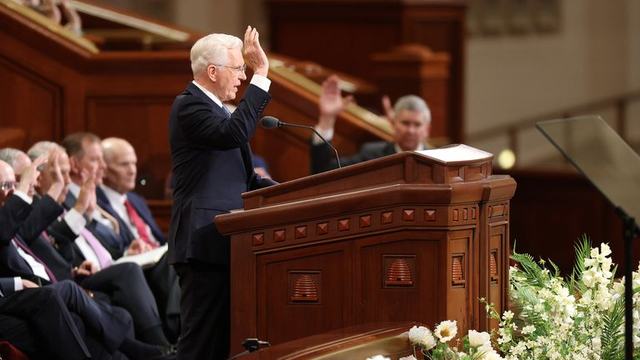
Sustaining of General Authorities, Area Seventies, and General Officers
 Open talk in Gospel Library
Ideas for Opening the Lesson
- Begin by asking class members what it means to them to sustain Church leaders. Invite a few brief responses, then explain that this message focused on how the Church formally presented leaders for sustaining, release, and expressions of gratitude. This can help the class approach the lesson as more than a procedural report and see sustaining as a covenant act.
- Start with a simple show-of-hands activity. Ask, without discussing names, what feelings class members usually have when they participate in a sustaining vote in conference or stake conference. Use their responses to introduce the themes of trust, gratitude, common consent, and support for those who serve.
- Open by reading the line, "We again thank you for your sustaining vote on behalf of the leadership of the Church." Then ask: Why do you think the Lord asks His people to participate in sustaining rather than simply announcing leaders? This can lead naturally into a discussion of accountability, unity, and personal commitment.
- Invite class members to think of a Church leader whose service has blessed them personally. Let a few share brief experiences. Then connect those experiences to the talk’s repeated expressions of gratitude for released leaders and their families, helping the class see the human sacrifice behind Church service.
- Begin by explaining that this talk was largely administrative in form, but that it still taught important doctrine and principles. Ask the class to listen for what the process of sustaining, releasing, and calling leaders taught about how the Lord governed His Church. This opening can help members look for spiritual meaning in what might otherwise seem procedural.
Topics
We sustained leaders by common consent
President Christofferson presented General Authorities, Area Seventies, and General Officers to the Church for a sustaining vote. He invited members to express support in the usual way and explained that those who opposed should contact their stake president. His remarks showed that sustaining was an active, orderly participation by Church members in the governance of the Lord’s Church.
We ask that you please express your support in the usual way. If there are those who oppose any of the proposals, we ask that you contact your stake president.
- What did this talk teach about the meaning of sustaining Church leaders?
- How was sustaining more than simply raising a hand?
- Why do you think the Lord used a process of common consent in His Church?
- What responsibilities came with sustaining a leader?
- How could we better support leaders after we sustained them?
- What had you learned from participating in sustaining votes in ward, stake, or general conference settings?
We honored released leaders with gratitude
President Christofferson repeatedly invited the Church to express gratitude for leaders who were being released from their assignments. He specifically acknowledged General Authority Seventies, Area Seventies, and the Primary General Presidency, and he included appreciation for their wives, families, and years of devoted service. The talk emphasized that releases were not casual transitions but moments to honor consecrated service.
Those who wish to express gratitude to these brethren and to their wives and families for their years of dedicated service throughout the Church may do so by the uplifted hand.
- Why was it important that the talk repeatedly expressed gratitude for released leaders?
- What stood out to you about the mention of wives and families in these expressions of thanks?
- How could we show more gratitude for those who serve in the Church locally?
- What had you seen leaders and their families sacrifice in order to serve?
- How did gratitude for past service strengthen the Church?
- How might our wards and branches improve in honoring faithful service when callings change?
We recognized orderly transitions in leadership
The talk described established policies and effective dates for releases and new assignments. President Christofferson noted that General Authority Seventies were released and granted emeritus status in the year they turned 70, and he identified specific effective dates for leadership changes. This showed that leadership transitions in the Church were orderly, deliberate, and governed by established patterns.
According to established policy followed for many years, General Authority Seventies are released and granted emeritus status in the year a General Authority Seventy turns 70.
- What did the orderly nature of these changes teach about how the Lord governed His Church?
- Why do established policies matter in Church leadership transitions?
- How can orderly transitions bless both leaders and members?
- What can we learn from the way the Church handled releases and new assignments with clarity and respect?
- How might this pattern help us accept changes in our own wards or stakes?
- When have you seen a well-handled transition strengthen confidence and peace in the Church?
We sustained newly called leaders
President Christofferson presented newly called leaders for the sustaining vote of the Church, including a new member of the Presidency of the Seventy, new General Authority Seventies, new Area Seventies, and a new Primary General Presidency. The talk emphasized that new leaders were not simply announced but were formally sustained by the members. This reflected trust in revelation and invited members to support those whom the Lord had called.
It is proposed that we sustain the following as new General Authority Seventies: Elders Christian C. Chigbundu, Matthew J. Eyring, Hutch U. Fale, James O. Fantone, Kevin J. Hathaway, Thabo Lebethoa, Jeremiah J. Morgan, and Paul H. Sinclair.
- Why was it meaningful that new leaders were presented for sustaining rather than merely introduced?
- How did sustaining newly called leaders show faith in revelation?
- What can we do personally when someone receives a new calling we do not know much about?
- How can we welcome and support new leaders in ways that strengthen their service?
- What blessings have come into your life from leaders who were newly called and then sustained?
- How does sustaining help turn a leader’s calling into a shared responsibility with the members?
We supported the whole leadership of the Church
Near the end of the talk, President Christofferson asked the Church to sustain the other General Authorities, Area Seventies, and General Officers as presently constituted. This broad sustaining reminded members that support was not limited to a few prominent names but extended to the full body of Church leadership. The talk reinforced unity and collective confidence in the Lord’s established order.
It is proposed that we sustain the other General Authorities, Area Seventies, and General Officers of the Church as presently constituted.
- What did it mean to sustain the leadership of the Church as presently constituted?
- How did this broader sustaining invite unity among Church members?
- Why is it important to support leaders we may never meet personally?
- How can we avoid treating sustaining as something only for well-known leaders?
- What might change in our discipleship if we saw sustaining as support for the Lord’s whole work?
- How has your confidence in the Church been strengthened by its united leadership?
We acknowledged worldwide Church service
The talk and the accompanying list of Area Seventies highlighted the global nature of the Church. Names from many nations and backgrounds reflected that the Lord was calling leaders throughout the world. This underscored that Church leadership was broad, international, and representative of a growing worldwide membership.
We note that 91 new Area Seventies were sustained during the general conference leadership meetings on Thursday, April 2, and then announced on the Church’s website.
- How did the worldwide list of leaders deepen your appreciation for the global Church?
- What did this talk suggest about the Lord’s work among many nations and peoples?
- Why was it valuable to notice the diversity of those who were called to serve?
- How can a global view of Church leadership strengthen our sense of belonging in the kingdom of God?
- What experiences have helped you feel the worldwide reach of the Church?
- How can we better pray for and support leaders serving in places far from our own?
Additional Discussion Questions
- What principles about the Lord’s pattern of governing His Church could we learn from this sustaining session?
- How should sustaining influence the way we speak about Church leaders at home and in our congregations?
- Why do you think expressions of gratitude were included so prominently in this message?
- What can we learn from the fact that releases and new callings were both handled in a spirit of dignity and appreciation?
- How can we teach youth and children that sustaining is a sacred act and not just a routine gesture?
- What role did trust play in the process President Christofferson described?
- How might our prayers change when we truly feel responsible to sustain those who lead?
- What can local leaders and members do to make leadership transitions more faith-filled and less unsettling?
- How did this talk help you see both the order and the humanity of Church leadership?
- What is one thing you felt inspired to do differently because of this message about sustaining and supporting leaders?
