
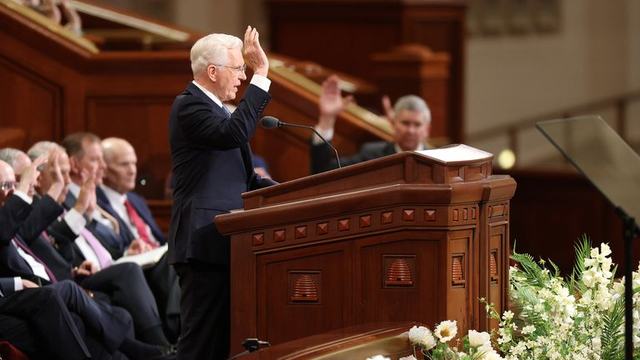
Sustaining of General Authorities, Area Seventies, and General Officers
 Open talk in Gospel Library
Contents
Before Reading
Before reading or listening to the talk, consider the following questions:
- What does the sustaining process teach about common consent in the Church?
- Why does the speaker repeatedly express gratitude for those who are released from service?
- What responsibilities do members have when they sustain Church leaders?
- How does this message show that the Church is governed in an orderly and established way?
- What can I learn from the pattern of calls, releases, and continued service in the Church?
Topics
Participate in sustaining by common consent
President Christofferson presents Church leaders to the membership for a sustaining vote and invites members to express support in the usual way. He also explains the process for those who may oppose, showing that sustaining is a meaningful act of common consent rather than a mere formality.
President Oaks has asked that I now present the other General Authorities, Area Seventies, and General Officers of The Church of Jesus Christ of Latter-day Saints for your sustaining vote.
We ask that you please express your support in the usual way.
If there are those who oppose any of the proposals, we ask that you contact your stake president.
We again thank you for your sustaining vote on behalf of the leadership of the Church.
- What invitation does President Christofferson extend to the members regarding sustaining Church leaders?
- How does the talk show that sustaining includes both support and a process for expressing opposition?
- What does the phrase "for your sustaining vote" teach about the role of Church members?
- When I sustain Church leaders, what do I believe I am promising before the Lord?
- How can I show support for my local and general leaders beyond raising my hand?
- Do I treat sustaining as a sacred act of discipleship or as a routine action?
Honor faithful leaders as they are released
The talk repeatedly expresses gratitude for leaders who are being released from their assignments, including General Authority Seventies, Area Seventies, and the Primary General Presidency. This emphasis teaches respect for consecrated service and appreciation for the sacrifices made by leaders and their families.
Those who wish to express gratitude to these brethren and to their wives and families for their years of dedicated service throughout the Church may do so by the uplifted hand.
We note with gratitude the 75 Area Seventies who will complete their service and whose names can be found on the Church’s website.
Those who wish to join in expressing appreciation to these brethren and to their families for their years of selfless service may manifest it.
We extend, with sincere gratitude, releases to the Primary General Presidency, effective on August 1, 2026, as follows: Susan H. Porter as President, Amy A. Wright as First Counselor, and Tracy Y. Browning as Second Counselor.
All who wish to join in expressing gratitude to these sisters and their families for their devoted service may manifest it.
- How does President Christofferson speak about those who are released from service?
- Why are the families of released leaders specifically acknowledged?
- What words in the talk highlight the value of dedicated and selfless service?
- How can I better express gratitude for leaders who have served in my ward, stake, or the Church?
- Do I recognize the sacrifices made by leaders’ families as well as by the leaders themselves?
- What have I learned from the examples of those who serve faithfully and then accept release with humility?
Recognize the Church’s orderly pattern of calls and releases
President Christofferson notes established policies governing service, including the granting of emeritus status to General Authority Seventies in the year they turn 70. The talk reflects the orderly administration of the Lord’s Church, where transitions in leadership occur according to established patterns and under priesthood direction.
According to established policy followed for many years, General Authority Seventies are released and granted emeritus status in the year a General Authority Seventy turns 70.
Therefore, the following General Authority Seventies will be released from their assignments and given emeritus status, effective on August 1, 2026.
It is proposed that we sustain the other General Authorities, Area Seventies, and General Officers of the Church as presently constituted.
- What established policy does President Christofferson explain regarding General Authority Seventies?
- How does this talk demonstrate order and continuity in Church leadership?
- Why is it significant that leaders are sustained and released in a clear and formal manner?
- How does seeing order in the Church strengthen my trust in the Lord’s way of governing His Church?
- Am I willing to accept changes in leadership with faith and confidence?
- What can I learn from the humility of those who accept both callings and releases?
Sustain newly called leaders in their assignments
The talk presents newly called leaders for sustaining, including a new member of the Presidency of the Seventy, new General Authority Seventies, new Area Seventies, and a new Primary General Presidency. Members are invited to sustain these leaders, showing that new callings are received by the Church with faith and support.
Elder Benjamin M. Z. Tai has been called to serve as a member of the Presidency of the Seventy, effective on August 1.
It is proposed that we sustain the following as new General Authority Seventies: Elders Christian C. Chigbundu, Matthew J. Eyring, Hutch U. Fale, James O. Fantone, Kevin J. Hathaway, Thabo Lebethoa, Jeremiah J. Morgan, and Paul H. Sinclair.
We note that 91 new Area Seventies were sustained during the general conference leadership meetings on Thursday, April 2, and then announced on the Church’s website. We invite you to sustain these brethren in their new assignments.
It is proposed that we sustain the following as the new Primary General Presidency, to be effective on August 1, 2026: Rosemary K. Chibota as President, Nina M. Garfield as First Counselor, and Theresa A. Collins as Second Counselor.
- Which newly called leaders are presented for sustaining in this talk?
- How does the speaker invite members to respond to new callings?
- What does the sustaining of new leaders teach about the Church’s confidence in inspired calls?
- How can I pray for newly called leaders as they begin their assignments?
- When new leaders are called in my ward or stake, how can I help them succeed?
- How do I respond when the Lord calls others whose backgrounds or experiences may be different from my own?
Value the worldwide service of the Lord’s servants
The extensive listing of names from many nations and backgrounds reflects the global nature of the Church and the broad reach of priesthood and auxiliary service. The talk quietly witnesses that the Lord calls servants throughout the earth and that His Church is led by people serving in many lands and cultures.
We note with gratitude the 75 Area Seventies who will complete their service and whose names can be found on the Church’s website.
We note that 91 new Area Seventies were sustained during the general conference leadership meetings on Thursday, April 2, and then announced on the Church’s website.
We invite you to sustain these brethren in their new assignments.
- How does the broad range of names in the talk reflect the worldwide Church?
- What does the calling of many Area Seventies suggest about the needs of the global Church?
- How does this message show that the Lord’s work is moving forward in many places?
- How can I deepen my appreciation for the worldwide nature of the Church?
- Do I rejoice in the Lord calling leaders from many cultures and nations?
- How can I better feel unity with Saints and leaders across the world?
Acknowledge the sacrifice of families who serve with leaders
President Christofferson repeatedly includes wives and families when expressing gratitude. This teaches that Church service is often supported by unseen sacrifice at home and that families participate in the offering of consecrated service.
Those who wish to express gratitude to these brethren and to their wives and families for their years of dedicated service throughout the Church may do so by the uplifted hand.
Those who wish to join in expressing appreciation to these brethren and to their families for their years of selfless service may manifest it.
All who wish to join in expressing gratitude to these sisters and their families for their devoted service may manifest it.
- Whom does President Christofferson include when thanking released leaders?
- Why might it matter that families are mentioned alongside those who served in leadership positions?
- What does this repeated acknowledgment teach about the nature of Church service?
- How can I better support the families of those who serve in demanding callings?
- Have I thanked not only leaders but also their loved ones for their sacrifices?
- What sacrifices has my own family made in supporting Church service, and how have I seen the Lord bless us?
