
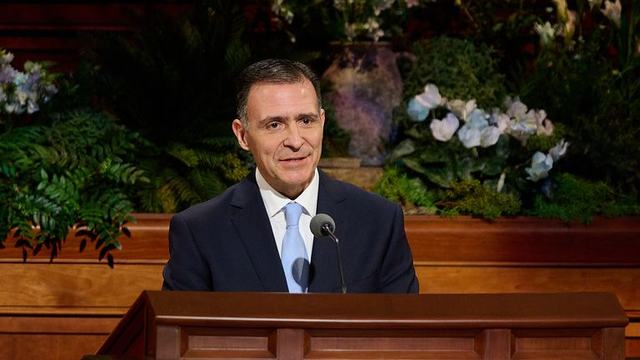
Christ—Author and Finisher of Our Faith
 Open talk in Gospel Library
Ideas for Opening the Lesson
- Invite class members to briefly reflect on this question: “When did the gospel become personal for me?” Give them 30–60 seconds to think silently, then ask a few volunteers to share. This could help set the tone for Elder Ortega’s emphasis that faith was not merely inherited but was strengthened through personal decision and testimony.
- Begin by writing two phrases on the board: “family heritage” and “personal testimony.” Ask the class how these two blessings relate to each other. This could lead naturally into the talk’s teaching that family legacy was a blessing, but it was not a substitute for a personal witness of Jesus Christ.
- Show or describe the image of climbing a mountain and ask: “Why might the safest path not be the shortest path?” After a few responses, connect the idea to discipleship and Elder Ortega’s comparison of the covenant path to a firm and safe mountain path that led to the true summit.
- Invite class members to think of someone in their family or ward whose decision to follow Christ blessed future generations. Ask a few to share briefly. This could open discussion about Elder Ortega’s grandmother Mercedes and the lasting influence of one faithful disciple.
- Read aloud the talk’s title, “Christ—Author and Finisher of Our Faith,” and ask the class what that title teaches about the Savior’s role in their discipleship. This could help the lesson begin with a Christ-centered focus and prepare the class to notice how every part of the talk pointed back to Him.
Topics
Choose discipleship personally
Elder Ortega taught that faith was not simply passed down through family lines. He said true discipleship began with a personal decision to follow Jesus Christ. He emphasized that even in strong multigenerational gospel families, enduring faith depended on individual choice.
Some may think that faith is inherited. True discipleship, however, always begins with a personal decision.
- What stood out to you in Elder Ortega’s statement that true discipleship began with a personal decision?
- How have you seen the difference between borrowing faith from others and choosing faith for yourself?
- Why do you think personal decision was essential even in strong gospel families?
- What choices help us show the Lord that we are personally committed to Him?
- How could we help family members or quorum and Relief Society members make their own choice to follow Christ?
- When have you felt your discipleship become more intentional and personal?
Seek your own testimony diligently
Elder Ortega taught that family heritage and Church participation were blessings, but they were not enough by themselves. He said a personal testimony came through a sincere and dedicated quest to know for oneself and then to act on spiritual impressions. He illustrated this by sharing that he gained his own undeniable testimony while serving as a missionary.
A personal testimony comes in response to our sincere and dedicated quest to want to know for ourselves and then to act upon the impressions and the knowledge received.
- What did Elder Ortega teach about how a personal testimony was gained?
- Why was it significant that he said his upbringing in the gospel was not enough by itself?
- How has acting on spiritual impressions strengthened your testimony?
- What are some practical ways we can seek to know for ourselves more diligently?
- How can we help youth, new members, or less-active members seek their own witness of truth?
- What experiences have helped your testimony become more personal and undeniable?
Honor faithful family pioneers
Elder Ortega expressed deep gratitude for his grandmother Mercedes, whose conversion blessed generations of her family. He taught that one person’s courageous decision to follow the Savior could bring blessings far beyond that individual life. Her example showed how faith and courage in imperfect circumstances could shape a family legacy.
I am deeply grateful for my grandmother’s faith and courage in following the Savior’s example, even though her circumstances were not perfect or ideal. Her decision brought blessings not only to her but also to many of us.
- What did Elder Ortega’s story about his grandmother teach you about the power of one faithful decision?
- How have you seen the faith of earlier generations bless your life?
- What can we learn from the fact that Mercedes followed the Savior even when circumstances were not ideal?
- How might our decisions today bless future generations?
- Who has been a spiritual pioneer in your family, ward, or personal life?
- How can we better honor and build on the righteous sacrifices of those who came before us?
Welcome and encourage new disciples
Elder Ortega spoke directly to those who had recently joined the Church and expressed joy in their decision to follow the Savior. He reassured them that they belonged in the family of God and that there was hope in Christ despite imperfect circumstances. He also taught that new members could become spiritual pioneers for their families and descendants.
We are so happy and we rejoice in your decision to follow the Savior. We want you to feel welcome to this great family as brothers and sisters and children of a loving Heavenly Father.
- What feelings or impressions came as you read Elder Ortega’s words to those who had recently joined the Church?
- Why was it important that he emphasized belonging in the family of God?
- How can our class, ward, or branch help new members feel truly welcomed and needed?
- What does it mean that a new member may become to future generations what Mercedes was to Elder Ortega’s family?
- How can we better support those whose circumstances are not ideal as they follow Christ?
- When have you seen a new disciple strengthen a family or ward through faith and courage?
Press forward on the covenant path
Elder Ortega taught that the invitation to seek, come to know, do, and endure on the covenant path applied to everyone. He emphasized pressing forward with steadfastness in Christ, being nourished by the word of God, remaining watchful in prayer, and relying on the merits of Christ. He connected enduring discipleship with hope, love, and eternal life.
The invitation to seek, to come to know and to do, and then to endure on the covenant path is the same for all of us, regardless of whether the gospel has been in our families for generations or we were baptized just last week.
- What did Elder Ortega teach about who was invited to walk the covenant path?
- What does it look like in daily life to press forward with steadfastness in Christ?
- How do the word of God and prayer help keep us in the right way?
- Why is it important to rely alone on the merits of Christ as we endure?
- What helps you keep moving forward when discipleship feels difficult or slow?
- How have hope and love helped you stay on the covenant path?
Trust Christ’s refining process
Elder Ortega testified that over time he had seen the Lord’s hand perfecting and refining him as he trusted in Christ. He acknowledged that sometimes perspective came only with time. He also quoted President Oaks to show that building faith and overcoming doubt could be a lengthy process that required patience, even with ourselves.
Over the years I have seen the Lord’s hand and His gospel work in me to perfect and refine me as I have trusted in Him and strived to “press forward with a steadfastness.”
- What did Elder Ortega teach about the Savior’s refining and perfecting work in our lives?
- Why do you think it sometimes takes time to recognize the Lord’s hand in us and in our families?
- How has patience with yourself helped you continue in faith?
- What can we do when we feel discouraged by slow spiritual progress?
- How have you seen the Lord refine you through ordinary daily discipleship?
- How can we support others who are in the middle of a long process of building faith?
Follow the safe path to Christ
Elder Ortega compared discipleship to climbing a mountain, teaching that the shortest route was not always the safest or best. He said disciples must choose the firm and safe path even when it was long and demanding. He identified Jesus Christ and His restored gospel as that safe path leading to the true summit.
Jesus Christ and His restored gospel constitute that safe path that leads us to the true summit.
- What did the mountain-climbing comparison teach you about discipleship?
- Why might the shortest path not be the safest path spiritually?
- What are some examples of the world offering shortcuts that do not lead to Christ?
- How have you learned to trust the Lord’s path even when it felt demanding?
- What helps you stay on the firm and safe path when other options seem easier?
- How can we teach our families that the covenant path is safe even when it requires sacrifice?
Center faith in Jesus Christ
Throughout the talk, Elder Ortega pointed to Jesus Christ as the source, strength, and completion of faith. He testified of the Savior’s healing, refining, and perfecting power, as well as His Resurrection and victory over death. His message centered on relying wholly on Christ, who was the author and finisher of faith.
I testify of the healing, refining, and perfecting power of Jesus Christ. I know that Jesus Christ lives, that He was resurrected on the third day, and that the empty tomb is a symbol of His victory.
- How did Elder Ortega help you see Jesus Christ more clearly in this talk?
- What does it mean to you that Christ was the author and finisher of our faith?
- How does the Savior’s Resurrection strengthen your confidence in Him?
- In what ways have you experienced the healing, refining, or perfecting power of Christ?
- Why is it important that our efforts on the covenant path remain centered in the Savior rather than only in habits or heritage?
- How can we rely more wholly on the merits of Christ in our daily discipleship?
Additional Discussion Questions
- What phrases or teachings from this talk felt especially relevant to your life right now?
- How can we balance gratitude for our spiritual heritage with the need to gain our own testimony?
- What are some small daily spiritual events that help build lifelong discipleship?
- How can we become better at recognizing the Savior’s refining hand over time?
- What role does missionary service or sharing the gospel play in strengthening personal testimony?
- How can we help children and youth understand that testimony must become personal?
- What does “relying wholly upon the merits” of Christ mean in practical terms?
- How can our quorum or Relief Society better support both lifelong members and those newly joined to the Church?
- What helps you keep a “perfect brightness of hope” while enduring challenges on the covenant path?
- After studying this talk, what is one change you feel impressed to make in your discipleship?
