
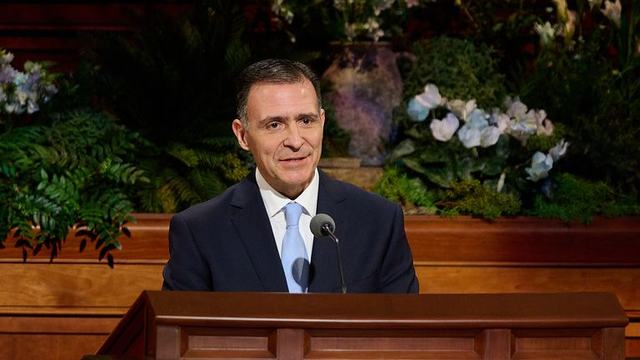
Christ—Author and Finisher of Our Faith
 Open talk in Gospel Library
Contents
Before Reading
Before reading or listening to the talk, consider the following questions:
- What does Elder Ortega teach about the difference between family heritage and personal testimony?
- How does a person gain a personal testimony of Jesus Christ and His restored gospel?
- What encouragement does this talk offer to new members of the Church?
- What does it mean to press forward with steadfastness in Christ?
- How does Jesus Christ refine and perfect His disciples over time?
- Why does Elder Ortega compare discipleship to climbing a mountain?
- What does it mean that Christ is the author and finisher of our faith?
Topics
Choose discipleship personally
Elder Ortega teaches that faith is not simply passed down through family lines. Even when people are blessed with righteous parents, traditions, and a strong gospel heritage, true discipleship begins when individuals personally choose to follow Jesus Christ. Family legacy can support faith, but it cannot replace a personal commitment to the Savior.
Some may think that faith is inherited. True discipleship, however, always begins with a personal decision.
Our family heritage is a great blessing, but it is not a substitute for our diligent and intentional search for a personal testimony of the Lord Jesus Christ and the truths of His restored gospel.
Our family legacy and traditions are very helpful, but in and of themselves they are not enough for us to build upon the rock of our Savior.
- According to Elder Ortega, why is family heritage not enough by itself to establish enduring faith?
- What does Elder Ortega say true discipleship always begins with?
- How does the Savior’s statement to Peter support the need for personal revelation?
- In what ways have I relied on family tradition more than personal spiritual seeking?
- What personal decision can I make now to follow the Savior more intentionally?
- How can I build my faith on Christ rather than only on the example of others?
Seek and receive a personal testimony
The talk explains that a testimony comes through a sincere, dedicated desire to know for oneself, followed by acting on spiritual impressions and truth received from God. Elder Ortega shares that although he grew up in a faithful home, he needed his own witness. He gained that testimony as a missionary while experimenting upon the word and helping others come unto Christ.
A personal testimony comes in response to our sincere and dedicated quest to want to know for ourselves and then to act upon the impressions and the knowledge received.
But that was not enough—I needed to know for myself.
It was not until I was serving as a young missionary in Colombia that I gained my own personal and undeniable testimony of Jesus Christ, "even to an experiment upon [His] words" while striving to "invite [and help] others to come unto Christ."
- What pattern does Elder Ortega describe for gaining a personal testimony?
- Why was growing up in a faithful home not enough for Elder Ortega?
- How did missionary service help Elder Ortega gain a personal testimony of Jesus Christ?
- What truths am I currently seeking to know for myself?
- How have I acted on spiritual impressions I have already received?
- When have I felt my testimony grow as I served or invited others to come unto Christ?
- What can I do this week to experiment more fully upon the word of Christ?
Honor faithful pioneers and become one for others
Elder Ortega honors his grandmother Mercedes as the pioneer in his family and highlights the blessings that flowed from her courageous decision to join the Church. He especially applies this message to new members, teaching that their choice to follow the Savior can bless future generations. Even if circumstances are difficult, there is hope in Christ and in His restored gospel.
My grandmother Mercedes was the pioneer in our family.
I am deeply grateful for my grandmother’s faith and courage in following the Savior’s example, even though her circumstances were not perfect or ideal.
Her decision brought blessings not only to her but also to many of us.
You may feel that your circumstances are not perfect or ideal, just as they were not for her. But there is hope in Christ and in His restored gospel.
You may become to your families and descendants what she was to us.
- What does Elder Ortega’s family story teach about the long-term effects of one person’s conversion?
- What message does Elder Ortega give to those who have recently joined the Church?
- How does this talk describe the hope available to those whose circumstances are not ideal?
- Who in my life has been a spiritual pioneer for me, and how have they blessed me?
- How might my faithfulness bless my family now or in future generations?
- If I am a newer member, how can I trust Christ more fully despite imperfect circumstances?
- How can I help new members feel welcomed as brothers and sisters in the gospel family?
Press forward on the covenant path
A central message of the talk is that all disciples, whether lifelong members or recent converts, must continue forward with steadfastness in Christ. Coming unto Christ is not a one-time event but an ongoing process of seeking, doing, and enduring. As disciples are nourished by the word of God, remain prayerful, and rely on Christ’s merits, they stay in the right way.
In addition to the changes you may have already experienced in your lives and hearts, there is a road ahead for you to "press forward with a steadfastness in Christ" as you endure on the covenant path.
The invitation to seek, to come to know and to do, and then to endure on the covenant path is the same for all of us, regardless of whether the gospel has been in our families for generations or we were baptized just last week.
And it is received individually as we seek diligently and are "nourished by the good word of God, to keep [us] in the right way, to keep [us] continually watchful unto prayer, relying alone upon the merits of Christ, who [is] the author and the finisher of [our] faith."
Wherefore, ye must press forward with a steadfastness in Christ, having a perfect brightness of hope, and a love of God and of all men.
- Who does Elder Ortega say is invited to seek, know, do, and endure on the covenant path?
- What practices help keep disciples in the right way?
- What does it mean to rely alone upon the merits of Christ?
- How does Nephi’s teaching deepen Elder Ortega’s message about pressing forward?
- What does pressing forward with steadfastness in Christ look like in my current season of life?
- How am I nourishing myself with the word of God?
- What changes could help me become more watchful unto prayer?
- Where do I need to rely more fully on the merits of Christ rather than on my own strength?
Trust the Savior to refine you over time
Elder Ortega teaches that discipleship is a lifelong process made up of many small daily spiritual experiences. Growth often takes patience, and the Savior’s refining work may only become clear with time and perspective. As disciples trust in Him and continue faithfully, He perfects and shapes them gradually.
Over the years I have seen the Lord’s hand and His gospel work in me to perfect and refine me as I have trusted in Him and strived to "press forward with a steadfastness."
Sometimes I need the perspective that time gives to see the refining and perfecting hand of our Savior, Jesus Christ, in my life and in my family’s life.
Becoming a lifelong disciple of Christ is a process, the sum of multiple small, daily, personal and spiritual events.
We need to be patient …, even with ourselves. Overcoming doubt … can be a lengthy process, as with building faith.
- How does Elder Ortega describe the process of becoming a lifelong disciple of Christ?
- Why is patience important in overcoming doubt and building faith?
- What role does time and perspective play in recognizing the Savior’s refining influence?
- What small daily spiritual events are helping me become a more devoted disciple?
- Where do I need to be more patient with myself in my spiritual growth?
- How have I seen the Lord refine or perfect me over time?
- What experiences from my life could I record to remember the Savior’s hand more clearly?
Follow the safe path that leads to Christ
Using the image of climbing a mountain, Elder Ortega explains that the shortest route is not always the safest or best. In discipleship, the firm and safe path may be longer and more demanding, but it leads to the true summit. Jesus Christ and His restored gospel are that safe path, guiding disciples securely toward eternal life.
The path of discipleship often resembles climbing a mountain.
The shortest path to the top is not always the most appropriate and often not the safest either.
Thus, we must choose the firm and safe path, even if it is sometimes the longest and most demanding one.
Jesus Christ and His restored gospel constitute that safe path that leads us to the true summit.
- What does the mountain-climbing analogy teach about discipleship?
- Why might the safest path in discipleship feel longer or more demanding?
- According to Elder Ortega, what is the safe path that leads to the true summit?
- What shortcuts in spiritual life am I tempted to take?
- When have I seen that the Lord’s way was safer, even if it was harder?
- What is one demanding but faithful step I need to take to stay on the covenant path?
Center your faith in the living Christ
Elder Ortega concludes with a testimony of Jesus Christ’s healing, refining, and perfecting power. He bears witness that Christ lives, that He rose on the third day, and that His Resurrection is the symbol of His victory. Because Jesus Christ is alive and victorious, He truly is the author and finisher of our faith.
I testify of the healing, refining, and perfecting power of Jesus Christ.
I know that Jesus Christ lives, that He was resurrected on the third day, and that the empty tomb is a symbol of His victory.
I testify that He is the author and the finisher of our faith.
- What aspects of Jesus Christ’s power does Elder Ortega testify of?
- Why is the empty tomb significant in Elder Ortega’s testimony?
- What does it mean to say that Christ is the author and finisher of our faith?
- How has Jesus Christ healed, refined, or strengthened me?
- How does my faith in the living Christ affect the way I face trials?
- What can I do to center my testimony more fully on the Savior’s Resurrection and victory?
- How would I express my own testimony that Christ is the author and finisher of my faith?
