
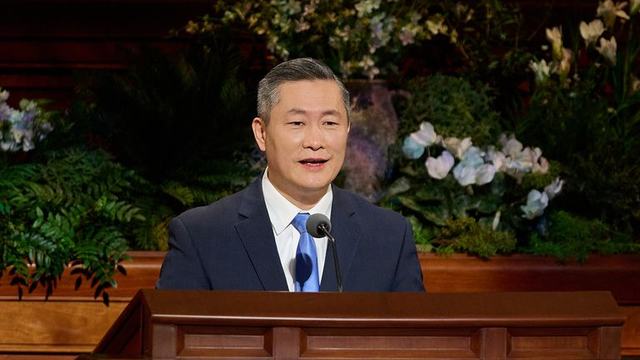
“I Will Give Away All My Sins to Know Thee”
 Open talk in Gospel Library
Contents
Before Reading
Before reading or listening to the talk, consider the following questions:
- What does it mean to truly know God rather than just know about Him?
- Why is repentance essential to gaining eternal life?
- What can I learn from Elder Wu’s conversion story about spiritual truth and personal revelation?
- What does it mean to “give away all my sins” to know God?
- How does Jesus Christ make it possible for me to return to Heavenly Father?
- What am I willing to change in order to follow Jesus Christ more fully?
Topics
Recognize God as your loving Heavenly Father
Elder Wu begins by describing his childhood in a non-Christian family and his experience worshipping many gods in Chinese temples. His life changed when he met missionaries in Bolivia and learned of the true and living God. They taught him that God has a glorified body, that He is our Heavenly Father, that He loves us, and that we are literally His children. This knowledge gave Elder Wu peace, direction, and a new understanding of his identity and destiny.
They taught me that He is a living God, with a glorified body of flesh and bones; that He is my Heavenly Father, that He loves me, and that I am literally His child.
I felt peace in my heart, and somehow I knew that what I was learning was good.
The gospel of Jesus Christ changed my life for the better. It gave me an eternal purpose—to prepare to return to God’s presence with my family.
- What truths did the missionaries teach Elder Wu about God?
- How did learning about Heavenly Father affect Elder Wu’s life?
- What does Elder Wu teach about our relationship to God?
- How has my understanding of Heavenly Father changed my life?
- When have I felt peace confirming truth to my heart?
- How can I strengthen my identity as a child of God in my daily life?
- What can I do to help others understand who God really is?
Choose faith when truth is revealed
Elder Wu emphasizes that spiritual knowledge comes as we choose to believe and act on truth. Even before fully understanding everything, he felt peace and chose baptism. He compares this to the Book of Mormon king who did not remain merely astonished by what he heard but acted in faith. Elder Wu teaches that the power is in us to choose belief, be meek and lowly in heart, and respond to God’s invitations.
Before they invited me to be baptized, I said to my two older sisters, who were already members of the Church, “I’ve already made up my mind. I’m getting baptized!”
If we have a sincere desire, being meek and lowly in heart, we can come to know the true God the Father and gain eternal life through His Son, Jesus Christ, for the power is in us—in choosing to believe and deciding to act accordingly.
The king did not remain stuck in his state of astonishment; he chose to believe and to act.
- What role does personal choice play in coming to know God?
- How did Elder Wu and the king both demonstrate faith through action?
- Why is it not enough to be interested or amazed by gospel truths?
- What gospel truth do I need to act on more decisively?
- When have I chosen to move forward in faith without knowing everything first?
- How can I be more meek and lowly in heart as I seek spiritual knowledge?
- What is one action I can take now to show the Lord I believe Him?
Learn from the king who gave away his sins to know God
Elder Wu uses the account of King Lamoni’s father to illustrate the process of conversion. Aaron taught the king about God, the Fall, and the plan of redemption through Christ. When the king understood the promise of eternal life, he was willing to give up everything, including his kingdom, and ultimately cried out to God, offering to give away all his sins to know Him. This account shows the depth of desire and sacrifice involved in true conversion.
What shall I do that I may have this eternal life of which thou hast spoken?
Behold, … I will give up all that I possess, yea, I will forsake my kingdom, that I may receive this great joy.
O God, Aaron hath told me that there is a God; and if there is a God, and if thou art God, wilt thou make thyself known unto me, and I will give away all my sins to know thee.
The story concludes not only with the king’s conversion but with the conversion of his entire household and several cities in his kingdom.
- What doctrines did Aaron teach the king?
- What did the king say he was willing to give up in order to receive eternal life?
- What does the king’s prayer teach about repentance and desire to know God?
- What were the results of the king’s conversion?
- What might I need to give up in order to know God more fully?
- How sincere is my desire to receive eternal life?
- What does “I will give away all my sins to know thee” mean in my current circumstances?
- How might my conversion bless my family or others around me?
Come unto Christ as the only way to eternal life
Elder Wu teaches clearly that eternal life is to know the only true God and Jesus Christ, and that the only way to the Father is through the Son. Coming unto Christ is not merely intellectual learning; it includes faith, works, conversion, and following the restored gospel. Through Jesus Christ, we can return to Heavenly Father and receive greater happiness, hope, peace, and purpose in this life and the next.
The Savior declared, “And this is life eternal, that they might know thee the only true God, and Jesus Christ, whom thou hast sent.”
How can we come to know the only true God and obtain eternal life? The Savior responds, “I am the way, the truth, and the life: no man cometh unto the Father, but by me.”
The only way we can come to know our Heavenly Father and gain eternal life is by coming unto Christ and following Him.
Coming unto Christ is much more than just learning of Christ. It includes faith and works; it means to be converted to Him and to His restored gospel.
As we do so, we “will have greater happiness, hope, peace, and purpose” in this life.
- How does the Savior define eternal life in this talk?
- Why is Jesus Christ the only way to the Father?
- How does Elder Wu distinguish between learning of Christ and coming unto Christ?
- What blessings come from truly following Jesus Christ?
- In what ways am I trying to come unto Christ more fully?
- Do I treat discipleship as information only, or as true conversion?
- How has following Jesus Christ brought happiness, hope, peace, or purpose into my life?
- What is one way I can follow the Savior more intentionally this week?
Repent and change through the gospel of Jesus Christ
A central message of the talk is that knowing God requires repentance and real change. Elder Wu asks what we are willing to give up or change to truly know God and be saved. He quotes President Dallin H. Oaks, who teaches that the gospel challenges every kind of practice contrary to God’s commandments and is meant to transform us into celestial citizens. Repentance is therefore not optional but essential to conversion.
What are we willing to give up or change to truly know God and be saved at the last day?
President Dallin H. Oaks taught: “The gospel of Jesus Christ challenges us to change. ‘Repent’ is its most frequent message, and repenting means giving up all of our practices—personal, family, ethnic, and national—that are contrary to the commandments of God.”
“The purpose of the gospel is to transform common creatures into celestial citizens, and that requires change.”
We cannot know God without a sincere desire and real intent. We need to have faith in Jesus Christ, continuously repent, and strive to obey the commandments.
- Why is repentance necessary if we want to know God?
- According to President Oaks, what kinds of practices may need to change?
- What does Elder Wu teach about the relationship between repentance and eternal life?
- What does it mean to have sincere desire and real intent?
- What attitudes, habits, or traditions in my life may be contrary to God’s commandments?
- What change is the Lord currently inviting me to make?
- How can I make repentance a continuous and hopeful part of my discipleship?
- What would it look like for the gospel to transform me more completely?
Trust the Savior’s love and redeeming power
Elder Wu testifies that Jesus Christ loves us beyond our comprehension and continually invites us to follow Him. The Savior gave His life, paid the price for our sins, and rose from the dead. Because of Him, we can have hope for a future existence with Heavenly Father. This doctrine provides the foundation for faith, repentance, and the confidence to seek eternal life.
The Savior loves us more than we can comprehend, and He pleads with us again and again, “Come, follow me.”
He gave His life for us, paid the price for our sins, and rose from the dead.
Because of Him, we have “hope for a future existence with Heavenly Father.”
I testify that Jesus Christ is risen. He lives!
- What does Elder Wu teach about the Savior’s love for us?
- What has Jesus Christ done to make eternal life possible?
- Why does the Resurrection matter in Elder Wu’s message?
- How have I felt the Savior’s love in my life?
- How does the Atonement of Jesus Christ give me hope right now?
- What does the Savior’s invitation “Come, follow me” mean for me personally?
- How can I strengthen my testimony that Jesus Christ lives?
Accept the invitation to follow Jesus Christ regardless of your background
Elder Wu closes by teaching that the invitation to come unto Christ is universal. Whether someone is a child or a king, and regardless of background or status, all are invited to choose faith in Jesus Christ and follow Him. Salvation comes only through His name. Elder Wu’s own life story reinforces that the gospel is for every nation, culture, and circumstance.
Whether you are a child or a king, and regardless of your background or your status, I invite you to choose to have faith in Jesus Christ and to decide to follow Him.
For “there is none other name given under heaven save it be this Jesus Christ … whereby man can be saved.”
- Who is invited to come unto Christ according to Elder Wu?
- What does this talk teach about the universality of the gospel?
- Why is Jesus Christ the only name whereby we can be saved?
- How does Elder Wu’s story help me see the gospel’s reach across cultures and backgrounds?
- Do I fully believe that the Savior’s invitation includes me?
- How can I extend Christ’s invitation more lovingly to people of different backgrounds?
- What will I do now to more deliberately choose faith in Jesus Christ?
