
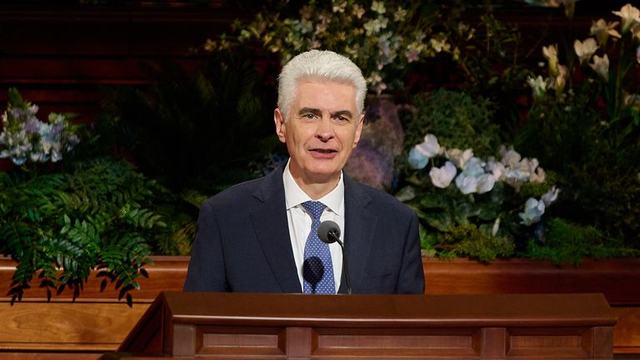
Love All; Love Each
 Open talk in Gospel Library
Contents
Before Reading
Before reading or listening to the talk, consider the following questions:
- What does it mean to say that God loves both all people and each person individually?
- How does Jesus Christ’s Atonement show both the universal and personal nature of divine love?
- In what ways might I be selective or limited in extending love to others?
- How can I better notice and care for individuals rather than seeing only crowds or groups?
- What can Church service and ministering teach me about learning to love people I may not know well at first?
- How does understanding my own infinite worth before God change the way I see myself and others?
- What examples from the Savior’s life show His pattern of loving one soul at a time?
Topics
Recognize that Christlike love grows as we share it
Elder Caussé begins by explaining that his service as an Apostle has increased his capacity to love. He and his wife felt God’s love through the prayers and kindness of Saints around the world, and that experience taught him that Christlike love multiplies when it is given. As disciples express the pure love of Christ, others feel the Lord’s care more deeply, and everyone involved is spiritually enlarged.
“I have learned that I can love even more.”
“Through you, my dear brothers and sisters, we have felt the love of God more intensely than ever before in our lives.”
“And in response, our own ability to love has grown in ways we never expected.”
“Christlike love grows and multiplies as it is shared.”
“When we show others the pure love of Christ, they come to recognize more fully how deeply the Lord cares for them—and, in turn, their own capacity to love is enlarged and strengthened.”
- What did Elder Caussé say he had learned after being ordained to the Quorum of the Twelve Apostles?
- How did the love and prayers of Church members affect Elder Caussé and his wife?
- According to the talk, what happens when we share Christlike love with others?
- How does showing love help others recognize the Lord’s care for them?
- When have I felt my capacity to love increase as I served or cared for someone else?
- Who has helped me feel God’s love through their kindness or prayers?
- What is one way I can intentionally share the pure love of Christ this week?
- How can I become more aware of the way love multiplies in my family, ward, or community?
See God’s nearness and remember your infinite worth
Using the image of stars appearing in a dark sky, Elder Caussé teaches that God may seem distant only until we pause and notice His presence. He connects this insight to David’s psalm, which acknowledges both the vastness of creation and the glory God gives to His children. Though the universe is immense, every person has infinite worth and is personally known, remembered, and loved by Heavenly Father and Jesus Christ.
“Some think He is distant, and life feels heavy as a result.”
“But if they pause to reflect on His presence in their lives, they will find that He is near—quietly present, far closer than they imagine.”
“This is the miracle of God’s relationship with us: The universe is vast beyond comprehension, yet every soul carries infinite worth in the eyes of our Creator.”
“Though we may seem small in a physical sense, each of us is personally known, remembered, and loved by our Eternal Father and by His Son, Jesus Christ.”
- What did Elder Caussé learn from looking at the stars in the night sky?
- How does Psalm 8 help explain humanity’s relationship to God?
- What truth does Elder Caussé teach about the worth of each soul?
- How does recognizing God’s nearness change the way a person experiences life?
- When have I felt that God was near, even in a dark or difficult time?
- What experiences help me remember that I am personally known and loved by God?
- How can I pause more often to notice the Lord’s presence in my daily life?
- How would my outlook change if I more fully believed in the infinite worth of every soul, including my own?
Trust that God loves all and cares for each
Elder Caussé emphasizes the dual reality of divine love: God’s love reaches all His children, and He also gives personal attention to each individual. He illustrates this with the story behind “His Eye Is on the Sparrow,” the Savior’s teaching that the Father notices even sparrows, and Elder Neal A. Maxwell’s statement that God is involved in the details of our lives. He then highlights scriptural patterns showing the words all and each together, teaching that God’s love is both universal and individual.
“How can I be discouraged when my Father watches the sparrows, and I know He loves and cares for me?”
“God is in the details!”
“He knows and loves each and all of mankind!”
“I bear witness of this truth: God and His Son, Jesus Christ, love all—and They love each.”
“The word all speaks to the universal reach of God’s love. The word each (or every) testifies of His power to care for each individual soul.”
- What does the phrase "all and each" teach about the nature of God’s love?
- How does the sparrow imagery illustrate God’s personal care?
- What did Elder Neal A. Maxwell’s statement add to Elder Caussé’s teaching?
- What does the scripture in Mosiah teach about the Lord’s relationship to His creations?
- How have I seen evidence that God is aware of the details of my life?
- Which is easier for me to believe—that God loves everyone or that He loves me personally? Why?
- How can I strengthen my testimony that God notices and cares for individuals one by one?
- What can I record in my journal that shows the Lord’s personal attention in my life?
See the Atonement of Jesus Christ as universal and personal
Elder Caussé teaches that the Savior’s Atonement perfectly expresses the truth that God loves all and each. Its blessings are offered to all of God’s children without exception, but the Atonement is also intimate and individualized. It meets each person’s needs and is applied one soul at a time. This helps disciples understand both the scope and the tenderness of Christ’s redeeming work.
“This dual reality is most clearly manifested in Jesus Christ’s Atonement.”
“All sons and daughters of God, without exception, will receive a full opportunity to access its supernal blessings.”
“Yet it is a remarkably intimate gift, tailored to each individual’s needs and applied to one person at a time.”
- How does Elder Caussé describe the Atonement as both universal and personal?
- What does he teach about who can access the blessings of the Atonement?
- What does it mean that the Atonement is "tailored to each individual’s needs"?
- Why is it important to understand both dimensions of the Savior’s redeeming love?
- How have I experienced the Atonement of Jesus Christ in a personal way?
- What need in my life do I want to bring more fully to the Savior?
- How does knowing that Christ’s Atonement is for all people influence the way I view others?
- What can I do to help someone else feel invited to come unto Christ and receive His healing power?
Extend Christlike love to all people without excluding anyone
Turning to the first half of his invitation, Elder Caussé asks whether disciples are selective in deciding who deserves love. He teaches that the Lord sees all people as neighbors and that there are no strangers or outcasts. Quoting Joseph Smith, he shows that a person filled with God’s love seeks to bless the whole human race. He also explains that true discipleship is not a closed circle of familiar friends but a diverse, Christ-centered community.
“As disciples of Jesus Christ, we bear witness of Him whenever we share His love with all around us—and help it take root in each person we meet.”
“First, loving all.”
“Are we selective, or exclusive, in determining who deserves our love, or do we extend Christlike love to all with whom we associate?”
“To Him, all people upon this earth are our neighbors—there are no strangers or outcasts, only brothers and sisters.”
“A man filled with the love of God, is not content with blessing his family alone, but ranges through the whole world, anxious to bless the whole human race.”
“Discipleship was never meant to be a comfortable circle of familiar friends focused on their own interests.”
“Rather, our congregations are a beautiful mosaic—enriched by diverse backgrounds, cultures, and experiences—yet united in devotion to Christ.”
- What question does Elder Caussé ask about being selective in our love?
- How does the Lord define our neighbors according to this talk?
- What did Joseph Smith teach about a person filled with the love of God?
- How does Elder Caussé describe what discipleship and congregations should look like?
- Are there people or groups I find it harder to love, include, or understand?
- How can I widen my circle of concern beyond my family and close friends?
- What can I do to help my ward or branch feel more like a Christ-centered mosaic of belonging?
- How can I show greater love to someone who may feel like a stranger or outsider?
Let service widen your circle of love
Elder Caussé explains that service in the Church helps disciples love more broadly. Through callings, ministering, missionary work, and association with those in need, members meet people from many backgrounds. Rather than serving only those they already love, they often come to love people because they serve them. Service becomes a means by which the Lord expands the heart.
“Service in the Church expands our circle of love and widens our associations.”
“We meet people from all walks of life—new friends, brothers and sisters in need, recent converts, and missionary or ministering companions.”
“We don’t serve only those we already love; rather, we come to love people as we serve them.”
- How does Church service affect our capacity to love others?
- What kinds of people does Elder Caussé say we encounter through service?
- What important principle does he teach about the relationship between service and love?
- Why can service be a remedy for narrowness or exclusiveness?
- How has serving in the Church helped me love someone I did not know well at first?
- Who in my current sphere of service needs more of my attention and love?
- How can I approach my calling or ministering with a greater desire to love rather than simply complete tasks?
- What opportunity to serve could help me grow in Christlike love right now?
Notice and care for one person at a time
In the second half of his invitation, Elder Caussé teaches that disciples must love each person individually. He contrasts superficial interaction with genuine care and points to the Savior’s example of giving full attention to individuals even when surrounded by crowds. In the Church, there should be no anonymity; covenant belonging means that people are known, accounted for, and cared for personally.
“Second, loving each.”
“Do we interact superficially with others, or do we genuinely seek to know and care for each person we meet?”
“Though He was often surrounded by multitudes, the Savior always gave His full attention to the one—one sheep, one leper, one Samaritan woman, one little child, one soul at a time.”
“In His love, no one was ever lost in the crowd.”
“Likewise, in the Church of Jesus Christ, there should be no anonymity.”
“As we enter the fold of Christ through sacred covenants, we are known, accounted for, and cared for—one person at a time.”
- What distinction does Elder Caussé make between superficial interaction and true Christlike care?
- What examples does he give of the Savior focusing on individuals?
- What does he mean when he says there should be no anonymity in the Church?
- How do sacred covenants relate to being known and cared for?
- Do I tend to notice crowds more than individuals? In what situations?
- Who in my ward, family, class, or neighborhood may be feeling anonymous?
- What can I do this week to know and care for one person more personally?
- How can I become more like the Savior in giving full attention to the one?
Look beyond appearances and see divine potential
Elder Caussé shares that people who may first seem insignificant often become remarkable and uplifting when truly known. He uses the story of Beauty and the Beast to illustrate the power of seeing beyond outward appearance and difficult behavior. Like Belle, disciples can learn to recognize a wounded soul beneath the facade. As they extend Christlike love, their eyes are opened to divine potential and to what people can become through the Savior’s grace.
“There is wonderful depth—so much to love—in every soul.”
“Rather than judging him by his appearance, Belle learns to see beyond it.”
“She comes to understand that the Beast’s bitterness, rude manners, and sudden anger are only a facade, hiding a wounded soul yearning to love and be loved.”
“Through Belle’s patience, personal kindness, and loving care, an astonishing transformation begins—one that starts deep within the Beast’s soul and ultimately changes even his outward appearance.”
“In a similar way, as we extend Christlike love to each person we serve, our eyes are opened to their divine potential.”
“We begin to see them as the Lord sees them—mortal souls with the capacity to become exalted beings through the Savior’s restoring power and grace.”
- What has Elder Caussé learned about people who may at first seem insignificant?
- How does the Beauty and the Beast story illustrate a gospel principle?
- What can difficult behavior sometimes hide, according to the talk?
- How does Christlike love change the way we see other people?
- Is there someone I have judged too quickly based on appearance, personality, or past behavior?
- How can I practice seeing others as the Lord sees them?
- What experiences have helped me discover unexpected goodness or depth in another person?
- How might patience and kindness help someone around me begin to change?
Help souls come to the Savior and be transformed
Elder Caussé concludes that caring for each soul does more than provide comfort; it helps connect people to Jesus Christ. Through that connection, they can be healed and transformed by His atoning blood. Those who love and serve in this way are also changed: they become more like the Savior and are filled with joy. The talk ends with his witness that Jesus Christ loves us more than we can imagine and with an invitation to love all and each as He does.
“As we care for each soul, we help connect them to the Savior, inviting them to be healed and transformed through His atoning blood.”
“In return, our own lives are blessed—we become more like the Savior and are filled with great joy.”
“My dear brothers and sisters, as one of His special witnesses, I testify that our Savior, Jesus Christ, loves us more than we can ever imagine.”
“For His eye is on the sparrow, and I know He watches me.”
“May we follow the Lord’s perfect example and learn to love all and to love each, just as He does.”
- How does caring for individuals help connect them to the Savior?
- What blessings come to those who love and serve others in Christlike ways?
- What testimony does Elder Caussé bear about Jesus Christ at the end of the talk?
- What final invitation does he extend to the Saints?
- How can my love for others more clearly point them to Jesus Christ rather than just to me?
- Who in my life may need healing and transformation through the Savior right now?
- In what ways has serving others helped me become more like Christ?
- What specific step will I take to better love all and love each?
