
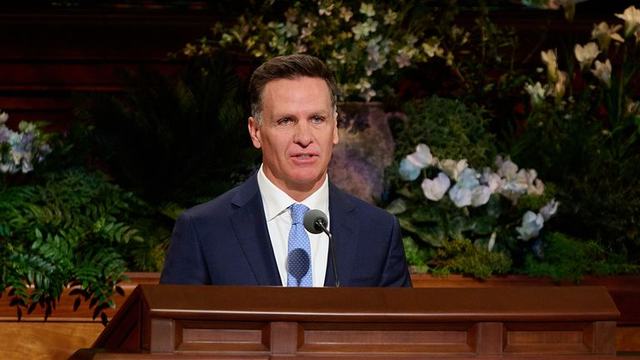
Jesus Christ Is the Way
 Open talk in Gospel Library
Contents
Before Reading
Before reading or listening to the talk, consider the following questions:
- What does it mean that Jesus Christ is not only our guide but also the way?
- How do covenants bind us to the Savior and bring power into our lives?
- Why is the covenant path the only path that leads to eternal life?
- What should we do when discipleship feels difficult or when doubts arise?
- How are following Jesus Christ and following His prophet connected?
- Why does the Lord continue to guide His children through prophets and apostles?
Topics
Recognize your need for a divine guide
Elder Holmes compares life to a steep and demanding mountain marathon. Although life includes beauty and joy, it also includes trials and obstacles that cannot be overcome by human strength alone. Like the blind runner who needed a guide to finish the race, every person needs help from a power greater than self. The talk teaches that our Father in Heaven lovingly provides that help.
Like that marathon, our journey through life has moments of beauty and joy but is no walk in the park.
We all want to cross the heavenly finish line and gain eternal life.
We all face trials. Without a power greater than our own, no one successfully finishes this race.
At some point, we are all like the blind runner. We all need a guide.
Our Father in Heaven, in His perfect love, has provided us with many helps to guide our journey.
- How does the marathon story illustrate the challenges of mortality?
- Why does Elder Holmes say that no one can successfully finish life’s race alone?
- What does the blind runner teach about our dependence on divine help?
- What does this topic teach about Heavenly Father’s love for His children?
- When have I felt that life was too steep or difficult to navigate alone?
- How have I seen the Lord provide help or guidance in my life?
- In what ways do I sometimes rely too much on my own strength instead of seeking the Savior?
- What can I do this week to more consciously seek divine guidance?
Trust Jesus Christ as the only way to the Father
The talk centers on the truth that Jesus Christ, through His Atonement, has done everything essential for our journey through mortality. Because He lived perfectly, suffered for sin and sorrow, and overcame death, He alone can bring us back to the Father. Elder Holmes emphasizes that the Savior is not merely one who points the way; He Himself is the way, the truth, and the life.
As President Dallin H. Oaks taught, the strongest help God has given us is a Savior, Jesus Christ.
Through His Atonement, Jesus Christ "has done everything that is essential for our journey through mortality toward the destiny outlined in the plan of our Heavenly Father."
Because He lived a perfect life, because He bore every sin and every sorrow, because He broke the bands of death, Jesus Christ alone can stand before the world and declare, "I am the way, the truth, and the life: no man cometh unto the Father, but by me."
In that simple declaration, the Savior taught that He is not only our guide; He is the path.
His way is the only path that leads to eternal life.
- What reasons does Elder Holmes give for why Jesus Christ alone can bring us to the Father?
- What is the difference between saying Christ is our guide and saying He is the path?
- How does the Atonement make Christ the strongest help God has given us?
- Why is it important to understand that there is only one path to eternal life?
- How has my testimony of Jesus Christ as the only way grown over time?
- What experiences have taught me that the Savior can do for me what I cannot do for myself?
- Are there any false substitutes I am tempted to trust instead of fully trusting Christ?
- How can I center my daily worship more fully on the Savior and His Atonement?
Walk the covenant path with Jesus Christ
Elder Holmes teaches that the Savior invites us to walk with Him on the covenant path. We enter that path through faith in Jesus Christ, repentance, and the ordinances of the gospel, and we remain on it by enduring to the end. These ordinances are not optional; they are essential for entering the kingdom of God. The covenant path is presented as the one path leading to our celestial destination.
Our Savior invites us to walk with Him.
His way is the covenant path, the one path that leads to our celestial finish line.
We choose to walk the covenant path by exercising faith in Jesus Christ unto repentance, receiving the ordinances of His gospel, and enduring to the end.
These ordinances are essential.
As Jesus taught Nicodemus, "Except a man be born of water and of the Spirit, he cannot enter into the kingdom of God."
- What does Elder Holmes identify as the covenant path?
- How do we choose to walk the covenant path?
- Why are ordinances essential rather than optional?
- What does the Savior’s teaching to Nicodemus add to our understanding of entering the kingdom of God?
- How am I currently progressing on the covenant path?
- Which covenant or ordinance has most strengthened my relationship with Jesus Christ?
- What does enduring to the end look like in my present circumstances?
- What is one step I can take to honor my covenants more faithfully?
Stay bound to the Savior through faithful covenant living
Using the image of the tether between the blind runner and his guide, Elder Holmes explains that covenants bind us to Jesus Christ. Through this covenant connection, we receive perspective, hope, power, peace, and joy. The Savior will never sever that tie; however, we can turn away. The talk stresses that covenant blessings come through ongoing faithfulness, especially during the steep stretches of life.
Just as the band tethered the blind runner to his guide, covenants bind us to our guide—Jesus Christ.
The covenant connection we have with our Heavenly Father and His resurrected and living Son is the supernal source of perspective, hope, power, peace, and enduring joy.
Once we bind ourselves to our Savior through covenant, only we can sever the tie. Jesus never will.
As we remain tightly bound to Him, He is bound to us.
We can expect His power to bless us with strength and joy even when we are experiencing a steep stretch of life.
But if we turn away, we have no such promise.
Covenant blessings flow from ongoing faithfulness, not merely from past participation.
- How do covenants function like the tether between the blind runner and his guide?
- What blessings does Elder Holmes say come through covenant connection?
- Who can sever the covenant tie between us and the Savior?
- Why does Elder Holmes emphasize ongoing faithfulness rather than past participation?
- What helps me feel more tightly bound to the Savior?
- Have there been times when covenant faithfulness gave me strength during a steep stretch of life?
- Are there ways I have become casual about covenants instead of living them actively?
- What can I do to renew my commitment to faithful covenant living?
Remain with Christ when discipleship feels hard
Elder Holmes points to Peter’s response when many disciples turned away from Jesus. This moment illustrates the need to stay with Christ when doubts arise, discipleship becomes demanding, or others choose to leave. Peter’s testimony shows that there is nowhere else to go for eternal life. The talk invites readers to remain bound to Christ in moments of testing.
When our path gets hard—and it will—we can remember the Apostle Peter.
When the road of discipleship became steep and many "walked no more" with Jesus, He turned to the Twelve and asked, "Will ye also go away?"
"Lord, to whom shall we go? thou hast the words of eternal life.
And we believe and are sure that thou art that Christ, the Son of the living God.
When we have doubts, when discipleship feels demanding, when others turn back, that is the moment to stay bound to Christ just as Peter did.
There is nowhere else to go; only Christ has the words of eternal life.
- What situation from Peter’s life does Elder Holmes use to teach this principle?
- How did Peter respond when Jesus asked, "Will ye also go away?"
- What does Peter’s answer teach about loyalty to Christ?
- According to Elder Holmes, what should we do when doubts or difficulties arise?
- How do I usually respond when discipleship feels demanding?
- What helps me stay close to Christ during times of doubt or discouragement?
- Have I had an experience when I knew there was nowhere else to go but to the Savior?
- What can I do now to strengthen my commitment before future tests come?
Follow the Savior by following His prophet
A major teaching of the talk is that walking with Jesus Christ includes following His prophet. The Savior calls prophets, speaks through them, and governs His Church by them. Prophetic witness is how God reveals His Son to His children in every dispensation. Elder Holmes warns against the idea that someone can knowingly reject prophets while still fully accepting Christ, because the Savior Himself taught otherwise.
As we walk with our Savior along the covenant path, we come to know an essential truth: To walk with Jesus is to follow His prophet.
The Savior Himself calls prophets, speaks through them, and governs His Church by them.
None of us could know the true and living Christ without prophetic witness.
From Adam to Noah, Moses to Peter, and Joseph Smith to our day, God has chosen to reveal His Son to His children through a prophet.
Some say, "I don’t need a prophet or a church to follow Jesus."
But Jesus Himself said to His chosen Apostles, "He that heareth you heareth me; and he that despiseth you despiseth me."
To knowingly reject His prophets is, by His own definition, to reject Him.
- What does Elder Holmes say is an essential truth about walking with Jesus?
- How does the Savior work through prophets according to this talk?
- Why is prophetic witness necessary to know the true and living Christ?
- What does Luke 10:16 teach about receiving or rejecting the Lord’s servants?
- How has following the prophet helped me follow Jesus Christ more closely?
- What prophetic counsel have I felt prompted to act on more fully?
- Do I ever separate my devotion to Jesus from my willingness to follow His servants?
- How can I show greater trust in living prophets and apostles?
Rely on apostles and prophets to stay anchored in truth
Elder Holmes teaches that without apostles and prophets, people tend to create a version of Christ and doctrine that fits their own preferences. This leads to doctrinal confusion, weakening standards, and loss of unity. The Church is built on the foundation of apostles and prophets, with Jesus Christ as the chief cornerstone, so that the Saints can be established and protected from spiritual instability and false doctrine.
The Lord warned of a time when "every man walketh in his own way, and after the image of his own god."
Without apostles and prophets, our perception of Christ gradually becomes whatever we want Him to be.
Our understanding of doctrine shifts. Our commitment to standards erodes. Unity dissolves.
That is why Paul taught that the Church is "built upon the foundation of the apostles and prophets, Jesus Christ himself being the chief corner stone."
Not so that we would be controlled but so that we would be established, "that we henceforth be no more children, tossed to and fro, and carried about with every wind of doctrine."
Our Savior promised, "If my people will hearken unto my voice, and unto the voice of my servants whom I have appointed to lead my people, … they shall not be moved out of their place."
- What dangers does Elder Holmes describe when people reject apostles and prophets?
- How can a person’s perception of Christ become distorted without prophetic guidance?
- What does it mean that the Church is built on apostles and prophets with Christ as the chief cornerstone?
- How do prophets help keep the Saints from being "tossed to and fro"?
- What promise does the Lord give to those who hearken to His voice and the voice of His appointed servants?
- How have prophetic teachings helped me stay anchored in truth?
- Where do I see pressures in the world to redefine Christ, doctrine, or standards?
- How can I better study and apply the words of living apostles and prophets?
- What can I do to build greater spiritual stability in my home and personal life?
Come home by binding yourself to Christ and His appointed servants
Elder Holmes concludes by testifying that Heavenly Father wants all His children to return home and that Jesus Christ is the only way back. Because the Savior bore the full weight of our salvation, we do not face life’s mountains alone. Safety and ultimate return come as we bind ourselves to Christ through covenants and follow His living prophet. This closing testimony gathers the talk’s main teachings into a clear invitation.
Brothers and sisters, our Father in Heaven desires all His children to come home.
His Beloved Son, Jesus Christ, is the only way back.
I testify that because Jesus Christ climbed the steepest mountain of all as He bore the weight of our salvation, we never have to face our mountains alone.
As we bind ourselves to Him through covenant and follow His living prophet, we walk the one path that leads us safely home.
- What does Elder Holmes testify is Heavenly Father’s desire for His children?
- Why does he say Jesus Christ is the only way back?
- How does the image of Christ climbing "the steepest mountain of all" deepen your understanding of the Atonement?
- What two actions does Elder Holmes emphasize as leading us safely home?
- What does "coming home" to Heavenly Father mean to me personally?
- How has the Savior helped me carry mountains I could not climb alone?
- What covenant action do I feel prompted to strengthen right now?
- How can I more faithfully follow the living prophet as part of my discipleship?
