
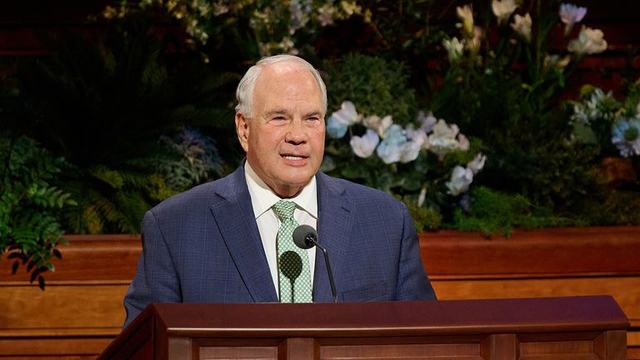
He Is Risen
 Open talk in Gospel Library
Contents
Before Reading
Before reading or listening to the talk, consider the following questions:
- What does the Resurrection of Jesus Christ mean for every child of God?
- Why is the Resurrection a central doctrine of The Church of Jesus Christ of Latter-day Saints?
- How do scriptural witnesses from both the Bible and the Book of Mormon strengthen faith in the risen Savior?
- What do the Savior’s hands teach about His character, His ministry, and His promises?
- How does the Resurrection bring hope to families who grieve the loss of loved ones?
- What does Elder Rasband invite us to do in response to the truth that Christ is risen?
Topics
Center faith on the risen Jesus Christ
Elder Rasband teaches that the Resurrection and Atonement of Jesus Christ are the most sacred and far-reaching events in human history. He emphasizes that Jesus Christ and His Resurrection are at the core of the doctrine of the restored Church. The testimony that Christ died, was buried, and rose again is foundational to true religion and to apostolic witness.
His Resurrection and His Atonement are the most powerful, far-reaching, and sacred events in all human history.
Jesus Christ and His Resurrection are at the very core of the doctrine of The Church of Jesus Christ of Latter-day Saints.
The fundamental principles of our religion are the testimony of the Apostles and Prophets, concerning Jesus Christ, that He died, was buried, and rose again the third day, and ascended into heaven.
As an Apostle called of Jesus Christ, I bear my testimony to all the world of that truth.
- According to Elder Rasband, why are the Resurrection and Atonement of Jesus Christ so significant?
- What does Elder Rasband say is at the very core of the doctrine of the Church?
- How does Joseph Smith’s statement define the fundamental principles of our religion?
- Why does apostolic testimony matter in understanding the Resurrection?
- How central is the risen Savior in my personal worship and study?
- What can I do to make my testimony of Jesus Christ more foundational in my daily life?
- How can I more intentionally remember the Savior’s death and Resurrection this Easter season and throughout the year?
- When have I felt my faith strengthened by the testimony of prophets and apostles of Jesus Christ?
Recognize Jesus Christ as the divine Son of God and Savior of the world
The talk identifies Jesus Christ across dispensations and scripture as the God of the Old Testament, the light of the New Testament, and the Messiah and Savior testified of in the Book of Mormon and latter-day revelation. Elder Rasband stresses that Jesus is far more than a great mortal teacher; He is the Only Begotten Son of the Father, whose divine power made His Resurrection possible.
Jesus Christ is "the God of Abraham, of Isaac, and of Jacob," "the Almighty God" of the Old Testament, "the light of the world" of the New Testament, "the Messiah" and "Savior of the world" of the Book of Mormon and other latter-day revelation.
He came, was crucified, and rose again.
Jesus Christ is more than a mortal first laid in a manger, more than a friend, teacher, rabbi, minister, or prophet.
He is the Only Begotten Son of the Father.
- How does Elder Rasband describe Jesus Christ’s identity across different dispensations of scripture?
- What does it mean that Jesus Christ is the Only Begotten Son of the Father?
- Why is it important to understand that Jesus is more than a moral teacher or prophet?
- How does Christ’s divine identity relate to His power over death?
- How has my understanding of who Jesus Christ is deepened through scripture study?
- What titles of the Savior are especially meaningful to me right now, and why?
- How can I show in my prayers, worship, and choices that I truly believe Jesus Christ is the Son of God?
- What can I do to strengthen my testimony of the Savior’s divine nature?
Rejoice that the Resurrection overcomes physical death for all
Elder Rasband teaches that when Jesus Christ rose from the tomb, He broke the bands of death brought by the Fall. Because of His Resurrection, all of God’s children will be resurrected. This universal gift extends to both the just and the unjust, and ultimately all will acknowledge Jesus Christ as Lord.
After three days in a borrowed tomb, Jesus Christ broke the bands of death imposed by the Fall.
With His Resurrection, He secured salvation from physical death for us, all of God’s children throughout the ages.
That includes the just, who herald Him as the Son of God, and the unjust, who will someday recognize Him as "the King of kings,"
"Every knee shall bow, and every tongue confess" that Jesus is the Christ.
- What did Jesus Christ accomplish by rising from the tomb?
- Who will receive resurrection because of Jesus Christ?
- How does Elder Rasband connect the Resurrection to the Fall?
- What does it mean that every knee shall bow and every tongue confess that Jesus is the Christ?
- How does the doctrine of universal resurrection affect the way I view death?
- In what ways does the Resurrection give me hope for the future?
- How can I share the hope of the Resurrection with someone who is grieving or fearful?
- What feelings arise in me when I think about Christ’s victory over death?
Strengthen hope through witnesses of the empty tomb and the living Lord
The talk recounts the witness of faithful women at the Garden Tomb and the angelic declaration, "He is not here, but is risen." Elder Rasband explains that these words have inspired faith, gratitude, and worship for centuries. He also includes President Dallin H. Oaks’s teaching that the Resurrection gives meaning, motivation, and hope.
When Mary and other faithful women approached the Garden Tomb to care for the body of their Lord, they found two angels, who announced, "He is not here, but is risen."
Those glorious words, "He is risen," have sparked religious ceremony, gratitude, faith in Jesus Christ and His promises for centuries.
The resurrection is a pillar of our faith. It adds meaning to our doctrine, motivation to our behavior, and hope for our future.
- What message did the angels give at the tomb?
- How have the words "He is risen" influenced Christian faith and worship?
- According to President Oaks, what does the Resurrection add to our doctrine, behavior, and future?
- Why are scriptural witnesses of the Resurrection important to disciples today?
- How do I respond personally to the declaration "He is risen"?
- What can I do to let the reality of the Resurrection shape my behavior and choices?
- How has the Resurrection brought hope into my life?
- How can I better celebrate and remember the risen Lord in my home and worship?
Trust the reality of the resurrected body
Elder Rasband teaches that Christ’s Resurrection was literal and physical. By His divine power, His body and spirit were reunited. He appeared to Mary, to His Apostles, to disciples on the road to Emmaus, and to many others. These appearances testify that the resurrected Savior is real, tangible, and living.
And by divine design, His Resurrection by His own godly power reunited His body and His spirit.
What a majestic and monumental event in Father in Heaven’s eternal plan.
The resurrected Jesus Christ first appeared to Mary and with tenderness spoke her name.
He appeared to His Apostles, saying, "Handle me, and see; for a spirit hath not flesh and bones, as ye see me have."
The risen Lord, "Endless and Eternal," appeared to hundreds in the Holy Land.
- What does Elder Rasband teach about the nature of Christ’s resurrected body?
- Why is it important that Jesus invited His Apostles to touch Him?
- What do Christ’s post-Resurrection appearances teach us about the reality of the Resurrection?
- How does the literal Resurrection fit into Heavenly Father’s plan?
- How does knowing that the Resurrection is literal strengthen my faith?
- What scriptural account of the resurrected Savior speaks most powerfully to me, and why?
- How can I deepen my gratitude for the Savior’s role in the Father’s plan?
- What doubts or questions can I bring to the Lord as I seek a stronger witness of His living reality?
Receive the Book of Mormon’s witness of the risen Christ
Elder Rasband highlights the appearance of the resurrected Savior at the temple in Bountiful as a powerful witness of His Resurrection. The people heard the Father’s voice, saw the Savior descend from heaven, and heard Him identify Himself as Jesus Christ. This sacred event confirms that the Book of Mormon testifies of the living Redeemer.
Accounts in the Book of Mormon: Another Testament of Jesus Christ also bear witness of Him resurrected.
A gathering at a temple in the New World, in the land Bountiful, heard a voice from the heavens saying, "Behold my Beloved Son, in whom I am well pleased, in whom I have glorified my name—hear ye him."
Then they beheld "a Man descending out of heaven; and he was clothed in a white robe; and he came down and stood in the midst of them."
He said, "Behold, I am Jesus Christ, whom the prophets testified shall come into the world."
- How does the Book of Mormon testify of the resurrected Jesus Christ?
- What happened at the temple in Bountiful?
- Why is the Father’s command "hear ye him" significant?
- How does Christ’s declaration in 3 Nephi strengthen testimony of His Resurrection?
- How has the Book of Mormon strengthened my witness of the living Christ?
- What can I do to study 3 Nephi more deeply as a witness of the Resurrection?
- How am I responding to the Father’s invitation to "hear ye him"?
- What experiences have helped me know that the Book of Mormon truly testifies of Jesus Christ?
See the Savior’s outstretched hand in His ministry and in your life
A central image in the talk is the Savior stretching forth His hand. Elder Rasband connects this image to many moments in Christ’s ministry: rescuing Peter, healing the crippled man, washing the disciples’ feet, instituting the sacrament, and promising through Isaiah to uphold His people. The Savior’s hand symbolizes His power, mercy, service, and personal care for each of us.
I love the image of Him stretching forth His hand.
That outstretched hand was well known in His earthly ministry.
His hand rescued Peter as he began to sink in the choppy waves of the Sea of Galilee.
His hand motioned for the crippled man at the Pool of Bethesda to "rise … and walk."
His hands washed the feet of His disciples, and His hands "took bread, and gave thanks, and brake it," initiating the sacrament "in remembrance of" Him.
He promised the prophet Isaiah, "Fear thou not; for I am with thee: … for I am thy God: … I will uphold thee with the right hand of my righteousness." That promise is for all of us.
- What does the image of the Savior’s outstretched hand represent in this talk?
- What examples does Elder Rasband give of Christ using His hands in ministry?
- How does Isaiah’s promise relate to disciples today?
- What do these examples teach about the Savior’s character?
- When have I felt the Savior reaching out to help or uphold me?
- In what current challenge do I need to trust His outstretched hand?
- How can I act as the Savior’s hands in serving someone else?
- What does the sacrament teach me about remembering the Savior’s loving ministry?
Come unto Christ and gain a sure witness of Him
Elder Rasband recounts the Savior’s invitation to the Nephites to come forward, feel the wounds in His body, and know for themselves that He is the God of Israel and the Savior slain for the sins of the world. The people responded individually and gained a sure witness. The talk teaches that Jesus Christ invites personal, direct faith and testimony.
He stood before them resurrected and said, "Arise and come forth unto me, that ye may thrust your hands into my side, and also that ye may feel the prints of the nails in my hands and in my feet, that ye may know that I am the God of Israel, and the God of the whole earth, and have been slain for the sins of the world."
The multitude of 2,500 souls "went forth, … and did see with their eyes and did feel with their hands, and did know of a surety and did bear record, that it was he."
- What invitation did the resurrected Savior give to the people at Bountiful?
- What did the people come to know through this experience?
- Why is the phrase "know of a surety" important?
- What does this account teach about gaining personal testimony of Jesus Christ?
- How am I accepting the Savior’s invitation to come unto Him?
- What helps me move from simply knowing about Christ to knowing Him with greater certainty?
- When have I felt spiritual assurance that Jesus Christ is real and living?
- How can I bear record of Him more faithfully?
Trust the Savior’s love for children and the afflicted
The talk highlights the resurrected Lord’s tenderness as He blessed little children one by one. Elder Rasband then connects this compassion to his grandson Paxton, who had severe disabilities. He testifies that the Savior’s love extends fully to those with afflictions and special needs, and that such souls can bring deep joy, trust in God, and spiritual refinement to families.
He invited "their little children" to be brought to Him and took them "one by one, and blessed them, and prayed unto the Father for them."
This scene of Him resurrected, reaching out with hands once nailed to a cross, touches me deeply.
His parents would have carried him to the Savior when He called for all "afflicted in any manner" to come that He might heal them.
Paxton lived three treasured years.
But little Paxton’s hands reached out to ours and to our Savior with love and affection.
He brought immense joy to our family.
Associating with Paxton, our whole family gained an increased, deep, and abiding trust in the Lord.
- How does the Savior minister to children in the Book of Mormon account?
- What does Elder Rasband’s experience with Paxton teach about the worth of souls with special needs?
- How did Paxton bless his family spiritually?
- What does this part of the talk reveal about the Savior’s compassion for the afflicted?
- How can I better see individuals with afflictions or special needs as precious in the Lord’s sight?
- What have I learned from someone whose life has refined my faith?
- How can I minister more tenderly to children, caregivers, or families carrying heavy burdens?
- When has the Lord increased my trust in Him through a difficult family experience?
Find peace and joy in promised resurrection and reunion
Elder Rasband bears witness that because Jesus lives, loved ones who die will live again in perfect form. He applies this doctrine personally to Paxton and then broadly to all who have lived. The Resurrection promises not only restored bodies but joyful reunions with family and eternal life in the presence of the Father and the Son. This doctrine brings peace in the face of grief.
Then God reached out and took him home.
The words of the psalmist say it all: "Weeping may endure for a night, but joy cometh in the morning."
That joy is, as the Savior said, "Because I live, ye shall live also."
I know Paxton’s tender "spirit and [his] body shall be reunited again in … perfect form."
By the power of the Atonement of Jesus Christ, his joy will be in not only a resurrected body but one that is resurrected whole and perfect.
All who live or ever have lived who come unto Christ and live His gospel will feel joy beyond any earthly expression as we reunite, resurrected, with our Father in Heaven and Jesus Christ and with our parents, grandparents, siblings, aunts, uncles, cousins, and ancestors.
May we be at peace, brothers and sisters, for the Lord has promised, "Where I am, there ye may be also."
- What hope does Elder Rasband offer to those who mourn?
- What does it mean to be resurrected in perfect form?
- How does the Resurrection make eternal family reunion possible?
- What conditions does Elder Rasband mention for experiencing joy in reunion with God and loved ones?
- How does the promise of resurrection bring peace to my own grief or fears?
- Who do I long to see again, and how does this doctrine strengthen me?
- What can I do now to come unto Christ and live His gospel more fully?
- How can I share the peace of eternal reunion with someone who is mourning?
Testify of the risen Lord through faithful living
Elder Rasband closes by inviting disciples to believe the Lord’s promises, remember that they are engraved upon His hands, and testify of Him by the way they live and what they love. The truth that Christ is risen should lead to rejoicing, reverence, gratitude, and public witness. The doctrine is not only to be believed but also lived.
May we believe the Lord’s words in Isaiah: "I have graven thee upon the palms of my hands."
May we testify of Him by the way we live and what we love.
May we feel to our very souls these stirring words: "He is risen! He is risen! Tell it out with joyful voice" and "let the whole wide earth rejoice."
As a special witness of the name of Jesus Christ—the King of glory, the Messiah triumphant, the Bright and Morning Star, and on this Easter morn, the Resurrection and the Life—I bear my witness of Him in reverence and in gratitude
- How does Elder Rasband invite us to testify of Jesus Christ?
- What does it mean to be graven upon the palms of the Savior’s hands?
- Why should the truth of the Resurrection affect the way we live and what we love?
- How does Elder Rasband model apostolic witness in his conclusion?
- What changes in my life would show more clearly that I believe Jesus Christ is risen?
- What do my choices and loves currently testify about my discipleship?
- How can I speak more openly and joyfully of the Savior with others?
- What personal witness of the risen Christ can I record in my journal today?
