
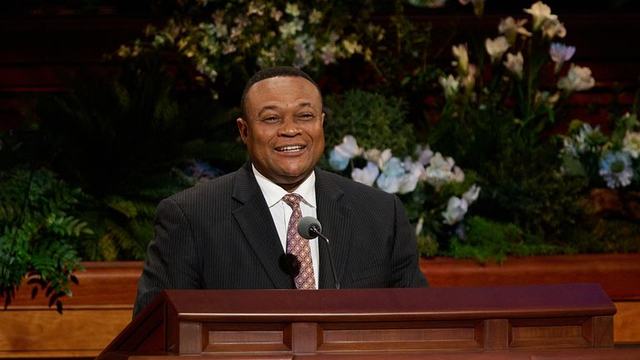
The Joy of a Covenant Relationship with God
 Open talk in Gospel Library
Contents
Before Reading
Before reading or listening to the talk, consider the following questions:
- What does the Resurrection of Jesus Christ make possible for me personally?
- How does making and keeping covenants deepen my relationship with Heavenly Father?
- What can I learn from Elder Mutombo’s experience with grief, loss, and faith?
- How can covenant faithfulness help me endure my own dark days?
- What traditions, attitudes, or worldly values might compete with wholehearted discipleship?
- How does Jesus Christ help His disciples when prayers are not answered in the way they hope?
- What does it mean to follow Christ as a continuous commitment and way of life?
Topics
Rejoice in the risen Christ
Elder Mutombo begins with the Easter acclamation, emphasizing that Christ’s Resurrection is not merely a greeting but a declaration of eternal hope. Through the Atonement and Resurrection of Jesus Christ, all people can find comfort, peace, and reassurance. Without Him, there would be no hope of returning to Heavenly Father and no victory over death. The Savior’s invitation to come unto Him is open to everyone, regardless of present circumstances.
“Christ is risen.”
“Truly, He is risen.”
“This is more than just a simple greeting or declaration. It is a celebration of the divine gift offered by Heavenly Father to us.”
“The understanding of what Jesus Christ offers through His Atonement and Resurrection brings comfort, peace, and reassurance to all of us.”
“Without Jesus Christ’s infinite Atonement, no one would have hope to return to our Heavenly Father. And without His Resurrection, death would be the end.”
“‘Come unto me’ is a divine invitation which means wherever you are now or whatever you are going through in your life, you can feel God’s infinite love manifested through His Son, Jesus Christ.”
- Why does Elder Mutombo say the Easter greeting is more than a simple declaration?
- What blessings does the Atonement and Resurrection of Jesus Christ bring to all people?
- What would be impossible without the Savior’s infinite Atonement and Resurrection?
- What does the Savior’s invitation to “come unto me” teach about His love and accessibility?
- How has the reality of the Resurrection brought me peace or hope?
- When have I felt the Savior inviting me to come unto Him?
- What can I do this week to more intentionally center my worship on the risen Christ?
- How would I explain to someone why Easter matters to me personally?
Deepen your relationship with God through covenants
The talk teaches that Heavenly Father has special love for those who enter into covenant with Him through baptism, and that this love deepens as additional covenants are made and faithfully kept in the temple. Covenants are not merely formal promises; they bind disciples to God and bring divine blessings, identity, and strength. Elder Mutombo presents covenant relationship as a source of joy and spiritual security.
“Indeed, our Heavenly Father has a special love for each person who makes the covenant with Him in the waters of baptism.”
“That divine love deepens as additional covenants are made in the house of the Lord and are faithfully kept.”
“Our Heavenly Father’s plan for us is happiness now and joy forever in His presence.”
“He gives us laws and commandments and makes covenants with us to bless us.”
“His desire, purpose, and glory are to have us return to Him pure, having proven ourselves worthy of an eternity of joy in His presence.”
- What does Elder Mutombo teach about Heavenly Father’s love for those who make covenants?
- How does he describe the effect of making and keeping additional covenants in the house of the Lord?
- Why does God give laws, commandments, and covenants?
- What does this talk teach about the ultimate purpose of God’s plan?
- How have my baptismal or temple covenants strengthened my relationship with God?
- What does covenant living mean in my daily life right now?
- How can I show greater faithfulness to the covenants I have made?
- What blessings have I seen come from living as a covenant disciple?
Stand by covenants in the midst of grief
Elder Mutombo shares the heartbreaking loss of four children and the intense sorrow he and his wife experienced. In the midst of unanswered prayers and cultural pressure to separate after repeated child loss, he turned to God in prayer, remembered temple sealing promises, and felt peace from the Savior. His decision to remain true to his eternal companion and to their covenants became a witness that covenant faithfulness gives strength in the hardest moments.
“Nathalie and I experienced this divine love during a very difficult time in our lives as husband and wife and eternal companions.”
“We experienced the death of four of our children at the beginning of our marriage.”
“Holding his body in my arms, I cried that day, begging for a miracle.”
“I went into the house and prayed, asking for strength to face this adversity.”
“I also remembered the words of our temple sealing and the promises we made to God and to each other.”
“I felt great peace and reassurance that Nathalie and I are a daughter and a son of a loving and caring Heavenly Father.”
“I felt the Savior’s love and His hand lifting me up.”
“I’m sorry, but Nathalie is my eternal companion. We are striving together to build an eternal family, and the Savior is helping us achieve it.”
“They opposed my decision, but exercising my faith in Jesus Christ made me stronger.”
- What trials did Elder Mutombo and his wife face early in their marriage?
- How did Elder Mutombo respond when family tradition conflicted with covenant truth?
- What role did prayer and temple covenants play in his response to grief and opposition?
- What does his experience teach about the Savior’s help during suffering?
- What covenant truths can I hold to when life feels painful or confusing?
- When have I felt the Savior strengthen me in a trial?
- Are there voices around me that pull me away from covenant commitments?
- How can I more consciously remember my temple or baptismal covenants during adversity?
Follow Christ with steady commitment
Quoting President Dallin H. Oaks, Elder Mutombo teaches that discipleship is not casual or occasional. Following Jesus Christ is a continuous commitment and a way of life that shapes every setting and decision. Covenant keeping may require disciples to leave behind worldly esteem and human traditions when those things conflict with the Savior’s path.
“Following Christ is not a casual or occasional practice. It is a continuous commitment and way of life that should guide us at all times and in all places.”
“His teachings and His example define the path for every disciple of Jesus Christ.”
“Keeping covenants ‘would require [the Savior’s] followers to leave what He called ‘that which is highly esteemed among men’ (Luke 16:15) and ‘the tradition of men’ (Mark 7:8).’”
- How does President Oaks describe true discipleship?
- What does it mean for following Christ to guide us at all times and in all places?
- What kinds of things may disciples need to leave behind in order to keep covenants?
- How do the Savior’s teachings and example define the disciple’s path?
- In what areas of my life is my discipleship strong and consistent?
- Where might I be treating following Christ as occasional rather than continuous?
- What worldly values or traditions might I need to leave behind?
- How can I let the Savior’s example guide one important decision I am facing?
Trust Christ when miracles come in His way and time
Elder Mutombo teaches that miracles are real and come through faith in Jesus Christ, but they do not always appear in the way people hope for during mortality. Sometimes the needed miracle is strength, confirmation, peace, or endurance rather than immediate deliverance. Faith in Christ includes trusting that all things will ultimately work out through Him, even when present circumstances remain painful.
“However, as you know, God’s plan for us is perfect, and that day He decided to take Allan back to Him.”
“My prayers did not change His mind and will.”
“The miracle Nathalie and I prayed for happened after we stood for the truth and the light that is in Jesus the Christ.”
“We received a strong confirmation that Christ works miracles according to our faith in Him.”
“Sometimes things do not work out in mortality as we hope, and sometimes we need the faith in Jesus Christ that all will work out in the end.”
- What does Elder Mutombo teach about God’s will and human prayers?
- How did the miracle he and his wife received differ from what they may initially have hoped for?
- What does this talk teach about the relationship between faith and miracles?
- What kind of faith is sometimes required when outcomes are painful?
- Have I ever received a different miracle than the one I asked for?
- How can I trust God more when His answers differ from my hopes?
- What experiences have taught me that Christ is working in my life even when circumstances do not change immediately?
- What would it look like for me to exercise faith that all will work out in the end?
Remember that Sunday will come after dark days
Elder Mutombo applies the message of Easter to every disciple’s personal suffering. All people face dark days of sorrow and disappointment, but the Crucifixion was followed by Resurrection morning. Because Jesus Christ overcame death and despair, sorrow does not have the final word. Those who faithfully keep covenants can hold to the promise that hope, healing, and redemption will come.
“During this mortal life, each of us will face our own dark days, times when things are not going as hoped.”
“When you face this darkness of sorrow, please remember that dark day when Jesus Christ was humiliated, bruised, abused, reviled, and lifted on the cross for you and me.”
“But the doom of that day did not last forever.”
“The despair did not linger because, on Sunday, the resurrected Savior overcame the bonds of death.”
“So no matter how dark your days are, please remember that Sunday will come if you faithfully keep the covenants that you made with the Lord.”
- How does Elder Mutombo connect the events of Easter with our personal trials?
- What does he teach about the temporary nature of despair?
- Why is the Resurrection central to enduring dark days?
- What promise does he attach to faithful covenant keeping?
- What ‘dark day’ in my life needs the hope of Easter right now?
- How can I remember the Savior more intentionally when I am discouraged?
- What does ‘Sunday will come’ mean in my current circumstances?
- How has covenant faithfulness helped me endure sorrow in the past?
Reject Satan’s counterfeit path and choose obedience
The talk contrasts Heavenly Father’s plan of happiness with Satan’s desire to make all miserable. The adversary seeks to destroy by enticing people to break covenants and by promoting the false idea that sin has no consequences. Elder Mutombo reinforces that life’s great test is obedience to God, life’s great task is learning and doing the Lord’s will, and life’s great commandment is loving the Lord.
“We know the adversary’s goal. He seeks for all to ‘be miserable like unto himself.’”
“He would have us break our covenants to bring sorrow upon us.”
“He is committed to our destruction.”
“Satan’s program is often described as ‘play now and pay later.’”
“He also tries to teach that there are never any consequences or accountability for our actions.”
“The great test of life is obedience to God.”
“The great task of life is to learn the will of the Lord and then do it.”
“The great commandment of life is to love the Lord.”
- What does Elder Mutombo teach about Satan’s goals and methods?
- How does breaking covenants relate to sorrow and destruction?
- What false messages does the adversary promote?
- According to President Ezra Taft Benson, what are the great test, task, and commandment of life?
- What messages from the world make sin seem harmless or attractive to me?
- How can I better recognize Satan’s efforts to weaken my covenant commitment?
- What is one area where I need to be more obedient to God?
- How can I show my love for the Lord more fully in daily choices?
Become humble and build on Jesus Christ
Elder Mutombo concludes by teaching that disciples can strengthen their covenant relationship with Heavenly Father and Jesus Christ through humility, childlike submission, and responsiveness to the Holy Ghost. Building life on the rock of Jesus Christ provides stability and power to keep baptismal and temple covenants. Spiritual transformation comes as individuals yield to the Savior in faith.
“We can grow in humility and strengthen our covenantal relationship with our Heavenly Father and our Savior Jesus Christ if we change our nature to become like a child, building our life on the rock, who is the Savior Jesus Christ, yielding in faith in Him, responding to the Holy Ghost’s direction to faithfully keep the covenants made with the Lord at our baptism and in the house of the Lord.”
- What qualities does Elder Mutombo say help us strengthen our covenant relationship with God?
- What does it mean to become like a child in our discipleship?
- Why is Jesus Christ described as the rock on which we should build?
- How does responding to the Holy Ghost help us keep covenants?
- What would becoming more childlike before God look like in my life?
- How am I currently building my life on Jesus Christ?
- When have I felt the Holy Ghost prompting me to be more faithful to my covenants?
- What change in my nature is the Lord inviting me to make now?
