
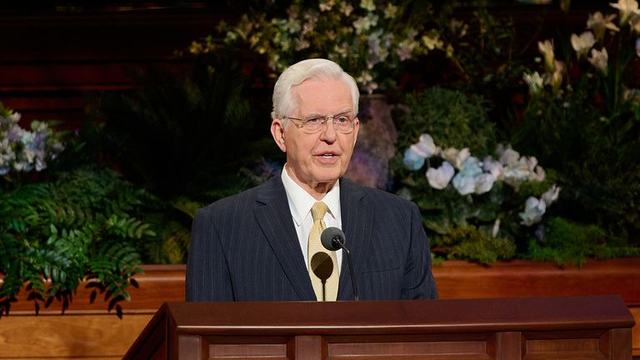
The Character of Christ
 Open talk in Gospel Library
Contents
Topics
Prepare for the Savior’s return by becoming holy and blameless
President Christofferson begins with Peter’s teachings about the Second Coming and emphasizes that the Lord’s coming is certain. Because of that reality, disciples should prepare now by becoming the kind of people the Lord would find at peace, without spot, and blameless.
“But the day of the Lord will come.”
“What manner of persons ought ye to be?”
“We should be preparing diligently now so that when the Lord comes, He will find us ‘in peace, without spot, and blameless,’ leading lives of holiness.”
“Adopting the character of Christ is not only a question of our personal preparation but a primary element of preparing the world for the Lord’s return and His glorious millennial reign.”Key Points:
- In the latter days, some will doubt or mock the promise of the Second Coming.
- The Lord’s seeming delay is an expression of mercy, giving people time to repent.
- The Second Coming will surely happen.
- Peter’s question invites disciples to examine the kind of people they are becoming.
- Preparation for the Lord’s return includes holiness, peace, and blameless living.
- Developing the character of Christ is central to that preparation.
- When have you felt the reality of the Second Coming become more personal to you?
- What experiences have helped you think more seriously about spiritual preparation?
- When have you felt grateful for the Lord’s mercy in giving you time to repent and grow?
- How have you seen a focus on becoming, not just doing, change your discipleship?
- What personal habits help you feel more at peace with God?
Develop Christlike character through a mighty change of heart
The talk teaches that Christlike character comes from Christlike motivations—our thoughts, desires, and intents. Real change happens through a mighty change of heart, whether suddenly or gradually, as we exercise faith in Christ, repent, make and keep covenants, and receive divine help through grace and the Holy Ghost.
“It is in emulating the character of Christ that we become the ‘manner of persons’ we ought to be.”
“Acquiring the character of Christ is one of the most important ways we take His name upon us.”
“Christlike character grows out of a Christlike heart.”
“Thus, if we are to succeed in developing a Christlike character, we must possess His motivations—His thoughts, desires, and intents of the heart.”
“For us, it will require what the scriptures call a mighty change of heart.”
“For most of us, our mighty change of heart occurs incrementally over time.”
“The good news of the gospel of Jesus Christ is that we, each of us, can call on the grace of Jesus Christ to help us.”
“This transformative power produces a mighty change of heart and the character qualities that accompany it.”Key Points:
- Christlike character is rooted in the heart, not just in outward actions.
- The Savior’s attributes flow from His inner motivations.
- A mighty change of heart may happen quickly for some and gradually for most.
- The process requires faith in Christ, repentance, baptismal covenant obedience, and grace through the Holy Ghost.
- We are not left to improve by willpower alone; divine help is essential.
- The companionship of the Holy Ghost brings transformative spiritual power.
- When have you noticed the Lord changing your desires, not just your behavior?
- What experiences have taught you that spiritual growth is often gradual?
- How has repentance helped you feel a real change in your heart?
- When have you felt the Holy Ghost strengthen you to become something better?
- How have your baptismal covenants helped shape who you are becoming?
Let pure love shape your character
The first major motivation in the Savior’s heart is charity, the pure love of Christ. President Christofferson teaches that this love led Jesus to become our Redeemer and continues to produce compassion, patience, correction guided by the Spirit, and forgiveness.
“Foremost among the motives that form Christ’s character is charity, ‘the pure love of Christ.’”
“It was pure love that, before the Creation, led Him to offer Himself as our Redeemer.”
“His Atonement was and is the supreme act of love.”
“Greater love hath no man than this, that a man lay down his life for his friends.”
“The love of Christ yields character traits such as compassion, patience, a willingness to correct ‘when moved upon by the Holy Ghost,’ and certainly a willingness to forgive.”
“Character is revealed … in the power to discern the suffering of other people when we ourselves are suffering.”Key Points:
- Charity is the foremost motivation in Christ’s character.
- The Savior’s redeeming mission was motivated by pure love.
- The Atonement is the ultimate expression of that love.
- Pure love produces compassion, patience, forgiveness, and inspired correction.
- Christlike character is often revealed when we turn outward even while suffering ourselves.
- Jesus exemplified this on the cross by caring for His mother in His own agony.
- When have you felt the pure love of Christ during a difficult time?
- Can you share an experience when someone showed Christlike compassion to you?
- When have you been prompted to care for someone else while carrying your own burdens?
- How has the Savior helped you forgive someone?
- What experiences have taught you that charity is more than a feeling—it is action?
Lift and minister to others as the Savior did
A second motivation in Christ’s heart is His desire to bless, advance, and bring happiness to others. This motivation leads to humility, meekness, selflessness, and courage, and it is beautifully reflected in the Savior’s ministry and in the service of His disciples.
“A second motivation that underlies the Savior’s character is His passion to foster the happiness and advancement of others.”
“His entire object, in harmony with the Father, is to bring to pass the immortality and eternal life of God’s children.”
“Whosoever will be great among you, shall be your minister.”
“For even the Son of man came not to be ministered unto, but to minister, and to give his life a ransom for many.”
“Look to the needs of others, and humility follows.”
“Learn of me; for I am meek and lowly in heart.”Key Points:
- The Savior is motivated by the happiness and eternal progress of God’s children.
- True greatness in the kingdom is found in ministering to others.
- Looking to the needs of others helps develop humility.
- Meekness includes self-control and wise use of one’s gifts and powers.
- Selflessness is seen in those who sacrifice to bless others, such as missionaries.
- Ministering in Christ’s way reflects His character.
- When have you felt joy from serving someone without expecting anything in return?
- Can you share a time when ministering changed your heart?
- When have you seen humility grow as you focused on someone else’s needs?
- How have missionaries or other disciples influenced you through selfless service?
- What experience has taught you what meekness looks like in real life?
Choose God’s will and pursue moral excellence
The third motivation President Christofferson highlights is the Savior’s complete devotion to glorifying the Father and doing His will. This devotion leads to honor, integrity, and virtue and calls disciples to seek moral excellence with the Lord’s help.
“A third motivating force essential to the character of Christ is His desire to glorify the Father and to fulfill the Father’s will in every particular.”
“My meat is to do the will of him that sent me, and to finish his work.”
“A Christlike desire to glorify God and do His will leads to the character qualities of honor, integrity, and virtue.”
“Jesus, the paradigm of integrity, ‘was in all points tempted like as we are, yet without sin.’”
“Virtue is a pattern of thought and behavior based on high moral standards.”
“Our thoughts, words, and actions need to be unfailingly virtuous and filled with the pure love of Jesus Christ towards all men.”
“The great opportunity before us is to become the people God needs us to be.”Key Points:
- Jesus delighted to do the Father’s will in every detail.
- A desire to glorify God produces honor, integrity, and virtue.
- The Savior is the perfect example of integrity.
- Disciples can pursue moral excellence with divine help.
- Virtue includes both thought patterns and behavior rooted in fidelity to God.
- Becoming the people God needs us to be requires virtuous thoughts, words, and actions.
- When have you had to choose God’s will over your own preferences?
- What experiences have strengthened your desire to live with integrity?
- How have you seen virtuous thoughts influence your actions?
- Can you share a time when obedience brought spiritual clarity or peace?
- What has helped you pursue moral excellence in a difficult environment?
Rely on faith, repentance, and the Holy Ghost to become like Christ
President Christofferson concludes by inviting disciples to pray for the Holy Spirit to instill Christlike motivations in their hearts. Through faith, repentance, and ongoing spiritual effort supported by grace, we can become more like the Savior.
“With faith in Christ, we can pray that the Holy Spirit will effect a mighty change in us to instill these same divine motivations in our heart and help us practice the attributes of a Christlike character.”
“We can keep repenting to improve as we strive to follow the Lord’s example, ‘which faith and repentance bringeth a change of heart.’”
“We can ‘become the people God needs us to be.’”
“With faith in Christ, may our character come to mirror His so that ‘when he shall appear we shall be like him … ; that we may have this hope; that we may be purified even as he is pure.’”Key Points:
- We should actively pray for the Holy Ghost to change our hearts.
- Faith in Christ and repentance remain central throughout the process of becoming.
- Christlike motivations can be planted and nurtured in us by divine power.
- Spiritual progress is ongoing and requires repeated repentance and effort.
- Our hope is to become like Christ and be purified through Him.
- When has prayer invited a change of heart in your life?
- How has repeated repentance helped you feel hope instead of discouragement?
- When have you recognized that the Lord was helping you become more like Him?
- What spiritual practices help you stay open to the influence of the Holy Ghost?
- How has hope in becoming like Christ strengthened you?
Influence the world one Christlike life at a time
The talk teaches that becoming like Christ is not only personal preparation but also part of preparing the world for His millennial reign. Though no one person changes the world alone, Christlike individuals influence families, communities, and society through consistent righteous choices.
“Adopting the character of Christ is not only a question of our personal preparation but a primary element of preparing the world for the Lord’s return and His glorious millennial reign.”
“We tend to underestimate the influence of Christlike individuals in the world, but working one by one has always been Jesus’s approach to changing society and establishing His kingdom.”
“It is the aggregation of individual choices over time that forms and changes societies for good or ill.”
“No one of us alone can change the world, but each of us can have an influence in the world.”Key Points:
- Personal Christlike development blesses more than the individual.
- Preparing for the Second Coming includes helping prepare the world.
- The Savior’s pattern is to work one by one.
- Societies are shaped by accumulated individual choices.
- Every disciple can exert meaningful influence for good.
- When have you seen one faithful person influence a family, ward, or community for good?
- How has someone else’s Christlike example changed your life?
- What small daily choices have helped you bless others over time?
- When have you felt that your influence mattered even in simple ways?
- How could your talk invite listeners to become a stronger influence for good?
