
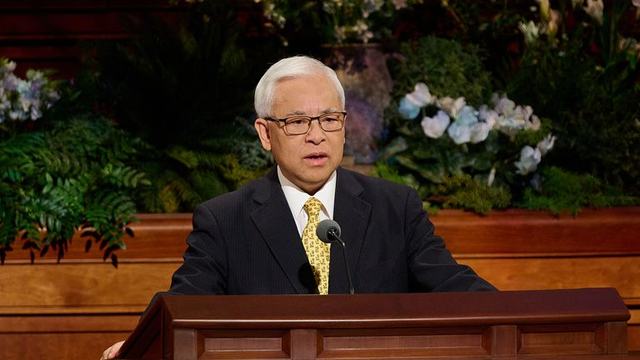
Remember, Remember
 Open talk in Gospel Library
Contents
Before Reading
Before reading or listening to the talk, consider the following questions:
- Why does Elder Wong connect Easter with remembering Jesus Christ?
- What are the five “remember, remember” verses he highlights from the Book of Mormon?
- What blessings come from keeping God’s commandments?
- What does the talk teach about the consequences of rejecting God’s commandments?
- Why is Jesus Christ the only way to salvation?
- What does it mean to build our foundation on the rock of Christ?
- How do covenants and ordinances help anchor us to the Savior?
- What does the Book of Mormon teach about agency and personal responsibility?
- How can remembering gospel truths help me act more faithfully each day?
- What does Elder Wong invite us to do during the Easter season?
Topics
Remember the Savior during Easter
Elder Wong teaches that Easter is not only a time to celebrate but also a time to remember Jesus Christ and His redeeming mission, especially His Resurrection. He frames the entire message around the question of what God wants us to remember and points to the Book of Mormon as a divinely prepared source of reminders for our day.
Easter Sunday is the ultimate celebration of Jesus Christ’s redeeming mission, especially His Resurrection.
The Easter season invites disciples of Jesus Christ not only to rejoice but to remember our Savior.
What would God want us to remember? How would He let us know? Where would we find His reminders?
He would put His reminders in the Book of Mormon.
Let us remember, remember our Savior, especially in this Easter season. He is resurrected. He wants us to come unto Him.
- How does Elder Wong describe the meaning of Easter Sunday?
- What does he say disciples of Jesus Christ should do during the Easter season besides rejoice?
- Where does Elder Wong say God has placed reminders for us?
- Why is remembering Jesus Christ central to this talk?
- How can I make Easter a season of remembrance rather than only celebration?
- What specific things about the Savior’s redeeming mission do I want to remember more intentionally?
- How can I use the Book of Mormon this week to focus more deeply on Jesus Christ?
- What personal reminders can I create to remember the resurrected Savior daily?
Keep God’s commandments and receive lasting happiness
Using Mosiah 2:41, Elder Wong teaches that obedience brings both temporal and spiritual blessings. Those who remain faithful to the end will be received into heaven and dwell with God in never-ending happiness. He emphasizes that God’s commandments are expressions of divine love and lead to joy, not restriction.
Keeping God’s commandments is a blessing, both temporal and spiritual.
If we can endure to the end, we will dwell with Him in a state of never-ending happiness.
Isn’t that amazingly wonderful!
O remember, remember that these things are true; for the Lord God hath spoken it.
- According to Mosiah 2:41, what blessings come to those who keep the commandments of God?
- What does Elder Wong teach about the eternal outcome of enduring faithfully to the end?
- How does this passage connect obedience with happiness?
- Why does Elder Wong emphasize remembering that these promises are true?
- Which commandment is currently bringing greater peace or strength into my life?
- How have I seen temporal or spiritual blessings come from obedience?
- What helps me stay faithful when obedience feels difficult?
- What can I do now to better endure faithfully to the end?
Recognize the consequences of disobedience
Elder Wong balances the promises of obedience with a sober warning: if we do not keep God’s commandments, we are cut off from His presence. Quoting Alma 37:13, he teaches that God’s commandments are strict, firm, and trustworthy. He also uses President Dallin H. Oaks’s kite analogy to show that commandments do not hold us back but keep us steady and safe amid the winds of mortality.
However, have you ever thought about what will happen if we do not keep His commandments?
God reminds us that His commandments are firm and that obedience to them brings promised blessings.
If ye will keep my commandments ye shall prosper in the land—but if ye keep not his commandments ye shall be cut off from his presence.
If we lose our hold on the string, the kite will not rise higher. It will be carried about by these winds and inevitably crash to the earth.
- What warning does Alma 37:13 give about failing to keep God’s commandments?
- How does Elder Wong describe the nature of God’s commandments?
- What does the kite analogy teach about the purpose of commandments?
- Why is it incorrect to think that freedom increases when we reject divine guidance?
- When have I seen commandments protect and steady my life?
- Are there any commandments I have viewed as restrictive instead of protective?
- What mortal winds are trying to pull me away from God right now?
- What can I do to hold more firmly to the Lord’s guidance?
Come unto Christ through the Father’s plan
Elder Wong teaches that our goal is to return to our Heavenly Father by coming unto Jesus Christ. He reminds listeners that this was part of the premortal plan we accepted with joy. Obedience and remembrance are not isolated duties; they are part of the covenant path that leads us home through the Savior.
We need to return to our Heavenly Father through coming unto Jesus Christ.
That was the plan that we agreed to and caused us to “[shout] for joy” (Job 38:7).
- According to Elder Wong, how do we return to our Heavenly Father?
- What does he teach about our premortal acceptance of the Father’s plan?
- How does this truth help explain why commandments matter?
- How is coming unto Christ connected to the plan of salvation?
- What does coming unto Jesus Christ look like in my life right now?
- How does remembering the premortal plan affect my willingness to obey?
- What daily habits help me move closer to Heavenly Father through Christ?
- What is one next step I can take on the covenant path?
Trust Jesus Christ as the only source of salvation
Drawing from Helaman 5:9, Elder Wong testifies that salvation comes only through the atoning blood of Jesus Christ. He explains that Christ is central to the plan of salvation and exaltation and that every promise of redemption, resurrection, and eternal life depends on Him. Without Jesus Christ, there is no way back to the Father.
Remember that there is no other way nor means whereby man can be saved, only through the atoning blood of Jesus Christ.
Jesus Christ stands at the very heart of God’s plan of salvation and exaltation.
Every promise of redemption, every hope of resurrection, and every assurance of eternal life flows through Him.
Without Jesus Christ, there is no salvation, no victory over sin and death, and no path back to our Heavenly Father.
He is the very foundation of the whole plan of salvation and exaltation.
- What does Helaman 5:9 teach about the source of salvation?
- How does Elder Wong describe the central role of Jesus Christ in God’s plan?
- What blessings does he say flow through Jesus Christ?
- Why is it doctrinally important to understand that there is no other way to be saved?
- How has the Savior’s Atonement become more real to me personally?
- In what ways do I rely on Jesus Christ each day?
- What can I do to deepen my gratitude for His redeeming mission and Resurrection?
- How can I bear clearer testimony that salvation comes only through Christ?
Build your life on the rock of Christ
Using Helaman 5:12, Elder Wong teaches that Jesus Christ is the sure foundation that can protect us from the adversary’s storms. When life brings temptation, opposition, and hardship, those who build on the Redeemer cannot be dragged down. He reinforces this teaching with Elder David A. Bednar’s explanation that sacred covenants and ordinances anchor us ever more firmly to Christ.
Remember, remember that it is upon the rock of our Redeemer, who is Christ, the Son of God, that ye must build your foundation.
It shall have no power over you to drag you down to the gulf of misery and endless wo, because of the rock upon which ye are built.
Which is a sure foundation, a foundation whereon if men build they cannot fall.
Every time we faithfully receive, review, remember, and renew sacred covenants, our spiritual anchors are secured ever more firmly and steadfastly to the ‘rock’ of Jesus Christ.
- What does Helaman 5:12 teach about building on Jesus Christ?
- What kinds of opposition does Elder Wong mention that may beat upon us?
- Why is Christ called a sure foundation?
- How do sacred covenants and ordinances help anchor us to the Savior?
- What am I currently building my life on most firmly?
- How have covenants helped me stay steady during spiritual storms?
- What can I do to receive, review, remember, and renew my covenants more intentionally?
- When have I felt the Lord keep me from falling because I was anchored in Him?
Use your God-given agency wisely
From Helaman 14:30, Elder Wong teaches that God has given us knowledge and freedom to act for ourselves. With that gift comes responsibility: those who choose iniquity bring harm upon themselves. He emphasizes that the Book of Mormon helps us discern right from wrong and strengthens us to use agency in wise and righteous ways.
Whosoever perisheth, perisheth unto himself; and whosoever doeth iniquity, doeth it unto himself.
For behold, ye are free; ye are permitted to act for yourselves; for behold, God hath given unto you a knowledge and he hath made you free.
As we study its pages, we come to know the truth.
As we understand its teachings, they begin to shape our hearts.
As we internalize its messages and immerse ourselves in its words, we will be guided to discern right from wrong and empowered to use our God-given agency wisely.
- What does Helaman 14:30 teach about agency and accountability?
- How does Elder Wong describe the relationship between knowledge and freedom?
- What role does the Book of Mormon play in helping us use agency wisely?
- Why is personal responsibility an important part of moral agency?
- What choices am I making right now that are shaping my spiritual future?
- How has the Book of Mormon helped me discern right from wrong?
- Where do I need to take greater responsibility for my decisions?
- What is one wise choice I feel prompted to make today?
Study the Book of Mormon to remember truth
Elder Wong teaches that the Book of Mormon was written for our day and future. As we study, understand, internalize, and immerse ourselves in its teachings, it changes our hearts and guides our decisions. The repeated “remember, remember” passages serve as a pattern for how scripture helps disciples retain essential gospel truths.
The Book of Mormon was written for our day and for our future.
As we study its pages, we come to know the truth.
As we understand its teachings, they begin to shape our hearts.
As we internalize its messages and immerse ourselves in its words, we will be guided to discern right from wrong.
- What does Elder Wong say the Book of Mormon was written for?
- What happens as we study and understand its teachings?
- How do the “remember, remember” verses illustrate the purpose of scripture?
- Why is immersion in the Book of Mormon important for modern disciples?
- How consistent is my current Book of Mormon study?
- Which teachings from the Book of Mormon have recently shaped my heart?
- How can I better internalize scripture instead of only reading it?
- What reminder from the Book of Mormon do I most need right now?
Prepare for the Savior’s return through daily faithfulness
At the close of the talk, Elder Wong summarizes the five reminders and invites listeners to act on them. He calls for united prayer, commandment keeping, wise use of moral agency, and preparation for the Savior’s glorious return in His resurrected body. Remembering truth should lead to faithful living and hopeful anticipation of Christ’s return.
Do you still remember the five sets of “remember, remember” verses in the Book of Mormon?
We can dwell with God in a state of never-ending happiness if we keep His commandments.
We will be cut off from God’s presence if we do not keep His commandments.
We can be saved only through the atoning blood of Jesus Christ.
We will not fall if we build our foundation upon Jesus Christ.
We were given knowledge and agency to choose and act wisely.
Let us pray unitedly that we will keep His commandments, use our moral agency wisely every day, and prepare for His glorious return in His resurrected body.
- What five truths does Elder Wong review at the end of the talk?
- What invitation does he extend to listeners in his conclusion?
- How does remembering doctrine lead to daily discipleship?
- What does the talk teach about preparing for the Savior’s return?
- Which of the five reminders do I most need to act on now?
- How can I pray more intentionally for help to keep the commandments and use agency wisely?
- What would it look like for me to prepare more earnestly for the Savior’s return?
- What change will I make because of this talk?
