
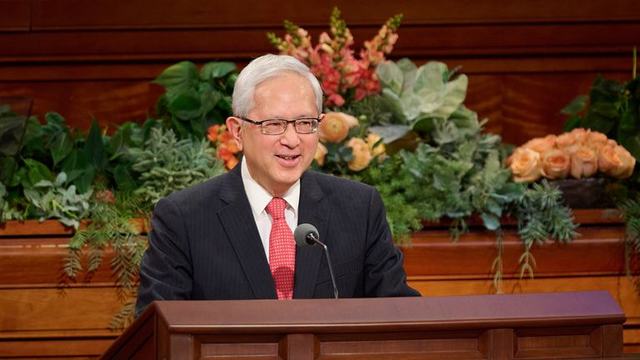
Come to the Lord in His Holy House
 Open talk in Gospel Library
Ideas for Opening the Lesson
- Write Elder Gong’s phrase “spiritual safety, harmony, and holiness” on the board. Invite class members to consider which blessing they especially need and how the Lord’s house helps them seek it. Introduce the lesson as an invitation to deepen both understanding of temple doctrine and personal temple worship.
- Display two headings: “Temple doctrine” and “Personal temple culture.” Ask what class members understand by each phrase, then explain that Elder Gong presents three doctrinal foundations and five elements of personal temple culture. Invite participants to look for one truth to understand more deeply and one practice to strengthen.
- Read Elder Gong’s statement, “Agency, faith and repentance, and Jesus Christ’s Atonement make change and forgiveness possible.” Invite a quiet moment of reflection about the hope this promise offers. Explain that sharing personal or painful family circumstances is not necessary for meaningful participation.
- Write on the board, “A temple dedication is a beginning.” Ask, “What begins when a temple becomes available to us?” Use the responses to introduce Elder Gong’s emphasis on the spiritual blessings of temple worship rather than only the building’s appearance or dedication.
- Invite class members to silently consider someone whose example strengthens their love for the temple. Ask volunteers to share a simple attitude or habit that makes that example meaningful, without discussing sacred ceremonial details. Connect these examples to Elder Gong’s invitation to develop a personal temple culture.
Topics
Seek the Lord’s Peace in His Holy House
The Lord invites us into His house as a place of spiritual safety, harmony, and holiness amid the world’s commotion. There He teaches His plan of happiness, blesses us, and prepares us to return to Him. Understanding temple doctrine helps bring His covenant blessings closer to our hearts.
In a world of commotion, contention, and cares, the Lord invites us to a place of spiritual safety, harmony, and holiness—the house of the Lord.
- What stands out to you about the Lord’s invitation to spiritual safety, harmony, and holiness?
- How does temple worship help you center your life on Jesus Christ amid daily cares?
- What experiences help you recognize the Lord’s house as a place of spiritual peace?
- How can you prepare your heart to receive instruction rather than simply complete a temple visit?
- What is one step you can take toward the Lord’s house in your present circumstances?
Strengthen Eternal Families Through Covenant Commitment
Heavenly Father’s work and glory includes our return to Him, united as families in lasting happiness. Elder Gong teaches that eternal relationships depend on covenant commitment, sacrifice, and consecration rather than convenience or changing attraction. Prayer, scripture study, church attendance, and service nourish and sanctify marriages and relationships.
Covenant belonging unites a husband, wife, and children, not until death do we part, not until convenience or attraction fade, but by covenant commitment, sacrifice, and consecration.
- How does Heavenly Father’s desire for eternal family happiness shape your understanding of temple covenants?
- What does covenant commitment look like in everyday interactions with loved ones?
- How do sacrifice and consecration differ from simply staying in a relationship out of habit?
- Which forms of spiritual nourishment help your relationships become more Christlike?
- How can our quorum or Relief Society communicate belonging to people whose family circumstances differ from their hopes?
Exercise Agency and Seek Healing Through Jesus Christ
Moral agency is essential to Heavenly Father’s plan, including our choices about eternal relationships. Jesus Christ’s Atonement, together with faith and repentance, makes change, forgiveness, and healing possible. Temple service for family members can soften hearts, and Elder Gong urges us not to delay the peace Christ offers.
Agency means we choose, directly and indirectly, our relationships. God will not require a woman or man to be sealed or live in an eternal relationship he or she does not choose. Agency, faith and repentance, and Jesus Christ’s Atonement make change and forgiveness possible.
- What reassurance do you find in Elder Gong’s teaching that God honors agency in eternal relationships?
- How does Jesus Christ help us become new creatures rather than remain defined by old patterns?
- What experiences, if you feel comfortable sharing, show how family history or temple service softens hearts?
- How can we seek forgiveness and peace while respecting agency and appropriate personal boundaries?
- What small step toward repentance or healing can you take now rather than postpone?
Honor Covenants and Receive the Spirit’s Confirmation
The Holy Spirit of Promise witnesses that saving ordinances are properly performed and their associated covenants are kept. As we honor our covenants, He confirms their eternal efficacy. Elder Gong emphasizes that receiving ordinances is not a substitute for choosing and faithfully living their covenants.
In His sacred role as Holy Spirit of Promise, the Holy Ghost “witnesses to the Father that the saving ordinances have been performed properly and that the covenants associated with them have been kept.”
- What does this teaching help you understand about the relationship between ordinances and covenant keeping?
- Why is it important to distinguish receiving an ordinance from faithfully honoring its covenants?
- How do daily choices express that we genuinely desire our covenant relationship with God?
- How can this doctrine encourage sincere discipleship rather than mere outward participation?
- Which covenant commitment invites greater attention in your life, and what helps you honor it?
Treat Temple Dedication as a Spiritual Beginning
Temple announcements, construction, and dedications are meaningful milestones, but dedication begins an ongoing opportunity for worship. Elder Gong invites us to treasure the spiritual blessings temples bring more than their physical beauty. A personal temple culture grows through continued participation rather than excitement about a building alone.
First, a temple dedication is a beginning. We are naturally excited when a temple is announced, groundbreaking and construction occur, and dedication takes place. Each is a milestone. But please, while we are grateful our temples and everything in them are physically beautiful, let us celebrate and treasure even more the spiritual blessings temples bring.
- What changes when we view a temple dedication as a beginning rather than a finish line?
- Which spiritual blessings of the temple do you especially treasure, and why?
- How can we sustain enthusiasm for temple worship after the excitement of a dedication?
- How can we help children, youth, or new members appreciate a temple’s purpose beyond its appearance?
- What ongoing habit helps you make temple blessings part of your life?
Offer Temple Sacrifice as Your Circumstances Allow
As temples become more accessible in many places, the spirit of sacrifice takes new forms. Elder Gong encourages more frequent worship, bringing family names, and serving as patrons or ordinance workers as life’s seasons allow. His invitation honors both the sacrifices of earlier generations and the differing circumstances members face today.
Today, as temples come closer in many places, we can manifest the precious spirit of temple sacrifice in new ways. We can come to the temple more often. We can search and bring more family names to bless deceased loved ones. As the seasons of our lives allow, we can regularly serve in the Lord’s house, both as temple patron and as temple ordinance worker.
- What does the spirit of temple sacrifice look like when a temple is nearby?
- How does the phrase “as the seasons of our lives allow” help you approach temple service wisely?
- What sacrifice of time, attention, or convenience can make more room for temple worship or family history?
- What experiences help you find joy in preparing family names or serving in the temple?
- How can we support members whose distance, health, caregiving, or other circumstances limit temple attendance?
Recognize Jesus Christ in Every Temple
Each temple reflects its location and culture, yet everything in it testifies of Jesus Christ. Temple leaders and workers serve under His authority, and ordinances and covenants are faithfully performed and recorded. Elder Gong reassures patrons that their service is acceptable to the Lord when they do their best.
Third, while each temple uniquely fits its place, culture, and circumstance, everything in each temple testifies of Jesus Christ. When patrons do their best, our service is acceptable to the Lord.
- How does focusing on Jesus Christ change the way you approach temple worship?
- Without discussing sacred ceremonial details, what helps you recognize the Savior’s influence in the temple?
- What reassurance do you find in the statement that our service is acceptable when we do our best?
- How can you remain receptive to the Spirit when temple worship feels unfamiliar?
- What can the united, Christ-centered service of temple leaders and workers teach us about serving in our ward?
Express Gratitude and Strengthen Your Eternal Family
Temple worship is a sacred privilege, not an entitlement, and gratitude shapes how we treat temple workers and speak about temples. The blessings of ordinances and covenants do not depend on a temple’s size or ornamentation. Family history and temple service also help us recognize belonging on both sides of the veil and become strong links in our eternal families.
Please, dear brothers and sisters, wherever we live, let us always be grateful for the gifts of eternity sacred temples bring. Look for the miracles. Whatever generation you are in the Church, in the chain of your eternal family, please be a strong link.
- How does viewing temple attendance as a sacred privilege affect your expectations and behavior?
- What helps you respond with patience when temple workers need time to assist you?
- Why do the blessings of temple ordinances matter more than a temple’s size or appearance?
- How does family history help you or others feel less alone and more connected?
- What does being a strong link in your eternal family mean in your current circumstances?
Show Reverence Through Caring for Temple Clothing
Where possible, Elder Gong invites members to consider saving for and purchasing their own ceremonial temple clothing. Reverent care and use of this clothing express love for the Lord and temple covenants. This example can help children and grandchildren recognize the sacred place temple worship holds in family life.
Fifth, where possible, please consider saving for and buying your own ceremonial temple clothes—cap or veil, robe, sash, and apron. As we reverently care for and use our own temple clothes, our children and grandchildren can see we love the Lord and our temple covenants.
- What does Elder Gong’s invitation teach about expressing reverence through ordinary actions?
- How do “where possible” and “please consider” help us approach this invitation without comparing financial circumstances?
- How can caring for temple clothing remind you of your commitment to the Lord?
- What do younger generations learn from the way we prepare for and speak about temple worship?
- What simple, appropriate practice can help you show greater love for your temple covenants?
Additional Discussion Questions
- Which doctrinal foundation in this talk most deepens your understanding of temple worship, and why?
- How do eternal family belonging, moral agency, and covenant faithfulness work together in Elder Gong’s message?
- What is the difference between making temple attendance a routine and building a Christ-centered temple culture?
- How can temple worship influence the way you speak to and serve family members between temple visits?
- How can we extend Elder Gong’s invitation warmly to people who are preparing for temple worship or cannot currently attend?
- What helps you trust Jesus Christ when questions about eternal family relationships remain unresolved?
- How can our quorum or Relief Society encourage temple and family history service without creating pressure or comparison?
- Which of Elder Gong’s invitations can you act on this week in a way that fits your circumstances?
- What experiences help you recognize forgiveness, healing, peace, or belonging as blessings connected with temple service?
- If you choose one truth and one practice from this talk to carry forward, what are they, and how can you remember them?
