
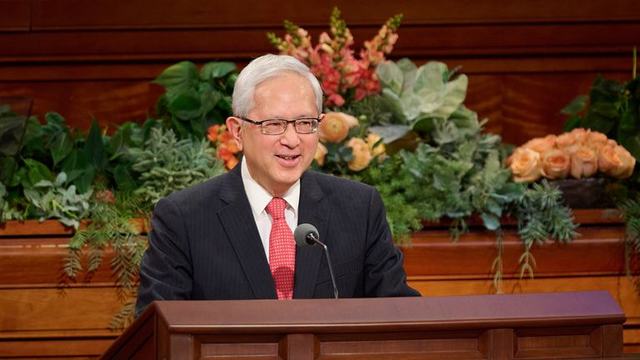
Come to the Lord in His Holy House
 Open talk in Gospel Library
Contents
Before Reading
Before reading or listening to the talk, consider the following questions:
- How does the house of the Lord help us prepare to return to Heavenly Father?
- How do agency and Jesus Christ’s Atonement influence eternal family relationships?
- What role does the Holy Spirit of Promise play in temple ordinances and covenants?
- What distinguishes appreciation for a temple’s physical beauty from appreciation for its spiritual blessings?
- How can I develop a personal temple culture in my present circumstances?
Topics
Build Eternal Families Through Covenant Commitment
Elder Gong teaches that Heavenly Father’s work and glory centers on our return to Him, united as families. Temple marriage rests on covenant commitment, sacrifice, and consecration rather than temporary convenience or attraction. Prayer, scripture study, church attendance, and service nourish and sanctify marriages and relationships.
Heavenly Father’s work and glory is for us to return to Him, united as families, happy and forever.
Temple marriages are meant to last forever.
Consistent spiritual nourishment through prayer, scripture, church attendance, service, etc. blesses and sanctifies our marriages and relationships.
- How does Elder Gong describe Heavenly Father’s purpose for His children and their families?
- How does covenant belonging differ from a relationship based only on convenience or attraction?
- What practices does Elder Gong identify as spiritual nourishment for marriages and relationships?
- Which relationship in my life needs more consistent spiritual nourishment, and what practice can I strengthen?
- How can I express covenant commitment through sacrifice or service this week?
- How does the promise of eternal family belonging influence the way I treat family members today?
Choose Repentance and Receive Christ’s Healing
Elder Gong teaches that moral agency allows us to choose and that God does not require anyone to accept an unwanted eternal relationship. Through agency, faith, repentance, and Jesus Christ’s Atonement, change and forgiveness become possible. Temple service for deceased family members can soften hearts and bring healing, and Elder Gong urges us not to postpone repentance or the peace Christ offers.
God will not require a woman or man to be sealed or live in an eternal relationship he or she does not choose.
Agency, faith and repentance, and Jesus Christ’s Atonement make change and forgiveness possible.
Jesus Christ can help us mend, forgive, move forward.
Please do not deliberately delay the spiritual peace and joyful freedom Jesus Christ wants you to have now.
- What does Elder Gong teach about agency in eternal relationships?
- How do repentance and the Savior’s Atonement make changes in relationships possible?
- How can temple service contribute to healing difficult family relationships?
- Why does Elder Gong encourage us to seek repentance and spiritual peace now?
- Where do I need the Savior’s help to mend, forgive, or move forward?
- What step toward repentance or healing can I take now rather than delay?
- What experiences help me recognize the Savior’s power to soften my heart?
- How might family history or temple service help me seek peace concerning a difficult family relationship?
Honor Covenants Through Faith and Action
Elder Gong explains that the Holy Spirit of Promise confirms the efficacy of ordinances and covenants, making them binding in time and eternity. This confirmation includes a witness that saving ordinances are properly performed and their associated covenants are kept. He emphasizes that ordinances alone do not make disregarded or unwanted covenants binding upon us.
When the Holy Spirit of Promise witnesses and confirms the efficacy of ordinances and covenants, they become binding in time and eternity.
In His sacred role as Holy Spirit of Promise, the Holy Ghost “witnesses to the Father that the saving ordinances have been performed properly and that the covenants associated with them have been kept.”
As we honor our covenants, the Holy Spirit of Promise seals our relationships with “efficacy, virtue, [and] force.”
- What does the Holy Ghost witness in His role as the Holy Spirit of Promise?
- Why does keeping covenants matter in addition to receiving ordinances?
- What does Elder Gong teach about covenants that someone does not honor, choose, or desire?
- How do my daily choices show that I desire and honor my covenants?
- Which covenant commitment needs more deliberate attention in my life?
- What can I change so my faith and actions more consistently reflect my temple promises?
Treasure Spiritual Blessings Beyond Temple Dedication
Elder Gong describes a temple dedication as a beginning rather than an endpoint. Announcements, construction, and dedication are meaningful milestones, but a temple’s greatest value lies in its spiritual blessings. He invites us to treasure those blessings even more than the building’s physical beauty.
First, a temple dedication is a beginning.
Each is a milestone.
But please, while we are grateful our temples and everything in them are physically beautiful, let us celebrate and treasure even more the spiritual blessings temples bring.
- Why does Elder Gong call a temple dedication a beginning?
- What distinction does he make between a temple’s physical beauty and its spiritual blessings?
- How can excitement about a new temple lead to ongoing worship rather than end with its dedication?
- Which spiritual blessings of the temple do I most treasure, and why?
- How can I turn enthusiasm about a temple into lasting preparation or participation?
- What helps me keep the temple’s sacred purpose at the center of my attention?
Express Sacrifice Through Temple and Family History Service
Elder Gong honors the sacrifices of members whose distance from temples limits their opportunities to attend. As temples become more accessible in many places, he invites members to express that same spirit of sacrifice through more frequent worship, family name preparation, and temple service. He recognizes that opportunities to serve vary with the seasons of life.
Today, as temples come closer in many places, we can manifest the precious spirit of temple sacrifice in new ways.
We can search and bring more family names to bless deceased loved ones.
As the seasons of our lives allow, we can regularly serve in the Lord’s house, both as temple patron and as temple ordinance worker.
- How does Elder Gong connect earlier sacrifices to present opportunities for temple worship?
- What forms of temple and family history service does he encourage?
- How does the phrase “as the seasons of our lives allow” shape his invitation?
- What expression of temple sacrifice is realistic and meaningful in my current circumstances?
- What next step can I take to identify or prepare a family name for temple ordinances?
- How can I make room for temple worship or service without overlooking the responsibilities of my present season of life?
Recognize Jesus Christ in Every Temple
Elder Gong teaches that every temple testifies of Jesus Christ, even as each temple fits its local setting and culture. Temple leaders focus on patrons and workers, and ordinances are performed and recorded by the Lord’s authority. He reassures patrons that when they do their best, their service is acceptable to the Lord.
While each temple uniquely fits its place, culture, and circumstance, everything in each temple testifies of Jesus Christ.
In each temple, by authority and in the name of the Lord, ordinances and covenants are truly and faithfully performed and properly recorded.
When patrons do their best, our service is acceptable to the Lord.
- What remains central in every temple despite differences in setting and culture?
- What does Elder Gong emphasize about the authority, performance, and recording of temple ordinances?
- What reassurance does he offer to patrons who do their best?
- How can I focus more intentionally on Jesus Christ as I prepare for or participate in temple worship?
- What helps me offer my best effort without allowing unfamiliarity or worry to dominate my experience?
- What aspect of temple worship helps me better understand the Savior?
Practice Gratitude and Strengthen Eternal Family Links
Elder Gong presents temple attendance as a sacred privilege, not an entitlement, and encourages patience and gratitude. He teaches that temple size or ornamentation does not determine the value of ordinances and covenants. He also reminds converts and all members that they belong to Heavenly Father’s family and can strengthen eternal family connections through temple and family history service.
Ordinances are not big or small. Covenants are not big or small.
Let us always only speak with love and gratitude for ‘Holiness to the Lord, the House of the Lord.’
And when you take family names to the temple, your eternal family extends on both sides of the veil.
Whatever generation you are in the Church, in the chain of your eternal family, please be a strong link.
- How does viewing temple attendance as a sacred privilege influence our treatment of temple workers?
- Why does Elder Gong discourage judging temples by their size or ornamentation?
- What message of belonging does he offer to new converts who feel alone?
- How does family history and temple service strengthen connections across generations?
- How can I show more patience and gratitude toward those who serve in the temple?
- Do comparisons or expectations distract me from the temple’s eternal gifts?
- What helps me recognize that I belong to Heavenly Father’s family?
- What specific action can help me become a stronger link in my eternal family?
Care Reverently for Ceremonial Temple Clothing
Elder Gong invites members, where possible, to consider saving for and purchasing their own ceremonial temple clothing. Reverent care and use of that clothing can show children and grandchildren our love for the Lord and our temple covenants. His account of a family helping their widowed mother obtain temple clothing illustrates devotion, sacrifice, and hope in the Resurrection.
Fifth, where possible, please consider saving for and buying your own ceremonial temple clothes—cap or veil, robe, sash, and apron.
As we reverently care for and use our own temple clothes, our children and grandchildren can see we love the Lord and our temple covenants.
- How does Elder Gong qualify his invitation to purchase ceremonial temple clothing?
- What can reverent care for temple clothing communicate to younger generations?
- How does the family’s example illustrate love for temple worship and hope in the Resurrection?
- If my circumstances allow, what practical step can I take toward obtaining my own ceremonial temple clothing?
- How can my care for sacred things reflect my love for the Lord and His covenants?
- What do my habits teach my family or others about the place of temple worship in my life?
