
Prophets, Seers, and Revelators
 Open talk in Gospel Library
Contents
Before Reading
Before reading or listening to the talk, consider the following questions:
- Why does hearing an Apostle matter so deeply to Elder Sikahema’s grandparents?
- What does the absence of prophetic revelation help you understand about the importance of the Restoration?
- How does the restoration of priesthood keys offer hope to families?
- What does it mean to hold the oracles of God as a light thing?
- How can you prepare to receive and act on the Lord’s messages through His servants?
Topics
Find Eternal Hope Through Restored Priesthood Keys
Elder Sikahema describes his grandparents’ determination to hear an Apostle despite a dangerous voyage and the heartbreaking loss of their infant son. Their faith centers on the restored gospel and the priesthood keys that make eternal family sealing possible. Their example illustrates how hope in God’s promises sustains devotion amid grief and hardship.
They were sailing toward an Apostle, who held priesthood keys, held the authority for the ordinances that would later seal them as an eternal family.
They sailed to sit at the feet of an Apostle, who would teach them their duty so they could bless others on their island with the message of the restored gospel of Jesus Christ.
Joseph helped restore the Savior’s Church with prophets, seers, and revelators who held priesthood keys that would one day bind them together as a family forever.
- How do priesthood keys and sealing ordinances help explain the grandparents’ desire to hear an Apostle?
- Besides receiving blessings for their own family, what do the grandparents hope to learn from the Apostle?
- How does their journey illustrate faith and courage without minimizing the reality of their grief?
- How does the promise of eternal family relationships influence the way I approach sorrow or uncertainty?
- What faithful examples in my family or community help me trust the Lord during difficulties?
- What step can I take to receive gospel instruction and use it to bless someone else?
Recognize the Need for Prophetic Revelation
Elder Sikahema describes the absence of revelation to prophets between the deaths of the ancient apostles and prophets and the Restoration. He connects this spiritual famine with Amos’s prophecy and with warnings from Jesus Christ and Paul about threats to the ancient Church. These teachings emphasize the need for prophetic voices that communicate the Lord’s guidance.
For centuries after the deaths of the ancient apostles and prophets until the boy Joseph knelt in the grove of trees near Palmyra, New York, there was no revelation to prophets.
Surely the Lord God will do nothing, but he revealeth his secret unto his servants the prophets
Even in modern times, there are people who thirst to hear prophetic direction and guidance.
- What kind of famine does Amos describe, and how does Elder Sikahema connect it to the absence of prophets?
- What does Amos 3:7 teach about the Lord’s relationship with His prophets?
- How do the warnings from the Savior and Paul relate to Elder Sikahema’s explanation of apostasy?
- In what areas of my life do I feel a particular need for the Lord’s direction?
- How does recognizing the spiritual famine described in the talk deepen my appreciation for living prophets?
- Which prophetic teaching helps me recognize and resist influences that draw me away from Jesus Christ?
Understand What God Restores Through Joseph Smith
Elder Sikahema presents the First Vision as the beginning of the work to restore the Savior’s ancient Church. Through Joseph Smith, God restores truths, priesthood authority, sacred ordinances, additional scriptures, and knowledge of the plan of salvation. The Restoration affirms that the heavens are open and that God continues to reveal His will through prophets and apostles.
One of them spake unto me, calling me by name and said, pointing to the other—This is My Beloved Son. Hear Him!
In the years that followed this momentous event, greater truths, priesthood authority, sacred ordinances, additional scriptures, and knowledge of God’s plan of salvation would all be restored or rediscovered through the Prophet Joseph Smith.
Are the heavens open? Does God reveal His will to prophets and apostles as in days of old? That they are and that He does is the unflinching declaration of The Church of Jesus Christ of Latter-day Saints to all the world.
- How does the Father’s introduction of Jesus Christ establish the focus of the Restoration?
- What blessings does Elder Sikahema identify as coming through the Prophet Joseph Smith?
- What does the quotation from President Jeffrey R. Holland affirm about revelation today?
- Which blessing of the Restoration most directly strengthens my relationship with Jesus Christ?
- How can I respond more intentionally to the Father’s invitation to hear His Son?
- What experiences strengthen my testimony of the Restoration, and how can I record them?
Treasure Access to Living Prophets and Apostles
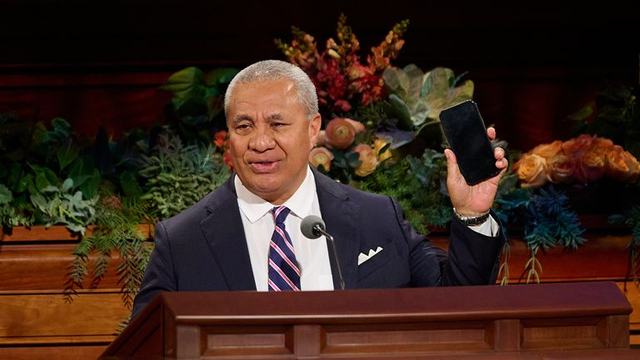
Elder Sikahema contrasts his grandparents’ costly journey with the ease of hearing prophetic messages through modern technology. He warns that convenient access does not necessarily lead to grateful or attentive listening. He invites members to value living prophets and apostles rather than treat the oracles of God as a light thing.
I suspect the Lord knew that even when we would have these devices (cell phones) to easily see and hear His anointed servants, many of us would still take them for granted.
What a blessing it is to live in a time when apostles and prophets are on the earth.
And all they who receive the oracles of God, let them beware how they hold them lest they are accounted as a light thing
- What contrast does Elder Sikahema draw between his grandparents’ circumstances and our access to prophetic teaching?
- What warning does Doctrine and Covenants 90:5 give those who receive the oracles of God?
- Why does easy access to prophetic messages still require deliberate attention and gratitude?
- What habits suggest that I sometimes take prophetic teaching for granted?
- How can I reduce distractions when I listen to or study general conference messages?
- What specific plan helps me revisit and apply a conference teaching rather than merely hear it?
Receive the Lord’s Word Through His Servants
Elder Sikahema recalls concerns among some early Church leaders about publishing revelations because of Joseph Smith’s writing skills. He directs attention to the Lord’s declaration that His word remains authoritative whether it comes through His own voice or the voice of His servants. The teaching invites readers to recognize divine messages without dismissing them because of a messenger’s limitations.
Some of them were embarrassed by the young prophet’s poor writing skills.
What I the Lord have spoken, I have spoken, and I excuse not myself; and though the heavens and the earth pass away, my word shall not pass away, but shall all be fulfilled, whether by mine own voice or by the voice of my servants, it is the same
I witness of the truths of the restored gospel and of living prophets, seers, and revelators in the sacred name of Jesus Christ, amen.
- Why do some early Church leaders hesitate to publish Joseph Smith’s revelations?
- How does Doctrine and Covenants 1:38 address concerns about receiving the Lord’s word through His servants?
- What does the Lord declare about the endurance and fulfillment of His word?
- Do I ever let a speaker’s style or limitations distract me from the gospel message?
- How can I approach prophetic teaching with greater humility and a desire to understand the Lord’s word?
- Which teaching from the Lord’s servants do I feel prompted to act on now, and what is my next step?
