
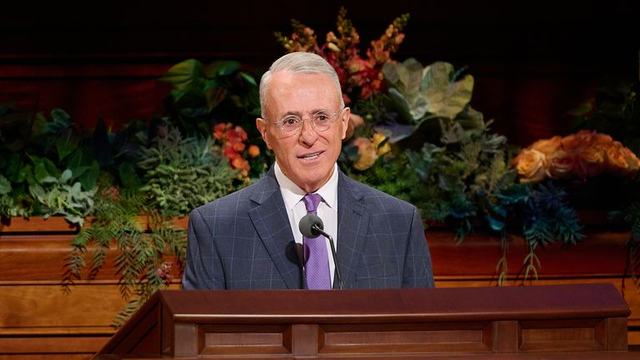
A Higher and Holier Fast
 Open talk in Gospel Library
Contents
Before Reading
Before reading or listening to the talk, consider the following questions:
- What distinguishes a higher and holier fast from simply going without food?
- How do fasting and prayer help us understand and accept the Lord’s will?
- What does Jesus Christ’s example teach us about the spiritual purpose of fasting?
- How do generous fast offerings connect our worship with Christlike service?
- What blessings does Elder Soares promise, and what does he invite us to do?
Topics
Make Fasting an Act of Sacred Worship
Elder Soares teaches that the law of the fast reaches beyond outward observance or physical restraint. It is an act of worship that refines our discipleship, brings the body into subjection to the spirit, and draws us nearer to God. Observing this law sincerely expresses our faith, love, and devotion to Heavenly Father and Jesus Christ.
In Isaiah chapter 58, the Lord lifted the vision of His covenant people beyond the outward observance of this law. He also revealed its divine purpose as an act of worship that shapes and refines our discipleship and draws us closer to Him.
Adopting this holy pattern of fasting is more than a physical test of restraint or a petition for specific blessings.
It is an elevating expression of faith and trust in the Lord through which our hearts can be filled with rejoicing as we commune with Him more deeply.
- How does Elder Soares distinguish the divine purpose of fasting from its outward observance?
- How does proper fasting help bring the body into subjection to the spirit?
- Why is fasting more than a petition for specific blessings?
- What attitudes or habits help me approach fasting as worship rather than merely physical restraint?
- What does my current approach to fasting reveal about my faith and trust in the Lord?
- What specific change can I make to honor the sacred purpose of my next fast?
Unite Fasting With Earnest, Intentional Prayer
A sincere fast includes humble, purposeful communication with the Lord. Elder Soares explains that fasting and prayer deepen our devotion, increase our awareness of our dependence on God, and soften our hearts. Together, they help us become more receptive to the Holy Ghost and better prepared to receive personal revelation.
A sincere and faithful fast is accompanied by earnest and intentional prayer.
As we lift our hearts to the Lord in humility, fasting becomes an expression of our desire to draw near to Him, communicate the true desires of our hearts, and understand His will for us.
Our hearts are softened, our souls become more receptive to the influence of the Holy Ghost, and we are better prepared to receive personal revelation and move forward along the covenant path.
- What purposes does earnest prayer serve during a fast?
- How does the union of fasting and prayer affect our humility and devotion?
- How does Elder Soares connect fasting with personal revelation and progress along the covenant path?
- What desires of my heart do I want to communicate honestly to Heavenly Father?
- How can I make prayer a more intentional part of my next fast?
- What experiences help me recognize the connection between humble worship and receptivity to the Holy Ghost?
Follow Christ and Align With the Father’s Will
Jesus Christ exemplifies fasting and prayer as a means of seeking complete alignment with His Father’s will. His example teaches that these practices do not necessarily remove burdens but provide divine power to overcome or endure them. Elder Soares encourages us to align our desires with the Lord’s purposes and trust His wisdom even when answers differ from our expectations.
As in all things, the Savior did not merely teach divine principles—He exemplified them perfectly.
His example teaches us that fasting and prayer may not remove every burden from our path, but they draw heaven near and endow us with divine power to overcome or endure whatever circumstances we may face, giving us the spiritual fortitude to remain faithful to the Father’s will.
It is a way to align our desires with His purposes, and our expectations with His wisdom.
Even when answers do not come in the way we expect, fasting and prayer help us develop greater confidence in the Lord, in our covenants with Him, and in His plan for our lives, as well as a deeper willingness to accept His will.
- What does the Savior’s preparation for His ministry reveal about the purpose of fasting and prayer?
- What is the difference between receiving strength to endure a burden and having that burden removed?
- How can fasting and prayer strengthen trust when answers do not match our expectations?
- In what situation do I need divine strength to overcome or endure rather than simply seek relief?
- Which desires or expectations do I need to bring into greater alignment with the Lord’s wisdom?
- How can I express both my sincere desires and my willingness to accept Heavenly Father’s will in my prayers?
Bless Others Through Generous Offerings and Consecrated Service
The law of the fast invites us to look beyond ourselves and express Christlike love for those in need. Elder Soares identifies generous fast offerings as a tangible way to respond to Isaiah’s call to free the oppressed and break every yoke. Giving our means and time consecrates our efforts to the Lord’s work and helps us become more compassionate instruments in His hands.
Thus, our fast becomes not only a personal act of devotion to God but also an outward expression of Christlike charity and love.
Each contribution reflects a willing heart, faith in the Lord Jesus Christ, and a sincere desire to bless those in need.
Though our fast offerings may seem small and simple, they become consecrated expressions of compassion, concern, and service.
As we give generously—not only for the benefit of those in need but also as an expression of our love for the Lord and our commitment to His work—we consecrate both our means and our time to Him.
- How do fast offerings give tangible expression to Isaiah’s teachings about an acceptable fast?
- How does the Savior’s example of succoring His people guide our response to others’ needs?
- Why does Elder Soares describe generous giving as consecration rather than simply financial assistance?
- How does fasting connect personal devotion with outward charity?
- How can I prayerfully evaluate the generosity and purpose of my fast offerings?
- Whose needs can I notice more carefully as I fast?
- What time, means, or service can I consecrate to help someone in need?
- How does my willingness to bless others reflect my love for Jesus Christ?
Embrace the Fast and Trust the Lord’s Promises
Elder Soares invites us to ponder Isaiah’s teachings and more intentionally embrace the divine purpose of fasting. He promises miracles, greater closeness to the Savior, strength to overcome weaknesses, and increased sensitivity to others’ needs. He also emphasizes that blessings often come quietly through softened hearts, stronger testimonies, personal revelation, and the Lord’s sanctifying influence.
I have personally witnessed how the blessings of fasting often enter people’s lives quietly and tenderly—softening hearts, strengthening testimonies, sanctifying souls, and transforming lives.
Fasting, when observed with joy and joined with prayer and generosity, brings sweeter communion with the Lord and a deeper, more personal connection with Him.
My dear friends, I invite you to prayerfully ponder Isaiah’s teachings and more intentionally embrace the divine purpose of the law of the fast in a higher and holier way as part of our worship.
You will draw nearer to the Savior, receive strength to overcome your weaknesses, and become more sensitive to the needs of others.
Through this divinely appointed practice, the Lord will sanctify us and pour His Spirit and blessings more abundantly into our lives.
- What action does Elder Soares invite us to take near the conclusion of his message?
- What blessings does he promise to those who embrace the divine purpose of fasting?
- How do quiet changes in the heart illustrate the sanctifying power of fasting?
- What do Isaiah’s promises teach about the Lord’s nearness and responsiveness?
- Which of Isaiah’s promises invites me to place greater trust in the Lord?
- What quiet spiritual blessings do I recognize in my life as I seek to fast sincerely?
- Which weakness do I want to bring before the Lord while seeking His strengthening power?
- What plan can I record for joining worship, prayer, and generosity in my next fast?
