
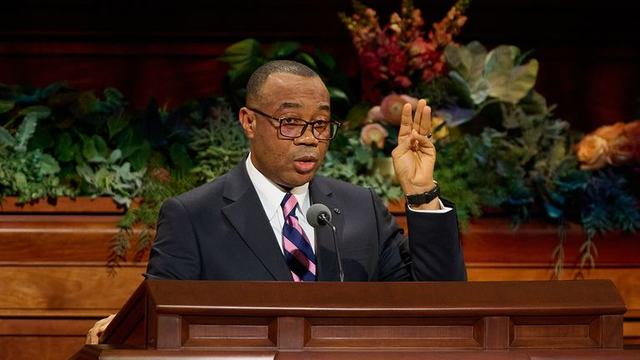
Spiritual Immunity
 Open talk in Gospel Library
Contents
Before Reading
Before reading or listening to the talk, consider the following questions:
- What concerns weigh on my mind, and how do I seek the Lord's help with them?
- What does spiritual immunity mean, and how does it help us face challenges without fear?
- How do small and simple gospel practices strengthen our relationship with Jesus Christ?
- What does the speaker teach about receiving strength when burdens remain?
- Which of the four practices do I feel prompted to approach more meaningfully?
Topics
Build Spiritual Immunity Through Small and Simple Things
Elder Chigbundu uses physical immunity as an analogy for the spiritual strength we need in troubled times. He teaches that challenges do not mean the Lord abandons us; they can provide opportunities for refinement and strengthening. Small and simple gospel practices serve as a spiritual compass and help us stand against the tactics of the devil.
As we build our spiritual immunity, we develop the strength and courage to withstand the challenges of life.
Know that the Lord has provided us with a spiritual compass to help us navigate life’s challenges.
By small and simple things are great things brought to pass
While they may seem small and simple, they are truly the armor of God that will help us stand against the tactics of the devil!
- How does Elder Chigbundu's comparison with physical immunity explain the purpose of spiritual immunity?
- What does President Eyring's teaching suggest about the Lord's love during proving moments?
- Which four small and simple practices does Elder Chigbundu identify as spiritual protection?
- What currently weighs on my mind, and how can these gospel practices help me navigate it?
- When do I recognize the Lord refining or strengthening me through a challenge?
- What small, consistent change do I feel prompted to make to strengthen my spiritual immunity?
Search the Scriptures to Know the Lord
Scripture study provides knowledge, but its deeper purpose is to help us come to know the Lord. As we apply His words, they shape our thoughts and responses to challenges. Daily, meaningful study invites the Holy Ghost's guidance, builds faith, and helps us become lifelong disciples of Jesus Christ.
When we study the scriptures, we get knowledge, but more important, we come to know the Lord.
As we apply what we learn, His words begin to shape how we think and how we respond to life challenges.
Daily, meaningful scripture study invites the guidance of the Holy Ghost and builds our faith to face the temptations and the troubles of the world.
As we do this, little by little we learn how to become lifelong disciples of Jesus Christ.
- What distinction does Elder Chigbundu make between gaining knowledge and coming to know the Lord?
- How does applying scripture change the way we respond to life's challenges?
- What does the missionary's experience illustrate about daily scripture study and understanding our purpose?
- How does my current scripture study help me know the Lord rather than simply gather information?
- What scripture helps me respond faithfully to a temptation or difficulty, and how can I apply it now?
- What specific study plan can I make to search the scriptures more diligently, especially the Book of Mormon?
Pray in Faith to Draw Near to God
Prayer draws us nearer to Heavenly Father as we seek His help, guidance, and blessings. Elder Chigbundu teaches that faithful prayer strengthens spiritual immunity and helps us recognize the Savior's love. The Lord does not always remove our burdens, but He can strengthen us to carry them.
Draw near unto me and I will draw near unto you; seek me diligently and ye shall find me
When we pray to our Heavenly Father, we draw near to Him and seek His help, guidance, and blessings.
As I pray daily, I realize that the Savior loves me.
The burden we carry may not always be removed, but our backs will be built to carry the load placed upon them
- How does prayer relate to the Savior's invitation to draw near to Him?
- What does the sister's experience with cancer teach about recognizing the Savior's love through prayer?
- What distinction does Elder Chigbundu make between removing a burden and receiving strength to carry it?
- What do I notice about the Savior's love as I pray daily?
- Which burden can I bring to Heavenly Father while also asking for strength to carry it?
- What experience with prayer can I record that reminds me of God's guidance or sustaining help?
Partake of the Sacrament and Remember Jesus Christ
The sacrament is a sacred ordinance that strengthens our relationship with the Savior. Elder Chigbundu emphasizes our promises to take upon ourselves Jesus Christ's name, always remember Him, and keep His commandments. Remembering Him throughout the week gradually refines our lives and helps us focus on learning and changing rather than asking only why we face difficulty.
The sacrament is a sacred ordinance that strengthens our relationship with the Savior.
During the sacrament we make promises to take upon us the name of Jesus Christ, to always remember Him, and to keep His commandments
As we partake of the sacrament, we can ask ourselves, “What would He have me do?”
Our “Why me?” questions will be replaced by “What can I learn, and what can I change?”
- Which promises does Elder Chigbundu highlight in connection with the sacrament?
- How does remembering Jesus Christ throughout the week refine and reshape our lives?
- How do the questions “What can I learn, and what can I change?” redirect our response to challenges?
- How can I prepare to partake of the sacrament with greater attention to my relationship with the Savior?
- As I ask “What would He have me do?”, what action comes to mind for this week?
- In a current challenge, what can I learn and what can I change?
Honor Covenants and Worship in the Temple
Covenants create a bond between us and God, and staying on the covenant path brings the blessings associated with that bond. Elder Chigbundu teaches that temple worship is vital to remaining on the covenant path. Even as trials come, worshipping in the temple and remembering our covenants help us receive personal direction from the Lord.
Making covenants and staying on the covenant path are inseparable companions.
Covenants create a bond between us and God, and staying on the covenant path brings the promised blessings that come with that bond.
Worshipping in the Lord’s house, the temple, is vital to staying on the covenant path.
Remember that trials may come, yet as we worship in the temple and remember our covenants, we receive personal direction from the Lord that will guide us along the covenant path.
- What relationship does Elder Chigbundu describe between making covenants and staying on the covenant path?
- According to President Oaks's teaching quoted in the talk, how do we honor our covenants?
- What does Elder Chigbundu promise about personal direction, and what does he acknowledge about continuing trials?
- How does remembering my covenant relationship with God influence my daily choices?
- What step can I take, according to my circumstances, to make temple worship or preparation more meaningful?
- What personal direction do I recognize as I remember my covenants, and how can I act on it?
