
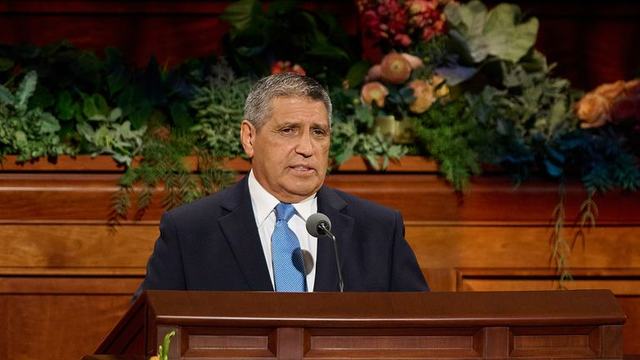
Trusting the Lord Through Tithes and Offerings
 Open talk in Gospel Library
Contents
Before Reading
Before reading or listening to the talk, consider the following questions:
- How does paying tithes and offerings demonstrate trust in the Lord?
- What does Elder Giuffra teach about obeying the law of tithing during financial hardship?
- How do prayer and fasting help people respond to a difficult commandment?
- How does obedience motivated by love differ from obedience motivated primarily by anticipated blessings?
- What blessings does Elder Giuffra describe, and what does he teach about their timing?
- How does paying tithing prepare us to live the law of consecration?
Topics
Exercise Faith Through Tithes and Offerings
Elder Giuffra presents the law of tithing as a law of faith rather than a commandment reserved for those with financial abundance. His account of a woman in Puerto Montt illustrates the tension between limited resources and trust in the Lord. His mission president invokes the widow’s mite to emphasize that difficult circumstances do not exclude someone from the commandment or its promised blessings.
President Caballero read to me the account of the widow’s mite and then said, “Elder Giuffra, you are no one to deny this sister the blessings of the law of tithing. There are no exceptions to this commandment.”
I testify that the law of tithing is a law of faith.
As we obey it, we demonstrate our trust in the Lord and allow Him to work miracles in our lives, often in ways we do not expect.
- Why does Elder Giuffra describe tithing as a law of faith?
- What does President Caballero’s counsel teach about the relationship between financial circumstances and the law of tithing?
- How does the account of the widow’s mite illuminate the principle of faithful sacrifice?
- What concerns or uncertainties do I bring to the commandment to pay tithes and offerings?
- When do I find myself evaluating obedience only from a worldly perspective? How can I also consider the Lord’s promises?
- What faithful step can I take to strengthen my trust in the Lord as I live this commandment?
Seek God's Help Through Prayer and Fasting
The missionary account shows both the missionaries and the woman turning to God for help. Elder Giuffra and his companion pray and fast, while the woman expresses her desire to join the Church and asks Heavenly Father to help her live the law of tithing. Her response brings the missionaries peace and assurance, and her consistent payment of tithes and fast offerings illustrates continuing commitment.
My companion and I decided to pray and fast because two days later we would return to review the commandments once again before her baptism.
Last night I knelt in prayer and told Heavenly Father that I truly wanted to become a member of His Church and that He would need to help me live this law.
As we heard those words, a profound feeling of peace and assurance filled our minds and hearts.
- How do the missionaries respond when teaching the law of tithing becomes difficult?
- What does the woman’s prayer reveal about her desires and her reliance on Heavenly Father?
- How does her ongoing payment of tithes and fast offerings illustrate commitment beyond an initial decision?
- Which commandment feels difficult for me to live, and how can I ask Heavenly Father for help?
- What experience with prayer or fasting strengthens my confidence that God hears me?
- What consistent habit can help me turn a sincere spiritual desire into ongoing obedience?
Keep Commandments Because You Love God
Elder Giuffra shares his wife’s teaching that love for God, rather than merely the hope of receiving blessings, motivates obedience. He explains that commandments draw us closer to the Savior, protect us, and help us remain free from sin and many worldly challenges. This perspective makes obedience an expression of relationship and devotion rather than only an expectation of reward.
We keep the commandments because we love God, not merely because we hope to receive the blessings that come from obedience.
Commandments are given to draw us closer to the Savior, to protect us, and to help us remain free from sin and many of the challenges the world presents.
- What distinction does Elder Giuffra make between loving God and hoping to receive blessings?
- What purposes do commandments serve beyond bringing particular blessings?
- How does obedience help deepen a person’s relationship with the Savior?
- What currently motivates my obedience to the law of tithing and other commandments?
- How can I make paying tithes and offerings a more deliberate expression of love for God?
- What examples in my life show that a commandment draws me closer to Christ or protects me from sin?
Trust God's Promises Amid Trials
Elder Giuffra describes both temporal and spiritual blessings associated with faithful payment of tithes and offerings, including greater stability, opportunities, stronger marriages, peace, and hope. He also makes clear that obedience does not eliminate uncertainty, financial hardship, illness, or loss. The Lord knows each person’s circumstances and fulfills His promises in His own time and way.
Some blessings have been temporal, others spiritual, but all have strengthened our testimony that the Lord always fulfills His promises and that the windows of heaven are opened according to our obedience.
Yet even when we do not understand the purpose of our trials, we can have the assurance that the Lord knows our circumstances, honors our obedience, and fulfills His promises in His own time and way.
Bring ye all the tithes into the storehouse, that there may be meat in mine house, and prove me now herewith, saith the Lord of hosts, if I will not open you the windows of heaven, and pour you out a blessing, that there shall not be room enough to receive it.
- What temporal and spiritual blessings does Elder Giuffra describe?
- Why does the presence of trials not mean that the Lord fails to honor obedience?
- How does the phrase “in His own time and way” shape our understanding of promised blessings?
- What spiritual blessings can I recognize even when my outward circumstances remain difficult?
- How can I avoid measuring God’s faithfulness only by immediate financial outcomes?
- What experience can I record that helps me trust the Lord’s timing during a current trial?
Prepare for Consecration Through Faithful Sacrifice
Quoting President Dallin H. Oaks, Elder Giuffra teaches that paying tithing brings unique spiritual blessings and demonstrates acceptance of the law of sacrifice. Tithing also prepares disciples for the law of consecration and other higher laws of the celestial kingdom. He connects these laws with keeping temple covenants, which deepens and perpetuates our relationship with Jesus Christ.
The payment of tithing … brings the individual tithe payer unique spiritual blessings.
Tithe paying is evidence that we accept the law of sacrifice. It also prepares us for the law of consecration and the other higher laws of the celestial kingdom.
These laws are fulfilled as we keep the covenants made in the house of the Lord, which deepens and perpetuates our relationship with Jesus Christ.
- According to President Oaks’s teaching, how does paying tithing demonstrate acceptance of the law of sacrifice?
- How does tithing prepare disciples for the law of consecration?
- What connection does Elder Giuffra make between these laws, temple covenants, and a relationship with Jesus Christ?
- What does my willingness to sacrifice reveal about my commitment to Jesus Christ?
- How can paying tithing help me become more willing to dedicate my resources and efforts to the Lord?
- How can I approach tithes and offerings with greater awareness of my temple covenants or my preparation to make them?
