
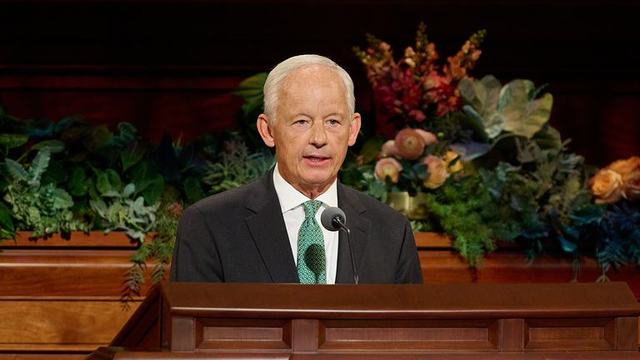
The Ninety and Ten
 Open talk in Gospel Library
Ideas for Opening the Lesson
- Display a backpack and invite class members to name burdens people carry that others cannot see. Ask, “What does it look like for Jesus Christ to carry a burden when the difficulty itself remains?” Introduce Elder Dunn’s race as an illustration of the Savior’s personal and sometimes unseen help.
- Write “Mile 90” on the board and briefly describe Elder Dunn’s exhaustion with only 10 miles remaining in his race. Invite class members to silently consider an area of life where they feel depleted or discouraged. Explain that the discussion explores how Christ helps us continue, without asking anyone to disclose private struggles.
- Read Elder Dunn’s statement, “the Redeemer rescues not by shortening our course but by helping us lengthen our stride.” Invite class members to discuss the difference between having a challenge removed and receiving strength to face it. Use their observations to introduce the talk’s teachings about grace.
- Invite class members to think of someone whose quiet support makes a difficult experience more bearable. Ask volunteers to share what makes that support meaningful, without revealing another person’s sensitive circumstances. Connect their observations to Ted’s example and the Savior’s practice of helping us through others.
- Write “Feeling broken” and “Being abandoned” on the board. Read Elder Dunn’s assurance that “feeling broken does not mean you’ve been abandoned by God.” Invite class members to consider why distinguishing these two experiences matters, and introduce the lesson as an opportunity to strengthen trust in Christ.
Topics
Recognize How Jesus Christ Carries Your Burdens
Ted quietly carries Elder Dunn’s water bottles and pack during the final 10 miles, illustrating help that is real even when it goes unnoticed. Elder Dunn connects this kindness to Jesus Christ, who bears our griefs and sorrows and lifts us in personal, sometimes unseen ways. The absence of obvious relief does not mean the Savior is absent.
But as I’ve come to learn through this race and the ups and downs of my life, He simultaneously lifts and uplifts, sometimes in unseen fashion, multiplying and magnifying even our most minuscule offerings.
- What does Ted’s quiet decision to carry the pack help you understand about the Savior’s care?
- How can we recognize the Lord’s support without assuming that every burden immediately disappears?
- What experience in your life helps you recognize the Savior’s care more clearly when you look back?
- How does knowing that Christ bears our griefs and sorrows influence the way we approach Him with emotional or spiritual burdens?
- What helps you remember the Savior’s love when you cannot identify how He is helping you?
- What practice can you adopt this week to notice and remember the Lord’s quiet help?
Turn to Christ for Strength to Continue
Elder Dunn describes grace as divine help or strength that increases our capacity beyond what we can accomplish alone. The Savior’s rescue does not always shorten the journey; it can enable us to keep moving through it. Turning to Christ, even with very little energy left, opens us to His sustaining help.
In other words, the Redeemer rescues not by shortening our course but by helping us lengthen our stride.
- How does the image of Christ helping us lengthen our stride deepen your understanding of grace?
- What is the difference between relying only on personal determination and relying on the Savior’s strength?
- What does turning to Christ look like in practical terms when you feel too tired to do much?
- What experience helps you understand the difference between a burden becoming lighter and your capacity becoming greater?
- How can we value small offerings of faith instead of dismissing them as insufficient?
- What manageable next step can help you turn toward Christ in a challenge you currently face?
Trust the Savior Who Knows Your Path
Elder Dunn trusts Ted because Ted knows the racecourse and believes in his ability to finish. He teaches that our trust in Jesus Christ rests on an even stronger foundation: the Savior knows the path of mortality, knows us personally, and understands our divine potential. His knowledge gives us reason to trust Him when our own confidence falters.
Because He “marked the path and led the way,” there is no portion of our mortal sojourn He has not trod. He not only knows the road; He knows you and what you, as noble offspring of the divine, are capable of.
- Why does it matter that Jesus Christ knows both the path and the person traveling it?
- What does Ted’s confidence in Elder Dunn illustrate about receiving encouragement when we doubt ourselves?
- How does your identity as a child of God influence the way you respond to discouragement?
- Which teachings or experiences strengthen your confidence that the Savior understands your particular struggles?
- How can we distinguish trust in Christ from confidence that events must unfold exactly as we prefer?
- What can you do to give the Savior’s understanding of your potential more influence than your current self-doubt?
Find Peace When Relief Comes Differently
Elder Dunn acknowledges that the timing and outcome of the Lord’s help may differ from what we plead for. Feeling broken does not mean God abandons us, and His involvement sometimes becomes clearer only with time and perspective. Through Jesus Christ, peace remains possible even when hoped-for outcomes do not come.
And even when the outcome or the timing is not what you plead for, take solace knowing that feeling broken does not mean you’ve been abandoned by God.
- Why is it important to acknowledge that faithful people can still feel depleted, defeated, or broken?
- How can we seek peace in Christ without pretending that disappointment or pain is easy?
- What helps you continue to pray when the answer or timing differs from your hopes?
- How does President Uchtdorf’s image of valleys and future mountains help you approach a trial you do not yet understand?
- What experience gives you confidence that the Lord’s love remains constant even when circumstances remain difficult?
- How can we speak about faith and trials in ways that comfort people rather than make them feel responsible for a lack of relief?
Help Others Carry Their Burdens
Elder Dunn teaches that the Savior sometimes sends people like Ted to encourage and support us. Ted illustrates patient companionship, sincere reassurance, and practical help offered without fanfare. His example invites us both to receive help and to consider how we can participate in the Savior’s care for others.
Other times He simply sends us a Ted.
- Which parts of Ted’s example show the difference between simply offering advice and genuinely helping someone carry a burden?
- How can we recognize someone who is approaching a personal “mile 90” without making assumptions about their situation?
- What experience with quiet, practical service helps you understand how the Savior works through others?
- What makes encouragement sincere and helpful rather than pressuring someone to hide exhaustion or pain?
- How can we become more willing to receive help instead of feeling that discipleship requires us to carry everything alone?
- Who can you support this week, and what respectful, specific form of help can you offer?
Additional Discussion Questions
- How does the race illustration change your understanding of what it means for the Savior to rescue us?
- What does Elder Dunn’s account teach about the relationship between preparation, personal effort, and help beyond our own strength?
- How can our quorum or Relief Society become a place where people feel safe acknowledging that they are struggling?
- What helps you distinguish the perceived invisibility of the Lord’s hand from the constancy of His love?
- How can remembering earlier experiences of divine help strengthen your faith during a present difficulty?
- What does “lay aside every weight” invite you to consider about burdens you can release or seek help carrying?
- How can we encourage patient endurance without suggesting that someone must face every difficulty without practical support?
- What does the talk teach about offering both spiritual reassurance and tangible assistance?
- How can trust in Christ shape the way you pray for someone whose circumstances you cannot change?
- Which teaching from this talk do you most need now, and what specific action can help you live it this week?
