
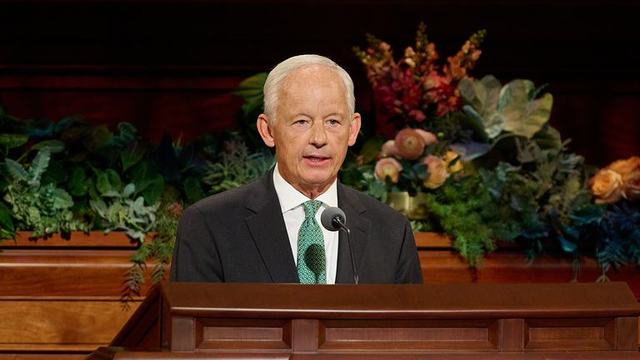
The Ninety and Ten
 Open talk in Gospel Library
Contents
Topics
Let Jesus Christ Carry Your Burdens
Elder Dunn discovers that his running partner quietly carries his water bottles and pack during the final miles of the race. This experience illustrates how Jesus Christ bears our griefs and sorrows, often helping us in ways we do not immediately recognize.
Without fanfare or fuss, he simply shouldered my heaviest burden.
He simultaneously lifts and uplifts, sometimes in unseen fashion, multiplying and magnifying even our most minuscule offerings.
In other words, the Redeemer rescues not by shortening our course but by helping us lengthen our stride.Key Points:
- Jesus Christ bears our griefs and carries our sorrows.
- The Savior’s help does not necessarily make the path shorter or remove its difficulties.
- Christ strengthens our capacity to continue and magnifies even our smallest offerings.
- His burden-bearing care sometimes becomes visible only as we look back.
- What difficult responsibility or trial helps you understand the difference between having a burden removed and receiving strength to carry it?
- When do you recognize, in retrospect, help from the Savior that you do not notice at the time?
- What experience illustrates how the Lord magnifies a small effort you offer?
- What everyday object or experience helps you explain the Savior’s burden-bearing care without overshadowing the doctrine?
Turn to Christ for Grace and Strength
Elder Dunn teaches that turning to Christ opens our lives to His constant care. He describes grace as divine help or strength and encourages those who feel depleted to use even their remaining energy to ask for the Savior’s assistance.
Anytime we turn to Christ, we turn a corner.
By His grace we can trust and expect His constant care.
His grace, which is a duality defined as a “divine means of help or strength,” can free us from the freight we would otherwise carry.
To those at or nearing their “mile 90,” ferrying the unimaginable, or if you feel like I did, both depleted and defeated, I promise that as you expend even your last drops of energy to ask, His helping hand will ultimately give you that much-needed leg up.Key Points:
- Turning to Jesus Christ changes how we face our challenges.
- Grace provides divine help and strength.
- God knows our needs before we express them in prayer.
- Even when our energy is nearly exhausted, we can ask for the Savior’s help.
- When does a simple prayer help you take the next step during an overwhelming experience?
- What experience helps you describe grace as strength rather than only relief?
- What does turning to Christ look like in your daily choices during a difficult season?
- How do you recognize God’s awareness of a need you struggle to express?
Trust the Savior Who Knows Your Path
Elder Dunn trusts Ted because Ted knows the course and believes he can finish it. He connects that trust to Jesus Christ, who knows our mortal journey, understands us personally, and recognizes our divine potential.
Because He “marked the path and led the way,” there is no portion of our mortal sojourn He has not trod.
He not only knows the road; He knows you and what you, as noble offspring of the divine, are capable of.
Through “him who is mighty to save,” you will find “strength beyond [your] own.”Key Points:
- The Savior’s knowledge of our journey gives us reason to trust Him.
- Jesus Christ knows each person individually.
- Our identity as offspring of the divine matters when we doubt our capacity.
- Relying on the Savior provides strength beyond our own.
- What experience with a trusted guide, teacher, or friend helps you explain trust in Jesus Christ?
- When does remembering that the Savior understands you personally change how you approach a challenge?
- How does your divine identity help you resist discouragement or self-doubt?
- What experience helps you testify that Christ supplies strength beyond your own?
Recognize Christ’s Help Through Other People
Ted’s patient encouragement and quiet service illustrate how the Savior’s care can reach us through others. Elder Dunn teaches that Christ enlists helpers and promises angels to bear us up.
“I know you can do this, Mike, and I’m going to get you there.”
And even when we don’t perceive Him at our side, He enlists the Teds—both of this world and sometimes even the Teds beyond—with His heartening promise of angels all around us to bear us up.
Other times He simply sends us a Ted.Key Points:
- The Savior sometimes answers our needs through another person’s encouragement and service.
- Quiet, practical assistance can meaningfully lighten a heavy burden.
- Christ’s care includes His promise of angels to support us.
- Recognizing those who help us can deepen our gratitude for the Savior.
- Who serves as a “Ted” in your life, and how does that person help you recognize Christ’s care?
- When does someone quietly lighten your load without seeking recognition?
- What experience of receiving help teaches you to accept support rather than face everything alone?
- When do you feel prompted to encourage or assist someone who seems close to giving up?
Keep Trusting When Relief Takes Time
Elder Dunn acknowledges that the Lord’s timing and the outcome of a trial may differ from what we request. He teaches that feeling broken does not mean God abandons us and that the Savior offers peace and strength as we patiently continue.
And even when the outcome or the timing is not what you plead for, take solace knowing that feeling broken does not mean you’ve been abandoned by God.
Often we can’t see the Lord’s hand in our lives until long after the trials have passed.
Peace will come even when hoped-for outcomes do not.
But most often He tops off our courage, capacity, and confidence by empowering us to “lay aside every weight” so we can “run with patience the race that is set before us.”Key Points:
- Unwanted outcomes and delayed relief do not mean God abandons us.
- As Elder Dunn emphasizes through President Dieter F. Uchtdorf’s teaching, hindsight often helps us recognize the Lord’s hand.
- The Savior can provide peace even when circumstances remain difficult.
- Christ empowers us to lay aside burdens and continue our race with patience.
- When does the answer to a prayer differ from what you hope for, yet still reveal God’s care?
- What past difficulty do you understand more clearly as you look back?
- When do you experience peace while an important problem remains unresolved?
- What small, faithful step helps you continue during a personal “last 10 miles”?
