
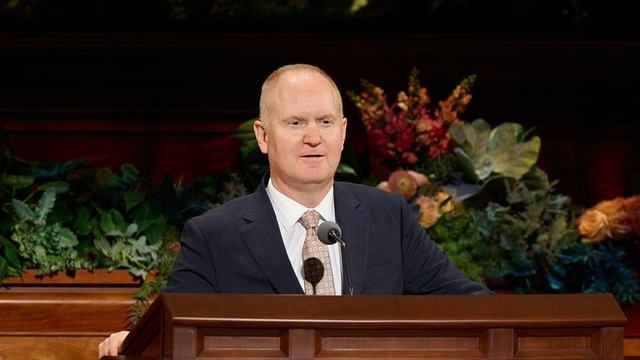
Comfort from the Holy Ghost
 Open talk in Gospel Library
Contents
Before Reading
Before reading or listening to the talk, consider the following questions:
- How do I respond when I face a problem I cannot fix?
- What does Elder Eyring teach about the relationship between comfort, hope, and faith?
- How does Jesus Christ’s victory over death and sin change my perspective on present challenges?
- Through what means does the Lord provide comfort and help?
- How can I make the constant companionship of the Holy Ghost a higher priority?
Topics
Recognize Your Limits and Comfort Others
Elder Eyring explains that everyone encounters burdens beyond personal strength, talent, or determination. His experiences with grieving parents illustrate how shared suffering can deepen empathy and help us fulfill our covenant responsibility to mourn with and comfort others. Recognizing our limits opens our hearts to receiving and offering help.
But our apparent self-reliance masks a deeper reality: All of us, regardless of experience, talent, or willpower, will sooner or later encounter burdens we cannot possibly carry ourselves.
As we sat at the table expressing empathy gained through our own suffering, we were grateful “to mourn with those that mourn … and comfort those that stand in need of comfort.”
We spoke together of parenthood, feelings of loss, and the path to healing and hope.
- Why does Elder Eyring distinguish apparent self-reliance from our deeper need for help?
- How does personal experience with suffering contribute to comforting others?
- What does the account of the grieving parents illustrate about mourning with those who mourn?
- What burden do I currently struggle to carry alone, and what help can I allow myself to receive?
- Who around me needs someone to listen, mourn with them, or offer companionship?
- How can I draw on my experiences to express empathy without assuming that another person’s grief is identical to mine?
Turn to Jesus Christ with Your Burdens
Jesus Christ understands our darkest and most trying experiences because He suffers for us. Elder Eyring invites us to turn humbly to the Lord and trust His promise to draw near. The Lord provides comfort and answers on His timetable, including through resources, practical tools, and other people as guided by the Spirit.
Our Savior, Jesus Christ, suffered for us. He knows exactly how we feel, especially in our darkest and most trying times.
As you humbly turn to the Lord and cast your burdens on Him, you have His promise: “Draw near unto me and I will draw near unto you.”
Answers will come by various means as guided by the Spirit, sometimes in the form of tools, resources, and help from other people.
- Why can we trust the Savior to understand our suffering?
- What does the Lord promise those who draw near to Him?
- What does Elder Eyring teach about the timing and forms of the Lord’s answers?
- What does humbly casting my burdens on the Lord look like in my present circumstances?
- When do I recognize the Lord’s help through another person, a resource, or a practical tool?
- How can I continue drawing near to the Savior while I wait for answers?
Find Hope in Christ’s Victory over Death and Sin
Elder Eyring teaches that hope rests in Jesus Christ and His rescue from physical death and separation from God because of sin. The reality of a universal resurrection changes how we view mortal limitations and the deaths of loved ones. This eternal perspective gives us strength to endure challenges without treating them as permanent tragedies.
There is hope in Jesus Christ.
He spares us from the only two things that can bring us permanent misery: separation from our bodies and separation from God because of sin.
Even as He comforts us through temporary times of challenge and pain, He has prepared our rescue from permanent tragedy.
Jacob, in the Book of Mormon, taught: “O how great the goodness of our God, who prepareth a way for our escape from the grasp of this awful monster; yea, that monster, death and hell, which I call the death of the body, and also the death of the spirit.”
- What two sources of permanent misery does Elder Eyring identify?
- How does belief in a literal, universal resurrection change our perspective on mortality?
- How does the Savior’s rescue from death and sin provide hope amid present suffering?
- How does the promise of resurrection influence the way I think about loss, illness, or physical limitations?
- What current fear can I examine in light of the Savior’s victory over death and sin?
- What can I record about Jesus Christ that helps me hold on to hope during difficult times?
Recognize God’s Generosity amid Suffering
Elder Eyring invites us to appreciate the depth of the Savior’s sacrifice and recognize the Father and the Son as givers of good gifts. He teaches that God prepares blessings beyond our present understanding. Suffering that brings us closer to the Savior prepares us for greater blessings, even when we cannot yet see their fullness.
Do we truly appreciate all the Lord has done for us?
We will better understand and appreciate the depth of the Savior’s sacrifice and the reality that He and the Father are truly givers of good gifts.
“Eye hath not seen, nor ear heard, neither have entered into the heart of man, the things which God hath prepared for them that love him.”
We will realize that all the suffering that brought us closer to the Savior was preparing us for greater blessings.
- What does Elder Eyring invite us to recognize about the Father and the Son?
- What does the passage from 1 Corinthians teach about the blessings God prepares?
- How does Elder Eyring connect drawing closer to the Savior through suffering with greater blessings?
- What gifts from the Father and the Son do I recognize in my life today?
- How can I draw closer to the Savior through a challenge without minimizing its pain?
- What experience helps me trust God’s goodness when I do not understand my circumstances?
Prioritize the Holy Ghost’s Constant Companionship
The Savior makes His peace manifest through the comforting power of the Holy Ghost. Elder Eyring emphasizes prophetic warnings that the Spirit’s constant influence is essential to spiritual survival, particularly amid increasing turbulence. He illustrates this comfort through a grieving father’s priesthood blessing and urges us to make living worthy of the Holy Ghost’s companionship one of our highest priorities.
We have received repeated prophetic warnings that in coming days we will not survive spiritually without the constant influence of the Holy Ghost.
Without divine comfort, we risk losing hope; and without hope, we can lose our faith and stop trying.
The Savior’s peace is made manifest through the comforting power of the Holy Ghost.
Living worthy of the constant companionship of the Holy Ghost should be one of our highest priorities.
I will not leave you comfortless: I will come to you.
- What does Jesus Christ promise about the Comforter?
- How does Elder Eyring explain the relationship between divine comfort, hope, and faith?
- What does the grieving father’s priesthood blessing illustrate about peace that passes understanding?
- Why does Elder Eyring make the Holy Ghost’s constant companionship such a high priority?
- When do I recognize the Holy Ghost bringing peace even though my circumstances remain difficult?
- What specific change can I make to better seek and welcome the Holy Ghost’s companionship?
- How can I remember the Savior’s promise not to leave me comfortless when I feel lonely or overwhelmed?
- When appropriate, how can I seek a priesthood blessing as part of turning to the Lord for comfort?
