
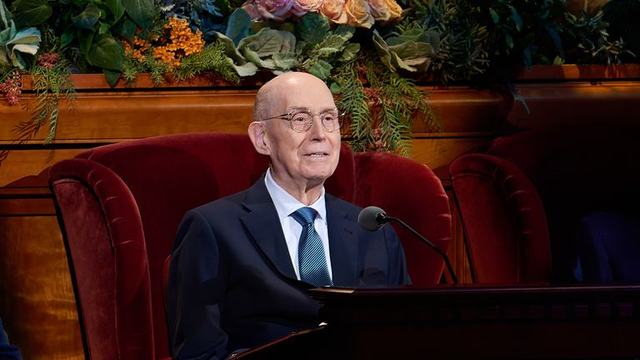
“Fear Not, I Am with Thee”
 Open talk in Gospel Library
Contents
Before Reading
Before reading or listening to the talk, consider the following questions:
- What does the promise “Fear not, I am with thee” mean when a trial continues?
- Why does a loving Heavenly Father allow His children to face difficult tests?
- How does the Savior’s knowledge of our griefs and sorrows help us trust Him?
- How does the Lord use His disciples to answer prayers and provide comfort?
- Who might need the encouragement or comfort I can offer?
Topics
Trust the Lord’s Promise of Sustaining Help
President Eyring affirms that the promises expressed in the hymn and in Isaiah are true. The Lord promises strength and help through challenges, not the removal of every challenge. These assurances become increasingly precious as we and those we love face trials.
My message today is that the promises in that hymn are true.
It is important to realize that the promise is not for the removal of challenges.
Fear not, I am with thee; oh, be not dismayed, For I am thy God and will still give thee aid. I’ll strengthen thee, help thee, and cause thee to stand, Upheld by my righteous, … omnipotent hand.
- What distinction does President Eyring make between receiving divine help and having challenges removed?
- Why do the Lord’s promises become more precious as we face difficulties?
- What does the hymn teach about the kinds of circumstances in which God offers help?
- Which current challenge invites me to rely more fully on the Lord’s sustaining help?
- What evidence of the Lord’s support do I recognize even while a difficulty continues?
- How can I keep the promise “Fear not, I am with thee” before me during the coming week?
Grow Through Trials by Choosing to Follow Christ
Mortal life tests our willingness to do what the Lord commands. Heavenly Father allows difficult experiences because we need to grow in spiritual cleanliness and stature to live in His presence. He provides a Savior who knows us perfectly, bears our griefs, and makes it possible for us to choose faith, obedience, and repentance.
It is because He knows that we must grow in spiritual cleanliness and stature to be able to live in His presence.
To make that possible, Heavenly Father gave us a Savior and the power to choose for ourselves by faith to keep His commandments and to repent and to come unto Him.
The Savior not only understands and has felt grief, but He has “borne [your] griefs, and carried [your] sorrows.” He knows you perfectly. He knows your heart.
But what is being tested is the same, at all times in our lives and for every person: Will we do whatsoever the Lord our God will command us?
- How does President Eyring explain the purpose of difficult mortal tests?
- What remains the same about our testing even when our trials differ?
- How do the Savior and our power to choose make spiritual growth possible?
- What choice to obey, repent, or come unto Christ is before me in my present circumstances?
- How does knowing that the Savior understands my heart influence my response to difficulty?
- What spiritual growth do I recognize as I continue to exercise faith through a trial?
Help the Lord Fulfill His Promises Through Service
President Eyring uses his parents’ experiences to illustrate how the Lord sends faithful disciples to help people in distress. God notices His children and often meets their needs through another person. Serving others allows us to participate in His work of providing comfort and sustaining help.
Now, I tell that story to offer evidence that the Lord sends faithful disciples to help Him keep His promise to succor others in their distress.
As President Spencer W. Kimball taught: “God does notice us, and he watches over us. But it is usually through another person that he meets our needs.”
I wish to thank those who have helped Him and encourage others to join Him in keeping His promise today and in the hard days ahead.
- What does the example of President Eyring’s father illustrate about the way the Lord helps His children?
- How does President Kimball’s teaching connect ordinary acts of service with God’s care?
- What invitation does President Eyring extend to those who can help others?
- Who helps me recognize the Lord’s care through their service?
- What needs around me offer an opportunity to help the Lord fulfill His promises?
- What specific act of service can I offer today, and how can I follow through?
Seek Promptings and Reach Out to Others
Prayer helps us recognize whom the Lord wants us to serve. President Eyring describes disciples who receive a name or face in their minds and respond by reaching out. Even simple attention can comfort someone and help that person recognize the Lord’s knowledge and love.
You have prayed in faith consistently for your family members or friends to know who the Lord would have you help for Him.
As a face or a name has come into your mind, you have reached out to them.
Even your simple attention was a comfort. That you felt prompted to reach out to them was evidence to them that the Lord knew and loved them.
- What connection does President Eyring describe between prayer, prompting, and service?
- How can a simple expression of attention help someone feel God’s love?
- Why is acting on a prompting an important part of the examples President Eyring gives?
- Whose name or face comes to mind as I prayerfully consider whom to help?
- What simple message, visit, or expression of care can I offer that person?
- What experiences help me recognize the value of responding promptly to invitations to serve?
Strengthen Missionaries and Church Servants Through Encouragement
Missionaries and others who hold Church callings need encouragement as they seek guidance and strength to serve. Kindness, warm smiles, prayers, appreciation, and expressions of confidence can help answer their prayers for assurance. Such support helps them feel that the Lord knows them and guides their work.
Whatever they are assigned to do, they are in need of encouragement.
Your kindness to them, even for a few seconds, or simply a warm smile can be a strengthening of their faith that the Lord is watching over them.
You are an important part of the Lord’s answers to their prayers for assurance.
- What needs does President Eyring identify among missionaries and those serving in Church callings?
- How can small expressions of kindness strengthen a missionary’s faith?
- How can appreciation and confidence help Church servants feel assurance about their callings?
- Which missionary or Church servant can I encourage this week?
- What sincere expression of appreciation can I offer for that person’s service?
- How can I make praying for those who serve a more consistent part of my personal worship?
Bear Burdens and Comfort Others Through the Spirit
President Eyring invites us to seek the Holy Ghost’s help in comforting those who plead for relief. Alma’s teaching connects belonging to God’s people with bearing burdens, mourning with others, and offering comfort. The Lord gives us the blessing and trust of helping His children through their mortal journey, and He keeps His promises through the Holy Spirit and faithful disciples.
Another great opportunity can come when you invite the Holy Ghost to help you find ways to help the Lord comfort those who are pleading for it.
As ye are desirous to come into the fold of God, and to be called his people, and are willing to bear one another’s burdens, that they may be light; … willing to mourn with those that mourn; yea, and comfort those that stand in need of comfort.
And He offers us the great blessing and trust to help Him keep His promise to succor Heavenly Father’s children in their tests along their mortal journey toward home.
I testify that this is His Church and that He keeps His promises, both through the Holy Spirit and through His loving, true, faithful disciples, in the name of Jesus Christ, amen.
- What responsibilities does Alma associate with becoming part of God’s people?
- How does the Holy Ghost help us participate in the Lord’s work of comforting others?
- According to President Eyring’s concluding testimony, through whom does the Lord keep His promises?
- Whose burden can I help make lighter without assuming I must solve every problem?
- How can I mourn with someone and offer comfort in a way that respects that person’s needs?
- What guidance do I seek from the Holy Ghost before reaching out?
- How does helping others deepen my understanding of the promise “Fear not, I am with thee”?
