
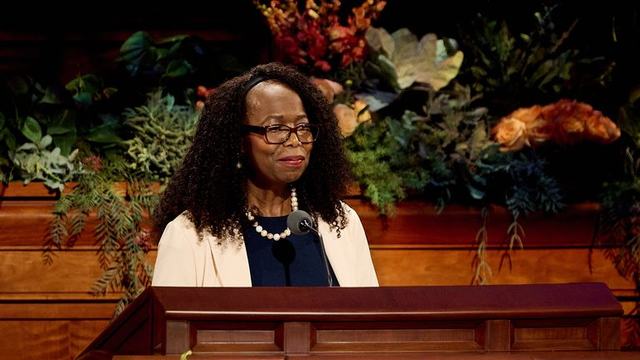
A Child of God
 Open talk in Gospel Library
Ideas for Opening the Lesson
- Write “Sawubona: I see you” on the board. Explain President Chibota’s teaching that this greeting communicates recognition, respect, and belonging. Invite class members to consider what helps them feel genuinely seen, then introduce the invitation to see others through the Savior’s eyes.
- Invite class members to silently consider someone whose quiet contributions often go unnoticed. Read the account of President Chibota’s daughter greeting the school janitor by name and helping him clean up. Ask what this example teaches about the connection between recognizing someone’s worth and serving them.
- Write “Child of God,” “Child of the covenant,” and “Disciple of Jesus Christ” on the board. Invite class members to consider how these eternal truths differ from labels based on occupation, achievement, or circumstances. Introduce the talk as an invitation to let divine identity shape how we see ourselves and others.
- Invite class members to open John 5:5–9 and notice how Jesus responds to the man at the pool of Bethesda. Read President Chibota’s observation that the Savior sees someone others pass by. Ask the class to consider whom we may overlook in our everyday routines.
- Give class members a quiet moment to reflect on this statement: “God’s view of us is always more complete and more hopeful than our own.” Invite anyone who wishes to share what stands out in that statement, without asking for private details. Explain that the lesson explores both our own divine worth and the worth of those around us.
Topics
See Each Person Through the Savior’s Eyes
President Chibota teaches that Jesus Christ sees beloved sons and daughters of God where others see labels. His encounters with individuals demonstrate recognition, love, and concern for their worth. As His disciples, we seek His perspective and treat every person accordingly.
I plead with you as disciples of Jesus Christ to pray to see others as He sees them and to treat them accordingly.
- What do the Savior’s encounters mentioned in the talk teach us about how He sees people?
- How does the meaning of sawubona—“I see you”—deepen our understanding of Christlike love?
- What assumptions or labels sometimes keep us from recognizing another person’s divine worth?
- What experiences help you understand the difference between noticing someone and truly seeing them?
- How can we show respect and love to someone whose choices or circumstances differ from our own?
- Whom might we overlook in our quorum, Relief Society, or community, and how can we change that?
Turn Recognition into Simple Acts of Service
Seeing another person’s divine worth leads to love and practical service. President Chibota highlights the good Samaritan and her daughter’s friendship with a school janitor to show that compassion includes action. Learning a name, offering a greeting, and helping with ordinary tasks can communicate belonging.
The Savior’s example and the good Samaritan’s compassion are not beyond our reach. Often, helping others feel seen as children of God begins with something as simple as learning their name.
- What stands out to you about President Chibota’s daughter’s interactions with the school janitor?
- Why can learning and using someone’s name make such a meaningful difference?
- What does the good Samaritan teach us about moving from recognition to action?
- What experiences show you that a small act of kindness can meet a significant need?
- How can we make room for simple service when our schedules feel full?
- What everyday opportunity allows you to help someone feel seen this week?
Place Eternal Identity Above Worldly Labels
President Chibota teaches that our identity as beloved children of God is inherited rather than achieved. Roles, circumstances, mistakes, and others’ judgments do not change that eternal identity. Embracing divine identity helps guide our decisions and changes how we view ourselves and others.
Our identity is not something we achieve; it is something we inherit as beloved sons and daughters of God.
- What is the difference between an identity we inherit and a status we try to achieve?
- How can useful descriptions, such as an occupation or family role, become limiting labels?
- How does knowing you are a child of God affect your response to mistakes or misunderstanding?
- What experiences help you recognize that your worth does not depend on achievement or recognition?
- How can your eternal identity guide a decision you currently face?
- What can you do to give “Child of God,” “Child of the covenant,” and “Disciple of Jesus Christ” greater influence in your daily thinking?
Trust Jesus Christ to Help You Become
The Savior sees both who we are now and who we can become. President Chibota teaches that His atoning sacrifice makes our divine potential possible and that His grace lifts us above labels and limitations. Trusting His fuller, more hopeful view of us helps us respond to feelings of inadequacy.
He sees not only who we are but who we can become. Through His atoning sacrifice, He makes that divine potential possible for all of us.
- How does the Savior’s view of who we can become differ from the way we sometimes view ourselves?
- What does President Chibota’s account of receiving her calling teach us about feelings of inadequacy?
- How does understanding Christ’s atoning sacrifice bring hope when a label feels difficult to escape?
- What experiences help you trust that the Lord knows you and sees your potential?
- How can we acknowledge real challenges without treating them as the full definition of a person?
- What step toward growth can you take as you rely on the Savior’s grace?
Seek Divine Guidance to Build Belonging
President Chibota teaches that Heavenly Father guides us toward people who need to feel seen as we pray and act on promptings. Her account of including an isolated coworker illustrates how small, inspired efforts deepen relationships. She invites us to learn a name, pray for divine perspective, and replace worldly labels with eternal truths.
I learned that when we ask Heavenly Father to help us see others, He guides us to those who feel unseen.
- What do you learn from President Chibota’s prayer and efforts to include her coworker?
- How might praying to see others change what we notice during an ordinary day?
- What experiences help you recognize the value of acting on a simple prompting to include someone?
- How can our quorum or Relief Society make belonging more than a friendly greeting?
- Which of President Chibota’s three invitations do you feel drawn to act on this week, and why?
- How can we follow through on an initial impression so that someone experiences lasting friendship and care?
Additional Discussion Questions
- How are seeing ourselves as children of God and seeing others as children of God connected?
- What does the Savior’s love for the rich young man teach us about loving someone who does not respond as we hope?
- How can we help someone feel seen without assuming we understand everything about their circumstances?
- What habits in our homes help family members feel recognized, respected, and valued?
- How can remembering divine identity change the way we speak about people who are not present?
- What does President Spencer W. Kimball’s teaching about God meeting needs through other people invite us to do?
- How can we respond when someone describes themselves mainly through a discouraging label?
- What might change in our ministering if we focus first on knowing and valuing the person rather than completing a task?
- How can we help one another remember that changing circumstances do not change our identity as children of Heavenly Father?
- As you consider the talk as a whole, what specific action can you take this week to help your home, ward, or community become a place of belonging, healing, and love?
