
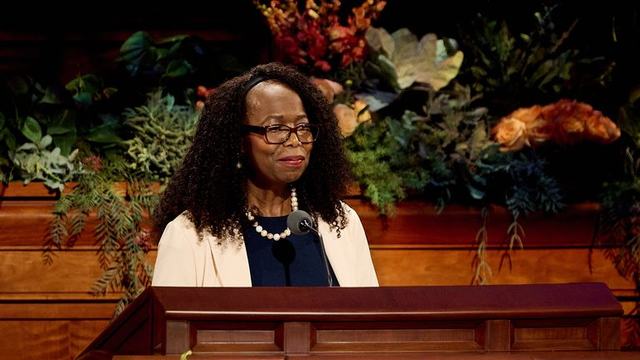
A Child of God
 Open talk in Gospel Library
Contents
Before Reading
Before reading or listening to the talk, consider the following questions:
- What does it mean to truly see someone as a child of God?
- How does Jesus Christ show that He recognizes and loves individuals?
- Which labels influence how I view myself or other people?
- How does my identity as a child of God influence my choices?
- Who might Heavenly Father guide me to notice and include this week?
Topics
See Each Person as a Beloved Child of God
President Chibota explains that seeing another person means acknowledging their worth, humanity, and belonging. Jesus Christ exemplifies this recognition by seeing beloved sons and daughters of God where others see labels. His example and the good Samaritan’s compassion invite us to recognize divine worth across differences.
This greeting is much more than a simple “hello.” It is an acknowledgment of another person’s worth and humanity.
Where others saw labels, He saw beloved sons and daughters of God.
Rather than allowing labels or differences to distract him, he saw a child of God in need and acted.
Remember that every person has divine worth.
- What does sawubona communicate beyond a simple greeting?
- How does the Savior’s response to the rich young man illustrate love that does not depend on another person’s response?
- What do the examples of the Savior and the good Samaritan teach about looking beyond labels?
- When do I feel genuinely seen and valued? What do those experiences teach me about treating others?
- Whom do I tend to view primarily through a label, role, or difference? How can I recognize that person’s divine worth?
- How can I communicate “I recognize you. I respect you. You matter” in an interaction today?
Pray, Notice, and Serve Those Who Feel Unseen
President Chibota teaches that love and service naturally follow when we see others through the Savior’s eyes. She shows how learning a name, offering a greeting, helping with ordinary work, and including an isolated coworker communicate care. She invites us to pray for Heavenly Father’s perspective and act on promptings to reach those who feel unseen.
Often, helping others feel seen as children of God begins with something as simple as learning their name.
I plead with you as disciples of Jesus Christ to pray to see others as He sees them and to treat them accordingly.
When we see others through the Savior’s eyes, love and service naturally follow.
Learn the name of someone who may feel unseen.
- How does President Chibota connect seeing others through the Savior’s eyes with love and service?
- What does the janitor’s response reveal about the significance of small acts of recognition?
- What does the coworker experience teach about prayer and acting on promptings?
- Whose name can I learn this week, and how can I follow that introduction with genuine interest?
- As I pray to see others as Heavenly Father sees them, what impressions do I notice?
- What simple act of inclusion or service can I offer to someone who seems isolated?
- How can I help my home, ward, school, or community become a place where people feel they belong?
Place Eternal Identity Above Worldly Labels
President Chibota teaches that our identity as children of God is inherited, not achieved. Roles, circumstances, mistakes, and misunderstandings do not change that eternal identity. She invites us to replace worldly labels with the truths “Child of God,” “Child of the covenant,” and “Disciple of Jesus Christ,” and to let divine identity influence our decisions.
Our identity is not something we achieve; it is something we inherit as beloved sons and daughters of God.
Before we were students, athletes, employees, parents, citizens, or leaders, we were spirit children of our Heavenly Father.
That eternal identity does not change when circumstances change, when we make mistakes, or when others misunderstand us.
Replace worldly labels with these eternal truths: Child of God. Child of the covenant. Disciple of Jesus Christ.
- What distinction does President Chibota make between an inherited identity and an achieved identity?
- Why can worldly labels never fully capture who we are?
- What circumstances does she identify as unable to change our identity as children of Heavenly Father?
- How does embracing divine identity influence major decisions?
- Which labels most strongly shape my self-image? How do they compare with my eternal identity?
- How can I respond to a mistake or misunderstanding while remembering that I remain a beloved child of God?
- What current decision can I reconsider through the identities “Child of God,” “Child of the covenant,” and “Disciple of Jesus Christ”?
- What experience helps me recognize that my worth is not something I must earn?
Trust Jesus Christ to Develop Your Divine Potential
President Chibota teaches that the Savior sees both who we are and who we can become. His atoning sacrifice makes our divine potential possible, and His grace lifts us above labels and limitations. Remembering that the Lord knows us helps us face inadequacy with hope and trust in Heavenly Father’s plan, with Jesus Christ at its center.
He sees not only who we are but who we can become.
Through His atoning sacrifice, He makes that divine potential possible for all of us.
Whatever labels may weigh heavily upon you today, Jesus Christ can raise you above them.
His grace is sufficient to lift you above every label and limitation.
He has a plan for your life, and Jesus Christ is at the center of that plan!
- How does the Savior’s view of our potential differ from a view limited to our present circumstances?
- What role does Jesus Christ’s atoning sacrifice play in making divine potential possible?
- How does President Oaks’s assurance that “The Lord knows you” help President Chibota respond to inadequacy?
- Where do I feel inadequate, and how can remembering that the Lord knows me change my response?
- What label or perceived limitation do I need the Savior’s help to rise above?
- When do I recognize the Savior’s grace helping me grow beyond my own expectations?
- What step can I take this week to place Jesus Christ more fully at the center of my efforts to grow?
