
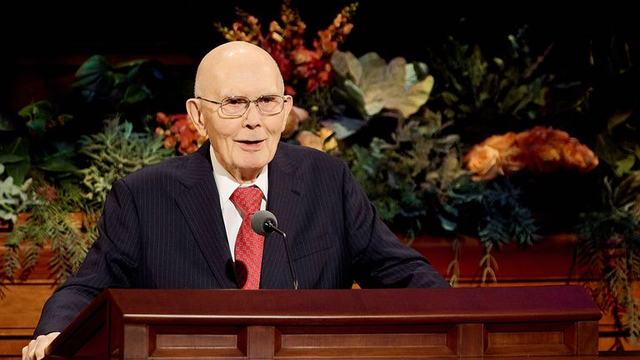
The Gospel of Jesus Christ Is for All
 Open talk in Gospel Library
Contents
Before Reading
Before reading or listening to the talk, consider the following questions:
- What does it mean that this is Jesus Christ’s Church?
- How can I draw closer to the Savior when I experience questions, doubts, or struggles?
- How do spiritual learning, humility, and covenant keeping strengthen faith?
- What does the Book of Mormon teach about the Savior’s love for all people?
- How can I act on and share the truth that the gospel of Jesus Christ is for all?
Topics
Center Your Faith on Jesus Christ
President Oaks identifies the Church as Jesus Christ’s Church because it possesses the restored fulness of His doctrine and authority. He explains the distinct roles of Heavenly Father and Jesus Christ in the plan of salvation and testifies that salvation comes through Christ’s atoning blood. The invitation to come unto Christ extends to everyone.
This is the Church of Jesus Christ, so named because it is His Church with the restored fulness of His doctrine and authority in these latter days.
As the Book of Mormon declares, “Salvation was, and is, and is to come, in and through the atoning blood of Christ, the Lord Omnipotent.”
Latter-day Saints invite each other and all men and women everywhere to “come unto Christ.”
- What reasons does President Oaks give for calling the Church Jesus Christ’s Church?
- How does President Oaks describe the roles of Heavenly Father and Jesus Christ?
- According to the scriptures he quotes, through whom does salvation come?
- How does knowing that this is Jesus Christ’s Church influence my approach to worship and Church participation?
- What experiences help me recognize the Savior’s redeeming power in my life?
- What specific step can I take this week to come unto Christ?
Strengthen Faith While You Wait Upon the Lord
President Oaks teaches that drawing closer to Jesus Christ is the way to address struggles, questions, and doubts. Strong faith requires daily effort through prayer and scriptural learning, not desire alone. Because everyone is a work in progress, he encourages patience with others and ourselves, humility, and trust in the Lord’s timing and promises.
Whatever they are, the way to overcome them is to get closer to our Savior, Jesus Christ.
Strong faith requires more than strong desire. It means daily trying, one step at a time, with prayer and scriptural learning.
Hold on to the first article of faith even if something else is uncertain.
And while you wait, wait upon the Lord, which includes trusting in His timing as well as in His promises.
- How does President Oaks distinguish strong faith from strong desire?
- Why does he encourage patience with ourselves and others on the covenant path?
- What does waiting upon the Lord include?
- What foundational beliefs does he invite us to hold onto during uncertainty?
- What concern or question can I bring to the Savior through prayer and scripture study?
- What daily practice helps me strengthen faith one step at a time?
- Where do I need greater patience with my own spiritual growth or someone else’s?
- How can I show trust in the Lord while an answer remains uncertain?
Seek Truth Through Study, Revelation, and Humility
President Oaks describes two methods of gaining knowledge: scientific and informational inquiry, and spiritual learning through faith, scriptures, inspired teaching, and personal revelation. He teaches that there is no ultimate conflict between truth learned through these methods because God knows all truth. Humility, understood as teachableness, helps us draw closer to Christ, recognize our limitations, and forgive others.
Never let your secular learning limit your spiritual horizons.
There is no ultimate conflict between knowledge obtained by these different methods because God, our omnipotent Eternal Father, knows all truth and expects us to learn by both methods.
Along the way we should work to draw closer to Jesus Christ by increasing our humility.
President Spencer W. Kimball defined humility as “teachableness.”
- What two methods of gaining knowledge does President Oaks describe?
- What sources does the spiritual method rely on?
- Why does President Oaks teach that there is no ultimate conflict between knowledge obtained by these methods?
- How does teachableness relate to humility and forgiveness?
- How do I make room for both careful study and personal revelation when seeking understanding?
- When an apparent conflict between science and religion troubles me, how can I respond with patience and humility?
- What assumptions might I need to reconsider to become more teachable?
- How can recognizing my own limitations help me forgive someone else?
Keep Covenants and Respond to Christ’s Atonement
President Oaks urges members to keep the commandments and remain true to their covenants. He identifies weekly sacrament participation, consistent covenant living, and regular temple attendance for endowed members as protective and strengthening practices. Although Christ dies for all, receiving forgiveness through His Atonement requires our response through faith, repentance, baptism, and obedience to His voice.
Protect yourself with the weekly renewing of your covenants by partaking of the sacrament and with consistent efforts to live according to those sacred covenants.
Those who have been endowed should include regular attendance at the temple.
This means that if our sins are to be forgiven through His Atonement, we must comply with the conditions He has prescribed, including faith, repentance, and baptism.
The fulfillment of these conditions depends on our desires, our choices, and our actions.
- Which covenant practices does President Oaks identify as sources of protection and strength?
- What conditions does he name for receiving forgiveness through Christ’s Atonement?
- How do our desires, choices, and actions relate to receiving the blessings the Savior offers?
- How can I prepare more thoughtfully to renew my covenants during the sacrament?
- Which covenant commitment needs more consistent attention in my daily life?
- What act of repentance helps me respond more fully to the Savior’s invitation?
- If I am endowed, how can I make regular temple worship a meaningful priority?
Recognize That Christ Invites Everyone
President Oaks teaches that the Book of Mormon witnesses of the Lord’s love for all people everywhere. Its teachings reject the assertion that God’s grace saves only a chosen few and affirm that all are alike unto God. The Savior denies none who come to Him and manifests Himself through the Holy Ghost to those in every nation who believe in Him.
The Book of Mormon is a great witness that the Lord loves all people and reaches out to all, everywhere.
The Book of Mormon teaches that our Savior inviteth “all to come unto him … ; and he denieth none that come unto him, black and white, bond and free, male and female; and he remembereth the heathen; and all are alike unto God, both Jew and Gentile.”
His grace is for all.
Similarly, the Book of Mormon tells us that the children of God in “every nation” have His promise that He “manifesteth himself unto all those who believe in him, by the power of the Holy Ghost.”
- What erroneous assertion about God’s grace does President Oaks reject?
- What does the teaching that all are alike unto God reveal about the Savior’s invitation?
- What promise does the Book of Mormon extend to believers in every nation?
- How does Christ’s invitation to everyone relate to the need to hearken to His voice?
- Do I ever assume that someone is beyond the reach of the Savior’s love or grace?
- How can I help someone feel welcome and valued in my ward or branch?
- What experiences help me know that the Lord remembers and loves me personally?
- How can I better reflect the truth that all are alike unto God in my relationships?
Recognize Christ’s Ministry Among His Scattered People
President Oaks explains that the Book of Mormon expands our understanding of the Savior’s ministry beyond Jerusalem. It records His appearance to the Nephites and His teachings about visiting other sheep, including the lost tribes of Israel. President Oaks also expresses belief that the Lord brings forth inspired teachings given to His children in various nations for the benefit of all people.
The Book of Mormon adds to our knowledge of how our Savior’s earthly ministry reached out to all of His scattered flock.
There He repeated that the Father had commanded Him to visit the other sheep which were not of the land of Jerusalem.
We believe that the Lord will eventually cause the inspired teachings He has given to His children in various nations to be brought forth for the benefit of all people.
- How does the Book of Mormon expand our knowledge of the Savior’s ministry?
- What does Jesus teach the Nephites about His other sheep?
- What does President Oaks say about inspired teachings given to people in various nations?
- How does the Savior’s ministry among scattered peoples deepen my trust in His care for everyone?
- What passages about Christ’s ministry to the Nephites strengthen my testimony of Him?
- How can I become more appreciative of the Lord’s concern for people whose backgrounds differ from mine?
Act on Gospel Truths and Share Them
President Oaks connects the coming forth of the Book of Mormon with the latter-day gathering of God’s people. He emphasizes its purposes of teaching the Lord’s covenants and convincing all people that Jesus is the Christ. He calls on everyone to act on these truths and share them so that all may draw closer to the Savior.
All around us we see evidence that many in the world are hungry for our Savior, Jesus Christ, and His teachings.
As declared on its title page, the Book of Mormon has come forth that we “may know [of] the covenants of the Lord” and also for the convincing of all “that Jesus is the Christ, the Eternal God, manifesting himself unto all nations.”
I call upon all to act on these truths and to share them with others that we may all draw closer to Jesus Christ, our Savior.
- What prophecy does President Oaks connect with the time in which we live?
- What purposes of the Book of Mormon does he highlight?
- What is the intended result of acting on and sharing these truths?
- Which truth from this talk most clearly calls me to action?
- Who might welcome a simple, sincere conversation about Jesus Christ?
- How can I share a Book of Mormon passage or personal testimony in a respectful, natural way?
- What action can I take this week to help myself and someone else draw closer to the Savior?
