
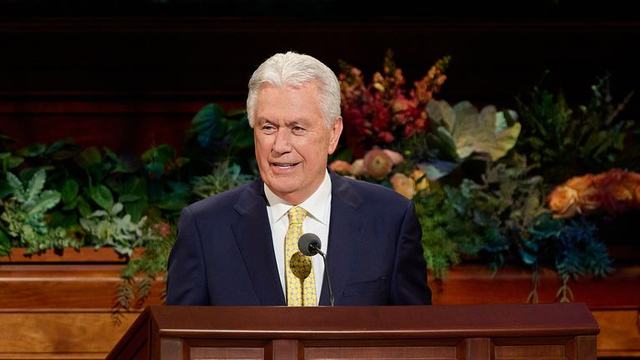
Christ-Centered Unity
 Open talk in Gospel Library
Ideas for Opening the Lesson
- Write two phrases on the board: “covenant individuals” and “a covenant people.” Invite class members to explain what each phrase means and how the two connect. Read President Uchtdorf’s statement that baptism makes us both, and introduce the lesson as an exploration of following Jesus Christ together.
- Ask class members to silently consider a place where they feel that they belong. Invite a few volunteers to describe the actions or attitudes that create that feeling, without naming anyone who makes them feel excluded. Read the invitation “come and see, come and help, and come and belong,” and ask how your quorum or Relief Society can extend that invitation.
- Display the statement “The closer we come to Him, the closer we will come to each other.” Ask what this teaches about the source of lasting unity. Invite class members to look throughout the discussion for ways that focusing on Jesus Christ changes their relationships.
- Read the phrase from the sacrament prayer, “the souls of all those who partake of it.” Invite class members to consider silently how remembering those around them changes their experience of the sacrament. Introduce President Uchtdorf’s teaching that the sacrament strengthens both our relationship with God and our unity with one another.
Topics
Walk the Covenant Path Together
President Uchtdorf describes spiritual growth as beginning with simple prayers and small acts of faith, then deepening through covenant experiences and service. Baptism is an individual ordinance that also joins us to a worldwide covenant people. Following Jesus Christ therefore includes bearing burdens, mourning with others, and offering comfort as we walk together.
Through baptism, we become not only covenant individuals but also part of a covenant people.
- How does seeing yourself as part of a covenant people change your understanding of baptism?
- What small acts of faith help your relationship with God deepen, even when your growth feels gradual?
- How do covenants and service strengthen your ability to support other disciples?
- What experiences help you recognize the value of bearing burdens or receiving comfort from others?
- What is one way you can help someone walk the covenant path without making that person feel pressured or judged?
Gather People Across Worldly Divisions
Jesus Christ reaches across cultural, political, religious, and social boundaries to gather Heavenly Father’s children. In contrast, Satan emphasizes differences and encourages isolation, mistrust, and contention. Covenant followers participate in the Savior’s gathering work by recognizing others as brothers and sisters and refusing to treat differences as impassable barriers.
He consistently reached out to those who would otherwise be shunned as outsiders.
- Which examples of the Savior reaching across boundaries in this talk most influence how you want to treat others?
- Where do differences become barriers in our community or congregation, and how can we respond without assigning blame?
- How can we recognize when a conversation or habit encourages isolation rather than Christlike connection?
- What experiences show you that friendship and service can grow across cultural, political, or social differences?
- Who might feel like an outsider in our meetings, and what practical actions can help that person feel included?
Center Our Unity on Jesus Christ
The unity of the Savior’s Church rests on love for God and neighbor, commitment to covenants, and the restored gospel—not shared politics, culture, or personal interests. President Uchtdorf points to the Nephites and Lamanites as evidence of Christ’s power to replace contention with love. As we draw closer to Jesus Christ, He changes us and draws us closer to one another.
Jesus Christ has the power to change us—you and me—purify us, and unite us. The closer we come to Him, the closer we will come to each other—and the closer we will come to the unity He wants for us.
- What distinguishes Christ-centered unity from simply sharing interests or opinions?
- How does love for God and neighbor help us remain united when we disagree?
- What does the example of the Nephites and Lamanites teach about the source of lasting reconciliation?
- What experiences help you see a connection between drawing closer to Christ and drawing closer to another person?
- What can we change in our class discussions so that Jesus Christ and His gospel remain our unifying focus?
Practice Unity Through Small Christlike Choices
Focusing on Christ helps us look on the heart rather than outward appearance. Patience, kindness, forgiveness, helpfulness, and neighborliness leave less room for pride, judgment, and contention. President Uchtdorf urges us to begin now, teaching that every small step toward unity matters even when perfect unity remains beyond our present reach.
When we try to be a little more patient, a little kinder, more forgiving, more helpful, more neighborly, there will be less room for pride or judgmental attitudes or contention.
- What helps you look on someone’s heart rather than make assumptions based on outward appearance?
- Which Christlike quality named in this passage most needs your attention right now?
- How can we disagree honestly while remaining patient, kind, and free from contention?
- What experiences illustrate how a small act of kindness or forgiveness strengthens a relationship?
- What small step toward unity can you take this week, especially in a relationship that feels difficult?
Renew Our Unity Through the Sacrament
The sacrament offers a fresh starting point for our relationship with God and our unity with others. We renew our baptismal covenant and remember our personal covenants while surrounded by fellow disciples. Its prayers remind us that we partake individually and together, with the Savior and a covenant community beside us.
The sacrament is a weekly reminder, a sacred reminder, that we are not alone. We have the Savior, and we have each other.
- What do you notice about the sacrament prayers when you consider their reference to all who partake?
- How can the sacrament become a fresh starting point in both your discipleship and your relationships?
- What helps you remember the people around you while still personally worshipping the Savior?
- What experiences during sacrament meeting help you feel that you are not alone?
- How can your preparation for the sacrament include a desire to comfort, forgive, or reconnect with someone?
Build Bridges and Invite Everyone to Belong
President Uchtdorf invites every person to participate in Christ-centered unity, emphasizing that the community is incomplete without them. He connects gathering in the Savior’s name and building bridges with experiencing God’s presence and blessings. This invitation extends to individuals, families, communities, and nations.
Wherever you are, I invite you to join the Christ-centered unity we are trying to build. It would be incomplete without you. Please, come and see, come and help, and come and belong.
- What does the statement “It would be incomplete without you” teach us about the worth of each person?
- How do “come and see,” “come and help,” and “come and belong” describe different ways to welcome someone?
- What does building a bridge look like in a family, a quorum, or a Relief Society?
- What experiences help you recognize God’s presence when people gather in the Savior’s name?
- How can our quorum or Relief Society help people feel that their presence and contributions genuinely matter?
Additional Discussion Questions
- How does this talk expand your understanding of what it means to take the Savior’s name upon yourself?
- What attitudes or habits do you need to surrender so that Christ can make you a more unifying influence?
- How can we offer comfort in ways that respect a person’s privacy and individual needs?
- How can our conversations, including those online, reflect our commitment to be one in Christ?
- What helps us seek unity without expecting everyone to have the same personality, background, or opinions?
- How can we welcome someone who is considering covenants or who feels uncertain about belonging?
- What does it look like to depend on Christ’s power when our own efforts to repair a relationship feel insufficient?
- How can sacrament worship lead to meaningful acts of service during the rest of the week?
- What signs help us recognize growing Christ-centered unity in our families and congregation?
- Which invitation in this talk do you feel drawn to act on, and what specific step can you take before next Sunday?
