
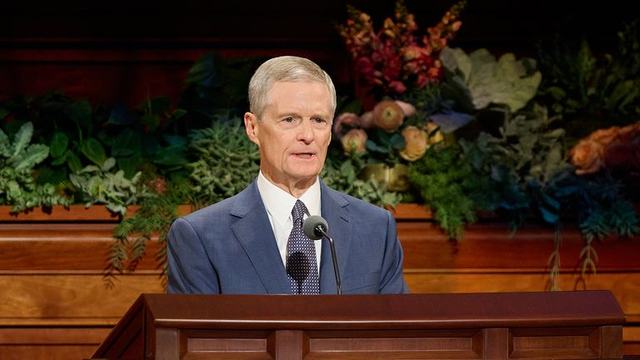
Sealed by the Holy Spirit of Promise
 Open talk in Gospel Library
Contents
Before Reading
Before reading or listening to the talk, consider the following questions:
- How do receiving sacred ordinances and honoring covenants help me return to Heavenly Father?
- What does the passport analogy teach about the difference between an opportunity and a guarantee?
- What does it mean for an ordinance or covenant to be sealed by the Holy Spirit of Promise?
- What are the two related parts of the temple sealing ordinance?
- What assurance does God offer faithful covenant keepers when another person breaks covenants?
Topics
Receive Sacred Ordinances and Honor Your Covenants
Elder Bednar describes ordinances and covenants as spiritual credentials for returning to Heavenly Father. God establishes the conditions of covenants, and His children use their agency to learn about and accept those conditions through sacred ordinances. Receiving these credentials opens opportunities for divine blessings, while ongoing faithfulness is necessary to receive what God promises.
A covenant is a solemn promise—an enduring commitment between God and His sons and daughters.
An ordinance is a holy act performed by the authority of the priesthood that has spiritual purpose and eternal significance and is related to God’s laws and statutes.
The covenants and ordinances of the Savior’s restored gospel are spiritual credentials that can open wide the heavenly windows of opportunity to receive in our lives divine purpose, direction, and strength.
Ongoing faithfulness is required for those credentials to be valid and for promised blessings to be received.
- Who establishes the conditions of gospel covenants, and how do God’s children exercise agency in accepting them?
- How do sacred ordinances relate to covenants?
- Why does receiving an ordinance not, by itself, guarantee all its promised blessings?
- Which covenant commitments can I study more carefully to understand what God asks of me?
- How do my covenants provide purpose, direction, or strength in my daily life?
- What specific change can I make this week to align my heart, mind, and actions more closely with God’s will?
Maintain Covenant Faithfulness Without Confusing Suffering With Unworthiness
The passport analogy illustrates that receiving authorized credentials provides an opportunity but does not alone guarantee admission. Elder Bednar uses this distinction to emphasize the importance of maintaining covenant faithfulness. He also explicitly limits the analogy: adversity and affliction that occur through no fault of our own do not invalidate our covenants or diminish God’s promises.
The lesson of this story is quite simple: the integrity of a passport must be maintained over time.
Holding a valid passport provided the opportunity for the man to enter the country, but the passport alone did not guarantee he actually would be allowed to enter the country.
Unlike damage to a physical passport, the adversities and afflictions we experience through no fault of our own do not diminish God’s promises to us or invalidate our covenants.
- What distinction between opportunity and guarantee does the passport story illustrate?
- What limitation does Elder Bednar place on the passport analogy?
- Why is it important to distinguish suffering through no fault of our own from failing to honor covenants?
- How can I approach covenant keeping as an ongoing commitment rather than a completed milestone?
- When hardship leads me to question my standing before God, how can Elder Bednar’s clarification help me?
- How can I support someone who mistakenly interprets adversity as evidence that God’s promises no longer apply to them?
Seek the Holy Spirit of Promise’s Ratifying Seal
The Holy Ghost serves as the Holy Spirit of Promise by confirming that righteous acts are acceptable to God. All gospel ordinances and covenants require this ratifying seal to have eternal efficacy, and the sealing remains conditional during mortality. Elder Bednar teaches that this blessing typically comes over time as disciples repent sincerely and consistently, honor their covenants, and yield their hearts to God.
The Holy Ghost is also described in scripture as the Holy Spirit of Promise, who ratifies or confirms as acceptable to God the righteous acts of His children.
Ultimately, all gospel ordinances and covenants must be sealed by the Holy Spirit of Promise.
When sealed by the Holy Spirit of Promise, an ordinance, vow, or covenant is binding on earth and in heaven.
Receiving this ratifying sealing by the Holy Ghost typically is not a one-time event; rather, it comes over time as we repent sincerely and consistently, honor our covenants, and yield our hearts unto God.
- What does the Holy Ghost do in His role as the Holy Spirit of Promise?
- Why must gospel ordinances and covenants receive the Holy Spirit of Promise’s ratifying seal?
- What does Elder Bednar teach about the timing and conditions of receiving this seal?
- How can unrighteousness affect a sealing that is conditional in mortality?
- What does yielding my heart to God look like in my current circumstances?
- How can I make sincere repentance a consistent part of my discipleship?
- What habits help me honor my covenants over time rather than rely only on receiving an ordinance?
- How does understanding this as an ongoing process encourage patience and faithful effort?
Understand Both Dimensions of the Temple Sealing
Elder Bednar identifies two fundamental, related parts of the sealing ordinance. The lateral aspect concerns the eternal marriage union of a man and a woman, while the vertical aspect concerns their sealing into God’s eternal family and the linking of generations. Both aspects are vital, and the intended outcomes of a temple marriage include spiritual growth, devotion, fidelity, shared effort, and enduring happiness.
The sealing of a man and a woman in the house of the Lord is a crowning covenant and ordinance of the Savior’s restored gospel.
The sealing ordinance includes two fundamental and related parts: (1) the eternal union of a man and a woman in marriage—what may be understood as a lateral sealing—and (2) the sealing of the husband and wife into God’s eternal family and the linking of humankind through all generations—what may be understood as a vertical sealing.
Both elements of the ordinance are vital.
The intended and prayed-for outcomes of a temple sealing between a man and a woman include a lifetime of spiritual growth, marital devotion, fidelity, working together to overcome the uncertainties and challenges of mortality, and enduring happiness.
- What does Elder Bednar mean by the lateral aspect of the sealing ordinance?
- What does he mean by the vertical aspect?
- What outcomes does he identify as the intended and prayed-for blessings of a temple marriage?
- How does understanding both dimensions of sealing deepen my appreciation for temple covenants?
- How can I cultivate spiritual growth, fidelity, and devotion in my family relationships?
- What can I do in my present circumstances to strengthen my commitment to God and His eternal family?
Trust God to Bless Faithful Covenant Keepers
Elder Bednar assures faithful disciples that another person’s unrighteous use of agency cannot deprive them of promised eternal blessings. A spouse who breaks covenants without repenting relinquishes the opportunity for ratification of both aspects of the sealing, while a faithful spouse remains worthy of ratification of the vertical aspect and all other associated individual blessings. Although revealed doctrine does not explain every detail of how or when these blessings come, God’s promises remain sure for those who hold fast to their covenants.
However, unrighteousness by one person cannot hinder or thwart the flow of God’s love, strength, and blessings to another person.
The power of the Lord’s infinite and eternal Atonement can overcome all things, all the time, everywhere, for every person who holds fast to their covenants with Him.
A faithful spouse who honors covenants and presses forward in faith remains worthy to receive for himself or herself the ratifying seal of the Holy Spirit of Promise for the vertical aspect of the sealing ordinance and to receive all other associated individual blessings.
I do not know and cannot explain precisely how and when promised blessings are received. But I do know promised blessings will be received.
No faithful disciple will ultimately be deprived of any eternal blessing God has promised because of another individual’s unrighteous exercise of moral agency.
- Can another person’s covenant violations deprive a faithful disciple of God’s promised eternal blessings?
- What distinction does Elder Bednar make between the consequences for an unrepentant spouse and the blessings available to a faithful spouse?
- What does Elder Bednar affirm with certainty, and what details does he acknowledge remain unexplained?
- How does King Benjamin’s testimony reinforce the promise to those who remain faithful?
- What uncertainty about family relationships can I entrust to God while continuing to honor my own covenants?
- How can I separate another person’s choices from my own responsibility and opportunity to remain faithful?
- When do I recognize the Savior’s love or strength sustaining me through disappointment or sorrow?
- How can I offer compassionate reassurance to someone facing marital heartbreak without claiming answers God has not revealed?
