
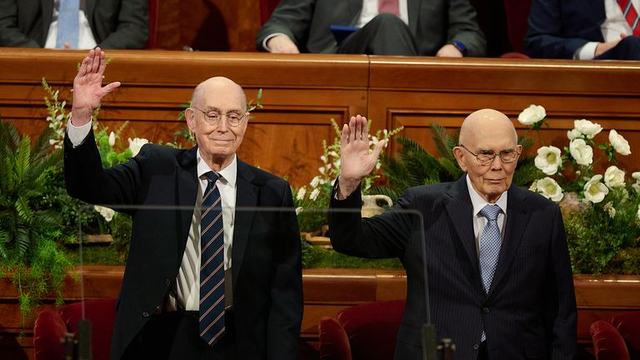
Solemn Assembly
 Open talk in Gospel Library
Ideas for Opening the Lesson
- Invite class members to briefly describe what they remembered feeling during a sustaining vote in general conference, stake conference, or ward conference. Then ask the class to listen for what this talk taught about the meaning and sacredness of sustaining Church leaders.
- Begin by writing the phrase "We are grateful for your faith and prayers" on the board. Ask class members what that phrase suggested about sustaining leaders beyond simply raising a hand. Use their responses to introduce the talk’s emphasis on support, faith, and prayer.
- Show a picture of a solemn assembly or of the First Presidency and Quorum of the Twelve Apostles. Ask, "What does it mean to sustain a prophet and other Church leaders?" After a few responses, explain that this talk centered on the sacred process of sustaining by quorums and groups.
- Invite class members to think silently about the covenant relationship between Church members and those called to lead. Then ask: "How is a sustaining vote both personal and collective?" Use the talk to explore how the whole Church participated in an orderly, sacred act.
- Read the opening line of the talk: "I have been asked to handle the business of the solemn assembly, the sacred event for which we are gathered today." Ask the class what made a solemn assembly different from an ordinary meeting, and let that question frame the lesson.
Topics
Treat sustaining as a sacred act
President Christofferson said that the solemn assembly was a sacred event. His wording showed that sustaining Church leaders was not merely procedural but spiritual and reverent. He framed the entire assembly as worshipful participation in the Lord’s order.
Brothers and sisters, I have been asked to handle the business of the solemn assembly, the sacred event for which we are gathered today.
- What did the phrase "the sacred event" teach you about how President Christofferson viewed a solemn assembly?
- How can we treat sustaining votes in ward, stake, and general Church settings with greater reverence?
- Why do you think the Lord would want sustaining to be done in a sacred and orderly way?
- How has your understanding of a sustaining vote changed over time?
- What can we do personally to prepare spiritually when we know we will be asked to sustain leaders?
- How might remembering the sacredness of sustaining affect the way we speak about Church leaders at home?
Sustain leaders in an orderly way
President Christofferson explained that the solemn assembly would proceed by quorums and groups, with each group standing and voting when invited. He emphasized order, clarity, and unity in the process. This reflected the Lord’s pattern of governing His Church through priesthood order and organized participation.
In this solemn assembly, as noted, we will vote by quorums and groups. We will call on each quorum or group in turn.
- What did the orderly structure of the solemn assembly teach about how the Lord governed His Church?
- Why might it matter that members voted by quorums and groups rather than in a random way?
- How have you seen spiritual strength come from order in the Church?
- What can this pattern teach us about sustaining leaders in our own ward organizations and quorums?
- How does orderly participation help the whole Church act in unity?
- What experiences have helped you appreciate that Church order can invite the Spirit rather than limit it?
Choose to sustain with uplifted hands
President Christofferson instructed members to stand and express by uplifted hand that they chose to sustain those presented. His language highlighted that sustaining involved a conscious choice. The outward act symbolized an inward commitment to support the Lord’s servants.
Wherever you are, you will then be invited to stand and express by your uplifted hand that you choose to sustain those whose names will be presented.
- What stood out to you in the phrase "choose to sustain"?
- How is sustaining more than a routine gesture?
- What commitments do you think are implied when we raise our hand to sustain a leader?
- How can we better align our private attitudes with the public act of sustaining?
- When have you felt that sustaining someone became more meaningful because you acted on it afterward?
- How can we teach youth and new members what the uplifted hand really represents?
Respond appropriately when concerns arise
President Christofferson gave instruction for those who opposed any proposal to contact their stake president. This showed that the Church made room for integrity, accountability, and proper channels. He taught that concerns should be handled respectfully and in order.
If there are those who oppose any of the proposals, we ask that you contact your stake president.
- What did this instruction teach about the Church’s approach to honesty and accountability?
- Why do you think the Lord provided orderly channels for expressing concerns?
- How can we distinguish between faithful questions and public criticism that weakens trust?
- What principles of respect and order can we learn from the invitation to contact a stake president?
- How can we respond in a Christlike way when we do not fully understand a calling or decision?
- How does this instruction strengthen your confidence in the integrity of the sustaining process?
Sustain the prophet and apostles
A central focus of the solemn assembly was sustaining the President of the Church as prophet, seer, and revelator, along with his counselors and the Quorum of the Twelve Apostles. President Christofferson repeatedly presented these leaders for sustaining by different groups. This repetition underscored the importance of prophetic leadership in the Church.
It is proposed that the First Presidency sustain Dallin Harris Oaks as prophet, seer, and revelator and President of The Church of Jesus Christ of Latter-day Saints.
- Why do you think the titles prophet, seer, and revelator were repeated so often in the talk?
- How has sustaining the prophet blessed your life personally?
- What does it mean to sustain apostles as special witnesses of Jesus Christ?
- How can we show greater loyalty to prophetic counsel in daily life?
- What experiences have strengthened your testimony that the Lord leads His Church through prophets and apostles?
- How can we help our families move from admiring leaders to truly following their counsel?
Unite the whole Church in sustaining
President Christofferson invited many groups throughout the Church to participate, including priesthood holders, Relief Society sisters, Aaronic Priesthood holders, young women, and finally the entire membership worldwide. This demonstrated that sustaining was a shared responsibility of the whole covenant community. The process emphasized unity across ages, offices, and locations.
We now ask the entire membership of the Church, wherever you are located, including all who have stood previously, to please stand.
- What did the participation of so many groups teach about the unity of the Church?
- Why is it significant that women, men, youth, and children of appropriate ages all had a role in sustaining?
- How does sustaining together strengthen our sense of belonging in the Church?
- What have you learned from participating in Church actions with members across the world?
- How can our ward better reflect the unity shown in this solemn assembly?
- What does it mean to you that the entire Church was invited to stand together?
Support leaders with faith and prayers
At the close of the assembly, President Christofferson thanked the members for their sustaining vote and expressed gratitude for their faith and prayers. This suggested that sustaining extended beyond the vote itself into ongoing spiritual support. Members were invited to uphold leaders through trust, prayer, and faithful discipleship.
Thank you, brothers and sisters, for your sustaining vote on behalf of these leaders of The Church of Jesus Christ of Latter-day Saints. We are grateful for your faith and prayers in our behalf.
- How did President Christofferson’s closing words expand the meaning of sustaining?
- What is the relationship between sustaining leaders and praying for them?
- How can we show faith in the Lord’s chosen servants even when their assignments are difficult?
- What are some practical ways we can support local and general leaders beyond simply sustaining them?
- When have you felt blessed as you prayed for Church leaders?
- How might our homes change if we spoke more often with faith and gratitude about those who lead the Church?
Additional Discussion Questions
- What did this talk teach about the difference between observing a sustaining vote and truly participating in one?
- How can sustaining Church leaders become a more active part of our covenant discipleship?
- Why do you think the Church invited each quorum and group to participate separately before inviting the whole Church to stand together?
- What can we learn from the repeated wording used as each group sustained the prophet and other leaders?
- How does the solemn assembly help strengthen confidence that the Lord directs His Church?
- In what ways can we sustain local leaders with the same seriousness we show when sustaining general leaders?
- How can we help children and youth understand the spiritual meaning of sustaining votes?
- What attitudes or behaviors might weaken our sustaining, even if we raise our hand publicly?
- How does sustaining leaders relate to sustaining the Lord whose servants they are?
- What is one change you feel impressed to make because of this talk in the way you support, pray for, or follow Church leaders?
