
Solemn Assembly
 Open talk in Gospel Library
Contents
Topics
Honor the sacred nature of a solemn assembly
President Christofferson begins by identifying the meeting as a sacred event and invites members to participate with order and reverence.
Brothers and sisters, I have been asked to handle the business of the solemn assembly, the sacred event for which we are gathered today.
We will now begin. Again, please stand and vote only when asked to do so.Key Points:
- A solemn assembly is a sacred event, not merely an administrative exercise.
- The gathering is conducted with reverence, order, and clear instruction.
- Members participate in a deliberate and organized way.
- The sacredness of the occasion invites thoughtful, faithful involvement.
- When have you felt that a Church meeting was especially sacred or set apart?
- What experiences have helped you appreciate reverence in worship?
- When have clear order and instruction in the Church helped you feel the Spirit?
- How have you felt participating in a temple, conference, or ward meeting that was spiritually significant?
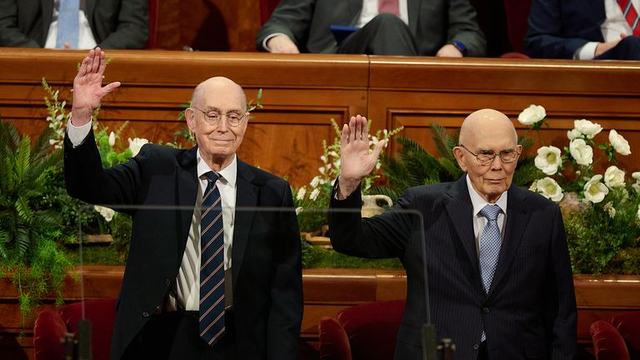
Sustain prophets and apostles with uplifted hands
The central action of the solemn assembly is the sustaining of the President of the Church, his counselors, and the Quorum of the Twelve Apostles.
It is proposed that the First Presidency sustain Dallin Harris Oaks as prophet, seer, and revelator and President of The Church of Jesus Christ of Latter-day Saints.
It is proposed that Dallin Harris Oaks be sustained as prophet, seer, and revelator and President of The Church of Jesus Christ of Latter-day Saints, together with his counselors and members of the Quorum of the Twelve Apostles as they have been presented and voted upon.
Thank you, brothers and sisters, for your sustaining vote on behalf of these leaders of The Church of Jesus Christ of Latter-day Saints.Key Points:
- Members formally sustain the President of the Church as prophet, seer, and revelator.
- Members also sustain the counselors in the First Presidency and the Quorum of the Twelve Apostles.
- Sustaining is expressed publicly by the uplifted hand.
- The sustaining vote reflects faith in divinely appointed leadership.
- What has helped you gain a testimony of living prophets and apostles?
- When have you been blessed by following prophetic counsel?
- How has raising your hand to sustain leaders become more meaningful over time?
- What personal experience could you share about praying for Church leaders?
Participate in sustaining as quorums and groups
The solemn assembly proceeds by quorums and groups, showing that every part of the Church has a place and voice in sustaining leaders.
In this solemn assembly, as noted, we will vote by quorums and groups.
We will call on each quorum or group in turn.
Wherever you are, you will then be invited to stand and express by your uplifted hand that you choose to sustain those whose names will be presented.Key Points:
- The sustaining process is organized by quorums and groups.
- Each quorum or group participates in turn.
- This pattern emphasizes unity and belonging across the whole Church.
- The process includes members throughout the world, not just those physically present.
- When have you felt strengthened by acting in unity with your quorum, class, or Relief Society?
- How has belonging to a Church group helped you feel included in the Lord’s work?
- What experience have you had seeing the worldwide nature of the Church?
- When have you felt that your individual participation mattered in a larger body of Saints?
Exercise agency and accountability in sustaining
Members are invited to express support honestly, and those with concerns are directed to proper priesthood channels.
Please express your support in the usual way with the uplifted hand.
If there are those who oppose any of the proposals, we ask that you contact your stake president.
Any opposed may manifest by the same sign.Key Points:
- Sustaining is a real expression of choice, not an empty formality.
- Members are expected to act honestly when they sustain or oppose.
- Concerns are to be handled through established priesthood leadership.
- The Church honors both order and individual moral agency.
- When have you learned that sustaining means more than passive agreement?
- How have you shown support for a leader through service, prayer, or cooperation?
- What experience has taught you the value of addressing concerns in the Lord’s way?
- When have you felt the importance of acting with integrity in a Church responsibility?
Recognize the order of Church leadership
The proceedings outline the structure of Church leadership, including the First Presidency, the Quorum of the Twelve Apostles, the Seventy, the Presiding Bishopric, and the general membership.
It is proposed that the First Presidency sustain Henry Bennion Eyring as First Counselor and David Todd Christofferson as Second Counselor in the First Presidency of the Church.
It is proposed that the First Presidency sustain Henry Bennion Eyring as President of the Quorum of the Twelve Apostles and Dieter Friedrich Uchtdorf as Acting President of the Quorum of the Twelve Apostles.
We ask the General Authority Seventies, Area Seventies, and members of the Presiding Bishopric please to stand.
We now ask the entire membership of the Church, wherever you are located, including all who have stood previously, to please stand.Key Points:
- The talk identifies the major governing quorums and councils of the Church.
- The First Presidency and Quorum of the Twelve are sustained in their appointed roles.
- Other leaders, including the Seventy and Presiding Bishopric, are part of the sustaining process.
- The entire Church membership ultimately joins in the sustaining vote.
- How has learning about Church organization increased your confidence in the Lord’s way of governing His Church?
- When have you been blessed by the service of leaders at different levels of the Church?
- What experience has helped you see that the Church is led with divine order?
- How could you illustrate that every member has a place in the Lord’s organized Church?
Include the whole Church in covenant support
President Christofferson specifically invites priesthood holders, Relief Society sisters, Aaronic Priesthood holders, young women, and the entire membership to participate, highlighting the inclusive nature of sustaining.
We ask the following to please stand, wherever you may be throughout the world: ordained patriarchs, high priests, and elders.
Will all members of the Relief Society—that is, all women 18 years of age and older—please stand?
Will all those holding the Aaronic Priesthood only—that is, ordained priests, teachers, and deacons—please stand?
Will the young women who are ages 11 to 18 please stand?
We now ask the entire membership of the Church, wherever you are located, including all who have stood previously, to please stand.Key Points:
- The sustaining process includes men, women, youth, and children old enough to participate in these groups.
- Members throughout the world are invited to join.
- The whole Church shares responsibility to support the Lord’s chosen servants.
- This participation reflects unity across age, office, and circumstance.
- When did you first remember participating in a sustaining vote, and what did it mean to you?
- How have you seen youth and adults alike contribute to the strength of the Church?
- What experience has shown you that all members are needed in the Lord’s kingdom?
- How has participating with Saints around the world strengthened your testimony of the Church?
Support leaders with faith and prayer
The concluding expression of gratitude emphasizes that sustaining leaders includes offering them faith and prayers.
Thank you, brothers and sisters, for your sustaining vote on behalf of these leaders of The Church of Jesus Christ of Latter-day Saints.
We are grateful for your faith and prayers in our behalf.Key Points:
- Church leaders value not only formal sustaining but also the faith of the members.
- Prayer is a meaningful way to sustain leaders.
- Sustaining should continue after the meeting through ongoing support.
- Members bless the Church as they pray for those called to lead.
- When have you felt prompted to pray for a Church leader?
- How have your prayers for leaders changed the way you listen to and follow them?
- What blessing have you seen come from supporting a leader with faith rather than criticism?
- How could you invite your congregation to sustain leaders more actively through prayer?
