
Solemn Assembly
 Open talk in Gospel Library
Contents
Before Reading
Before reading or listening to the talk, consider the following questions:
- What does a solemn assembly teach about the sacred nature of sustaining Church leaders?
- Why does the Church invite members to sustain leaders by quorums and groups?
- What does it mean to sustain a prophet, seer, and revelator?
- How is sustaining more than a formal vote or public gesture?
- What do the repeated invitations to stand, vote, and manifest support teach about order and unity in the Church?
- How should a disciple respond if he or she has concerns or opposition?
- What can I do to better support the Lord’s chosen servants with faith and prayer?
Topics
Honor the sacred nature of a solemn assembly
President Christofferson begins by identifying the occasion as "the business of the solemn assembly" and calls it a "sacred event." His wording frames the assembly as more than administration; it is an act of worship carried out with reverence. The talk teaches that sustaining Church leaders is a holy responsibility performed before God and as part of the order of the Church.
Brothers and sisters, I have been asked to handle the business of the solemn assembly, the sacred event for which we are gathered today.
In this solemn assembly, as noted, we will vote by quorums and groups.
- How does President Christofferson describe the solemn assembly?
- What words in the talk show that this event is sacred and not merely procedural?
- Why is sustaining Church leaders appropriately treated as part of a solemn assembly?
- How can I approach sustaining opportunities with greater reverence and spiritual intent?
- What helps me remember that sacred Church procedures can also be acts of worship?
- How have I felt the Spirit during moments when I sustained leaders of the Church?
Sustain leaders in an orderly way
The talk emphasizes that the sustaining is conducted by quorums and groups, each invited to stand and vote in turn. This orderly pattern reflects the Lord’s house as a house of order and shows that sacred participation in the Church is organized, deliberate, and unified. Members are instructed to vote only when invited with their assigned quorum or group.
In this solemn assembly, as noted, we will vote by quorums and groups.
We will call on each quorum or group in turn.
Wherever you are, you will then be invited to stand and express by your uplifted hand that you choose to sustain those whose names will be presented.
You should vote only when asked to stand with your quorum or group.
We will now begin. Again, please stand and vote only when asked to do so.
- How was the solemn assembly organized?
- What instructions were given about when members should stand and vote?
- What does this orderly process teach about the way the Church functions?
- How can I show greater respect for the order of the Church in meetings and callings?
- What does sustaining in an orderly way teach me about unity and discipline in discipleship?
- How can I better honor the inspired structure of quorums, auxiliaries, and councils?
Manifest support for Church leaders
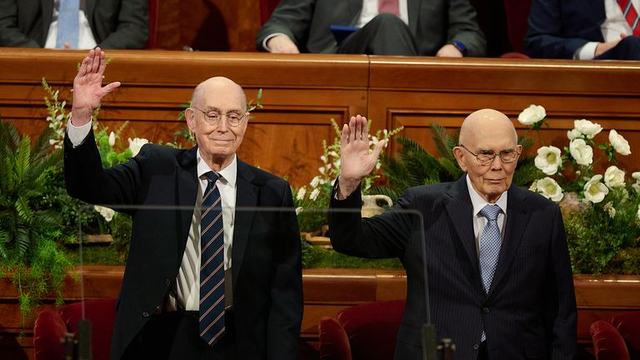
A central purpose of the solemn assembly is for members to openly express their willingness to sustain those called to lead the Church. President Christofferson repeatedly invites members to "manifest" their support by the uplifted hand. This public expression symbolizes covenant loyalty, willingness to follow inspired leadership, and unity with the body of the Church.
Please express your support in the usual way with the uplifted hand.
Members of the First Presidency in favor, please manifest it.
All in favor, please manifest it.
All in favor, please indicate by the uplifted hand.
Thank you, brothers and sisters, for your sustaining vote on behalf of these leaders of The Church of Jesus Christ of Latter-day Saints.
- How were members asked to show their support?
- What does the repeated phrase "manifest it" suggest about sustaining leaders?
- Why is it significant that support is expressed publicly and collectively?
- In what ways can I sustain leaders beyond raising my hand in conference or stake conference?
- How do my words and actions show whether I truly sustain my leaders?
- What is one specific way I can better support a current Church leader or local leader?
Follow the Lord’s pattern for addressing opposition
President Christofferson includes a clear and respectful process for those who oppose a proposal. Rather than creating disruption, those with opposition are asked to contact their stake president. This teaches that the Church provides an orderly, priesthood-guided way to address concerns while preserving the sacredness and unity of the assembly.
If there are those who oppose any of the proposals, we ask that you contact your stake president.
Any opposed may manifest by the same sign.
Any opposed may so indicate.
Any opposed, by the same sign.
- What instruction is given to those who oppose any proposal?
- How does this process balance agency with order in the Church?
- Why is it important that concerns be handled through proper priesthood channels?
- How can I respond faithfully if I have questions or concerns about Church matters?
- What does this pattern teach me about charity, order, and respect in disagreement?
- How can I help preserve unity while still acting honestly and responsibly?
Sustain the President of the Church as prophet, seer, and revelator
The central act of the solemn assembly is sustaining Dallin Harris Oaks as prophet, seer, and revelator and President of The Church of Jesus Christ of Latter-day Saints. The talk repeatedly states this proposal as each quorum and group participates. This repetition underscores the doctrinal importance of prophetic leadership and the united witness of the Church in sustaining the Lord’s chosen servant.
It is proposed that the First Presidency sustain Dallin Harris Oaks as prophet, seer, and revelator and President of The Church of Jesus Christ of Latter-day Saints.
It is proposed that the Quorum of the Twelve Apostles sustain Dallin Harris Oaks as prophet, seer, and revelator and President of The Church of Jesus Christ of Latter-day Saints, together with his counselors and members of the Quorum of the Twelve Apostles as they have been presented and voted upon by the First Presidency.
It is proposed that Dallin Harris Oaks be sustained as prophet, seer, and revelator and President of The Church of Jesus Christ of Latter-day Saints, together with his counselors and members of the Quorum of the Twelve Apostles as they have been presented and voted upon.
It is proposed that Dallin Harris Oaks be sustained as prophet and seer and revelator and President of The Church of Jesus Christ of Latter-day Saints, together with his counselors and members of the Quorum of the Twelve Apostles as they have been presented and voted upon.
- Whom were the members asked to sustain as President of the Church?
- What titles are used to describe the President of the Church?
- Why do you think the wording about sustaining the prophet is repeated throughout the assembly?
- What does it personally mean to me to sustain the living prophet?
- How can I better follow prophetic counsel in my daily life?
- When have I been blessed by listening to and acting on the prophet’s teachings?
Sustain the First Presidency and the Quorum of the Twelve Apostles
In addition to sustaining the President of the Church, the assembly includes sustaining his counselors, the President of the Quorum of the Twelve Apostles, the Acting President of the Quorum of the Twelve Apostles, and the members of the Quorum of the Twelve Apostles. The talk highlights that Church leadership functions in councils and quorums, and that members sustain the full presiding councils of the Church.
It is proposed that the First Presidency sustain Henry Bennion Eyring as First Counselor and David Todd Christofferson as Second Counselor in the First Presidency of the Church.
It is proposed that the First Presidency sustain Henry Bennion Eyring as President of the Quorum of the Twelve Apostles and Dieter Friedrich Uchtdorf as Acting President of the Quorum of the Twelve Apostles.
It is proposed that the First Presidency sustain the following as members of the Quorum of the Twelve Apostles: Dieter F. Uchtdorf, David A. Bednar, Quentin L. Cook, Neil L. Andersen, Ronald A. Rasband, Gary E. Stevenson, Dale G. Renlund, Gerrit W. Gong, Ulisses Soares, Patrick Kearon, Gérald Caussé, and Clark G. Gilbert.
It is proposed that the First Presidency sustain the counselors in the First Presidency and the Quorum of the Twelve Apostles as prophets, seers, and revelators.
- Which leaders besides the President of the Church were sustained in the solemn assembly?
- How does the talk show the importance of councils and quorums in Church leadership?
- What does it mean that the counselors in the First Presidency and the Quorum of the Twelve Apostles are also sustained as prophets, seers, and revelators?
- How can I become more familiar with the members of the First Presidency and Quorum of the Twelve Apostles?
- What can I do to study and apply the teachings of all the Apostles, not only the President of the Church?
- How have I seen strength come from the united leadership of these presiding quorums?
Unite the whole Church in sustaining
President Christofferson calls on many groups throughout the Church to participate: the First Presidency, the Quorum of the Twelve Apostles, General Authority Seventies, Area Seventies, the Presiding Bishopric, patriarchs, high priests, elders, Relief Society sisters, Aaronic Priesthood holders, young women, and finally the entire membership. This broad participation teaches that sustaining is a privilege and responsibility shared by the whole Church across the world.
We ask the following to please stand, wherever you may be throughout the world: ordained patriarchs, high priests, and elders.
Will all members of the Relief Society—that is, all women 18 years of age and older—please stand?
Will all those holding the Aaronic Priesthood only—that is, ordained priests, teachers, and deacons—please stand?
Will the young women who are ages 11 to 18 please stand?
We now ask the entire membership of the Church, wherever you are located, including all who have stood previously, to please stand.
- Which groups were specifically invited to participate in the solemn assembly?
- What does the worldwide participation of many groups teach about the Church?
- Why is it meaningful that adults, youth, priesthood holders, and sisters all participate?
- How does knowing that members throughout the world sustain together strengthen my faith?
- What can I do to feel more united with the worldwide Church?
- How can I teach my family that sustaining leaders is a privilege for every faithful member, including youth?
Support leaders with faith and prayer
The talk ends with gratitude for the sustaining vote and for the faith and prayers of the members. This closing statement teaches that sustaining includes spiritual support, not just formal approval. Members bless Church leaders by praying for them, exercising faith in their callings, and standing behind them as they serve.
Thank you, brothers and sisters, for your sustaining vote on behalf of these leaders of The Church of Jesus Christ of Latter-day Saints.
We are grateful for your faith and prayers in our behalf.
- What additional forms of support does President Christofferson mention at the end of the talk?
- How does prayer relate to sustaining Church leaders?
- Why is faith an important part of supporting those who preside?
- How often do I specifically pray for the prophet and other Church leaders?
- What would change in my discipleship if I treated prayer for leaders as part of sustaining them?
- How have I felt increased love or trust for leaders as I have prayed for them?
