
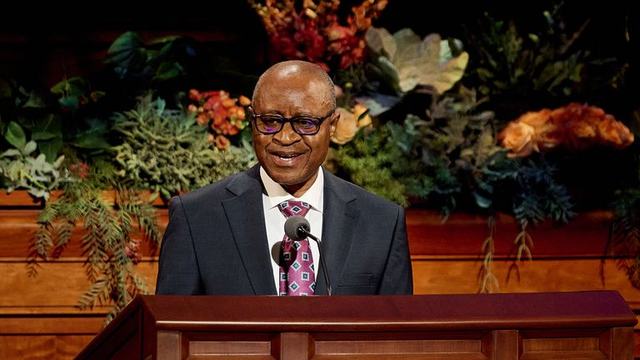
Using the Language of Peacemakers
 Open talk in Gospel Library
Contents
Before Reading
Before reading or listening to the talk, consider the following questions:
- How does the way I speak reflect my commitment to follow Jesus Christ?
- What distinguishes the language of peacemakers from language that creates contention?
- What do the scriptures teach about our responsibility for our words?
- How does filling my heart with the doctrine of Christ influence my communication?
- Which relationship needs more understanding, respect, or peace through the words I choose?
Topics
Follow the Prophet’s Call to Speak as Peacemakers
Elder Kyungu presents President Oaks’s invitation to forgo contention as a call to discipleship, not merely a suggestion. He encourages members to study prophetic messages prayerfully and act in faith by identifying contentious expressions and replacing them with peaceful language.
This invitation to forgo contention by using the language of peacemakers comes from the living prophet. It is not a simple suggestion; it is a call to discipleship as we follow Jesus Christ.
It is a spiritual exercise to identify the language and expressions we need to forgo and then replace them with words and phrases that bring peace wherever we are and at all times.
As the messages from this conference are published, we invite all to study and ponder them prayerfully and to act in faith on the principles they explain.
- Why does Elder Kyungu describe peaceful communication as a call to discipleship?
- What does acting in faith on President Oaks’s invitation involve?
- How does Elder Kyungu describe the spiritual exercise of changing our language?
- What do I feel prompted to change as I prayerfully ponder this invitation?
- Which contentious expression do I need to replace, and what peaceful phrase can I use instead?
- How can I practice peacemaking in my family, at work, and at church this week?
Accept Accountability for Words That Edify or Harm
Elder Kyungu draws on scripture to show that the Lord condemns lying, discord, and corrupt communication. Jesus Christ teaches that we are accountable for our words, while Paul counsels us to speak in ways that edify and minister grace. These teachings invite us to treat our speech as a serious part of gospel living.
But I say unto you, That every idle word that men shall speak, they shall give account thereof in the day of judgment.
For by thy words thou shalt be justified, and by thy words thou shalt be condemned.
Let no corrupt communication proceed out of your mouth, but that which is good to the use of edifying, that it may minister grace unto the hearers.
Let your speech be alway with grace, … that ye may know how ye ought to answer every man.
- What do the verses from Proverbs teach about lying and sowing discord?
- What does the Savior teach about accountability for our words?
- According to Paul’s counsel, what should our communication accomplish for those who hear it?
- How does accountability to the Savior influence what I choose to say?
- In which situations am I most tempted to speak in ways that discourage rather than edify?
- What can I ask myself before speaking to help my words minister grace?
Replace Hurtful Expressions with Words That Build Peace
Elder Kyungu explains that humiliating, degrading, and discouraging language weakens love, diminishes respect, and damages relationships. He offers practical alternatives that express appreciation, invite calm discussion, communicate care, and encourage forgiveness. Peacemaking requires choosing words that strengthen confidence and preserve relationships instead of escalating frustration.
Such words never edify. They weaken love, diminish respect, and damage relationships.
Rather than choosing words and language that escalate feelings of anger, disappointment, and frustration, let us use words that encourage understanding and peace.
We must choose language that strengthens confidence and preserves relationships.
Let us slow down and talk.
I don’t want this to divide us.
- How does Elder Kyungu describe the effects of hurtful language on relationships?
- What purposes do the peaceful expressions in the talk serve?
- How do words of appreciation, care, and forgiveness help preserve relationships during disagreement?
- Which examples of peaceful language feel most needed in my daily conversations?
- What can I say when I feel frustrated that communicates concern without blaming or belittling someone?
- How can I express sincere appreciation or care to someone today?
- What experiences show me the difference between words that escalate conflict and words that invite understanding?
Fill Your Heart with Christ’s Doctrine
Elder Kyungu compares abandoning contentious language to the converted Lamanites burying their weapons of war for peace. Because speech flows from the heart, he invites us to fill our hearts with the true doctrine of Christ. As we follow the Savior, His doctrine changes our language and helps us become instruments of His peace.
As the converted Lamanites “buried the weapons of war, for peace,” we too can bury the language of contention for peace.
We learn from the New Testament that “out of the abundance of the heart the mouth speaketh.”
Therefore, let us fill our hearts with the true doctrine of Christ, which has the power to change our language and help us speak more as peacemakers today, tomorrow, and always.
We can become instruments of His peace in the world.
- What does the example of burying weapons teach about abandoning contentious language?
- What relationship does the Savior identify between the heart and speech?
- How does Elder Kyungu connect learning Christ’s doctrine with becoming an instrument of peace?
- What attitudes in my heart contribute to harsh or defensive speech?
- How can my scripture study help Christ’s doctrine shape my words?
- What does a commitment to bury the language of contention look like in my life?
- Where do I recognize the Savior’s influence helping me speak with greater love?
Repent and Invite the Savior’s Peace into Relationships
Elder Kyungu invites us to repent of harsh language, pray for peaceful communication, and speak with warm respect despite differences of opinion. He testifies that the Savior’s peace is real and powerful and that peacemaking begins with our hearts, choices, and words. Heavenly Father’s love and Jesus Christ’s role as the Prince of Peace give purpose to these efforts.
Let us repent for the harsh language and expressions that have offended our friends, leaders, family members, or colleagues.
Let us pray for peaceful communication among us, regardless of the difference in our opinions.
Let us use the language that uplifts, edifies, comforts, and brings people together.
Peace I leave with you, my peace I give unto you.
This peace is real. It is powerful, and it begins with us—with our hearts, our choices, and our words.
- What actions does Elder Kyungu invite us to take when our language offends others?
- How does his invitation to peaceful communication address differences of opinion?
- What does the talk teach about the relationship between the Savior’s peace and our personal choices?
- Whom do I need to approach with a sincere apology or a request for forgiveness?
- What can I include in my prayers to seek help with peaceful communication?
- How can I show warm respect to someone whose opinion differs from mine?
- What experiences help me recognize the Savior’s peace as I choose words that uplift and bring people together?
