
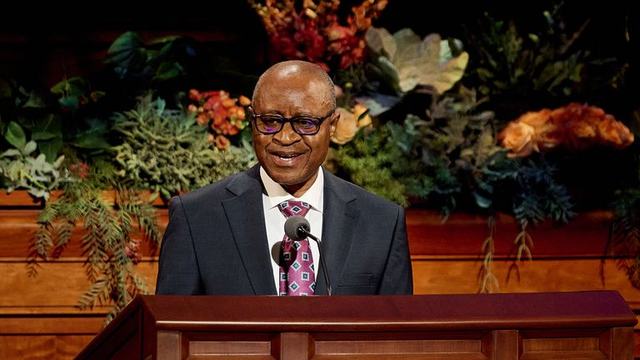
Using the Language of Peacemakers
 Open talk in Gospel Library
Contents
Topics
Follow Jesus Christ by Forgoing Contention
Elder Kyungu presents President Oaks’s invitation to use the language of peacemakers as a call to discipleship. Following Jesus Christ includes prayerfully studying prophetic counsel and acting on it in our families and other relationships.
This invitation to forgo contention by using the language of peacemakers comes from the living prophet. It is not a simple suggestion; it is a call to discipleship as we follow Jesus Christ.
It is a spiritual exercise to identify the language and expressions we need to forgo and then replace them with words and phrases that bring peace wherever we are and at all times.
My brothers and sisters, as followers of Christ, let us follow Him by forgoing contention and by using the language and methods of peacemakers.Key Points:
- Peacemaking is part of following Jesus Christ, not merely a communication technique.
- Prophetic invitations call for prayerful study, pondering, and faithful action.
- Disciples examine their language and deliberately replace expressions that create contention.
- The invitation applies in families and other personal relationships.
- What experience illustrates how acting on prophetic counsel strengthens your relationship with Jesus Christ?
- When do you recognize a choice between winning an argument and preserving peace?
- What relationship gives you opportunities to practice peacemaking as an expression of discipleship?
- How does prayerful pondering help you identify a change to make in your speech?
Choose Words That Edify Rather Than Harm
The scriptures teach that our words matter to God and that we are accountable for them. Elder Kyungu explains that humiliating, degrading, and discouraging language weakens love, diminishes respect, and damages relationships.
For by thy words thou shalt be justified, and by thy words thou shalt be condemned.
Let no corrupt communication proceed out of your mouth, but that which is good to the use of edifying, that it may minister grace unto the hearers.
Such words never edify. They weaken love, diminish respect, and damage relationships.Key Points:
- The Lord condemns lying and sowing discord.
- Jesus Christ teaches that we are accountable for our words.
- Our communication should edify and minister grace to others.
- Accusations, insults, and dismissive expressions harm relationships rather than resolve difficulties.
- Speech that conveys grace matters even when opinions differ.
- What experience helps you understand the lasting influence of encouraging or discouraging words?
- Who provides an example of speaking with grace in a difficult conversation?
- What helps you recognize when frustration begins to shape your language?
- What experience illustrates the difference between addressing a problem and attacking a person?
Replace Contentious Expressions With Peaceful Language
Elder Kyungu offers practical expressions that encourage understanding, patience, reassurance, and reconciliation. He compares abandoning contentious language to the converted Lamanites burying their weapons of war for peace.
Rather than choosing words and language that escalate feelings of anger, disappointment, and frustration, let us use words that encourage understanding and peace.
We must choose language that strengthens confidence and preserves relationships.
As the converted Lamanites “buried the weapons of war, for peace,” we too can bury the language of contention for peace.
Let us slow down and talk.
I don’t want this to divide us.Key Points:
- Peacemaking involves replacing harmful expressions, not simply avoiding conversation.
- Gratitude and respect help strengthen confidence and preserve relationships.
- Calm invitations such as “We can work this out” encourage cooperation.
- Expressions such as “I care about you” and “You are not alone” communicate support.
- We can deliberately abandon contentious language as the converted Lamanites abandon their weapons.
- What experience shows how a simple “Thank you” or “I appreciate that” strengthens a relationship?
- When does slowing down a conversation help people understand one another?
- What words help someone feel supported during a discouraging moment?
- Which contentious expression do you feel prompted to replace, and what peaceful phrase can you use instead?
Fill Your Heart With Christ’s Doctrine
Elder Kyungu connects our speech with the condition of our hearts. Filling our hearts with the true doctrine of Christ helps change our language and enables us to become instruments of His peace.
We learn from the New Testament that “out of the abundance of the heart the mouth speaketh.”
Therefore, let us fill our hearts with the true doctrine of Christ, which has the power to change our language and help us speak more as peacemakers today, tomorrow, and always.
We can become instruments of His peace in the world.Key Points:
- Our speech reflects what fills our hearts.
- The doctrine of Christ has power to change our language.
- Following Jesus Christ helps us both feel His peace and share it with others.
- Peacemaking calls for inward change as well as careful word choices.
- How does studying Christ’s teachings influence the way you speak to others?
- What experience helps you see a connection between your inward feelings and your outward words?
- Who exemplifies a Christ-centered heart through consistently loving speech?
- What spiritual practice helps you approach a difficult conversation with greater charity?
Repent and Reconcile Through the Savior’s Peace
Elder Kyungu invites us to repent of harsh language, pray for peaceful communication, and use words that bring people together. He testifies that the Savior’s peace is real and powerful and that peacemaking begins with our hearts, choices, and words.
Let us repent for the harsh language and expressions that have offended our friends, leaders, family members, or colleagues.
Let us pray for peaceful communication among us, regardless of the difference in our opinions.
Let us use the language that uplifts, edifies, comforts, and brings people together.
Peace I leave with you, my peace I give unto you.
This peace is real. It is powerful, and it begins with us—with our hearts, our choices, and our words.Key Points:
- Repentance includes acknowledging and turning away from speech that harms others.
- Apologies, requests for forgiveness, and expressions of forgiveness support reconciliation.
- Differences of opinion do not prevent respectful, peaceful communication.
- The Savior offers real and powerful peace.
- Each person can begin peacemaking through personal choices rather than waiting for others to change.
- What experience illustrates how a sincere apology opens the way to reconciliation?
- How does offering or receiving forgiveness help you understand the Savior’s peace?
- When does prayer help you communicate respectfully despite a disagreement?
- What personal experience can you appropriately share to testify that peace begins with your own choices and words?
