
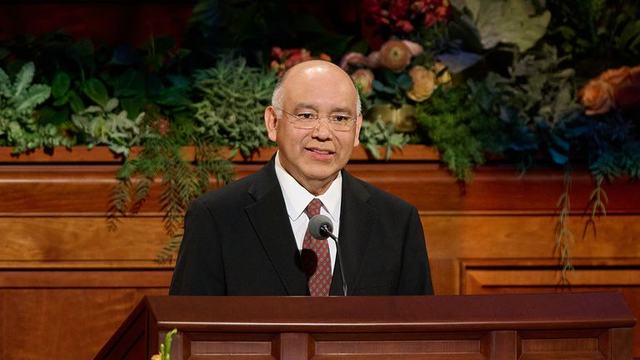
“Prove Me Now Herewith”
 Open talk in Gospel Library
Ideas for Opening the Lesson
- Write “Prove me now herewith” on the board and read Malachi 3:10 together. Invite class members to identify what the Lord asks and what He promises. Introduce Elder Villanueva’s message as an invitation to trust the Lord through living the law of tithing.
- Give class members a quiet moment to list blessings they notice in everyday life. Invite a few volunteers to share without discussing personal finances. Read Elder David A. Bednar’s statement from the talk about “significant but subtle blessings,” and invite the class to look for ways to recognize the Lord’s hand.
- Briefly describe Elder Villanueva’s mother as a mother supporting eight children in difficult financial circumstances who chooses to pay tithing. Ask, “What does her example teach us about trusting the Lord?” Explain that the discussion focuses on faith and discipleship rather than comparisons of financial circumstances.
- Write “Our expectations” and “The Lord’s way and timing” on the board. Ask class members what helps disciples remain faithful when these do not seem to match. Introduce the account of the sister who questions tithing because she does not receive the promotion or salary increase she hopes for.
Topics
Trust the Lord’s Promises Through Paying Tithing
Elder Villanueva presents paying a full tithe as an expression of faith in the Lord and His promises. He connects obedience with the laws upon which blessings depend and testifies that the Lord fulfills His word. His closing testimony emphasizes that Heavenly Father knows our needs and that Jesus Christ gives commandments because He wants us to receive His blessings.
I testify that Jesus Christ is the Son of the living God and that He directs His Church today. He gives us commandments because He wants us to receive His blessings.
- What does the invitation “prove me now herewith” in Malachi 3:10 teach us about the Lord’s willingness to fulfill His promises?
- How does understanding the purpose of commandments influence our attitude toward paying tithing?
- What do Doctrine and Covenants 130:20–21 and 58:31 add to your understanding of the Lord’s promises?
- How does knowing that Heavenly Father is aware of our needs help us approach tithing with faith?
- What experience in your life illustrates how obedience strengthens trust in the Lord?
- What change in your attitude or habits helps you approach tithing as an act of discipleship rather than merely a financial obligation?
Accept the Lord’s Way and Timing
Elder Villanueva cautions against expecting blessings to arrive exactly as we wish. The account of a faithful sister who hopes for a promotion and salary increase illustrates how specific expectations can obscure other blessings. He invites us to trust the Lord’s way and timing rather than measure His faithfulness by one desired outcome.
Sometimes we expect the Lord’s blessings to come the way we would wish, rather than in His own way and timing.
- Why is it easy to associate obedience with a particular outcome we want?
- What does the account of the sister who hopes for a promotion invite us to examine in our own expectations?
- How can we acknowledge disappointment honestly while continuing to trust the Lord?
- What experience helps you recognize the value of the Lord’s timing, even when it differs from your own?
- How can we support someone who faithfully pays tithing and still faces financial hardship without judging that person’s faith?
- What expectation might you need to place more fully in the Lord’s hands?
Recognize Significant but Subtle Blessings
Drawing on Elder Bednar’s counsel, Elder Villanueva invites us to notice blessings that are easy to overlook. His personal list includes employment, health, preserved possessions, opportunities for education, gratitude, and guidance from the Holy Ghost. These examples illustrate the temporal and spiritual blessings he recognizes in his life, rather than a checklist of outcomes every person must receive.
In his address “The Windows of Heaven,” Elder David A. Bednar taught, “As we live the law of tithing, we often receive significant but subtle blessings that are not always what we expect and easily can be overlooked” (Liahona, Nov. 2013, 17).
- Which blessing on Elder Villanueva’s list draws your attention, and why?
- What makes some of the Lord’s blessings easy to overlook?
- How can the Holy Ghost help us recognize the Lord’s hand in ordinary circumstances?
- What subtle blessing do you recognize in your life that strengthens your gratitude or faith?
- How do spiritual blessings, such as gratitude and guidance, broaden our understanding of the windows of heaven?
- How might keeping a personal list of blessings change your prayers and your outlook during the coming week?
Exercise Faith When Obedience Requires Sacrifice
Elder Villanueva connects his mother’s faithful payment of tithing in difficult circumstances with the widow of Zarephath’s willingness to follow Elijah’s counsel. Both examples highlight trust expressed through action when resources are scarce. He teaches that blessings come after the trial of faith and expresses gratitude for his mother’s choice to trust the Lord.
Elijah understood that blessings will come after the trial of our faith. The widow trusted in Elijah’s words and offered up all that she had (see also Mark 12:41–44).
- What similarities do you see between Elder Villanueva’s mother and the widow of Zarephath?
- What does Elijah’s invitation “Fear not” teach us about facing a difficult act of obedience?
- How does the widow’s decision to act demonstrate trust in the Lord’s promise?
- What helps you take a faithful step when you cannot yet see how circumstances will work out?
- Who in your life provides an example of faithful sacrifice, and how does that example influence you today?
- What step of obedience does this talk invite you to take, and what helps you prepare to take it?
Additional Discussion Questions
- How does the title “Prove Me Now Herewith” capture the central invitation of this talk?
- What connections do you see among faith, sacrifice, obedience, and gratitude throughout Elder Villanueva’s message?
- How does Jesus Christ’s loving purpose in giving commandments shape the way we teach tithing in our homes?
- What does this talk teach us about the difference between trusting a promise and prescribing its fulfillment?
- How can we share testimonies of blessings without implying that faithful people never experience illness, unemployment, or loss?
- How does recognizing the Lord’s hand influence the way we manage our time and resources?
- What helps you cultivate gratitude while still honestly acknowledging unmet needs?
- How can our quorum or Relief Society offer compassionate support to members who struggle with questions about tithing?
- Which passage or example from this talk strengthens your desire to trust the Lord, and why?
- What specific action do you choose for this week to apply the talk, and how do you plan to follow through?
