
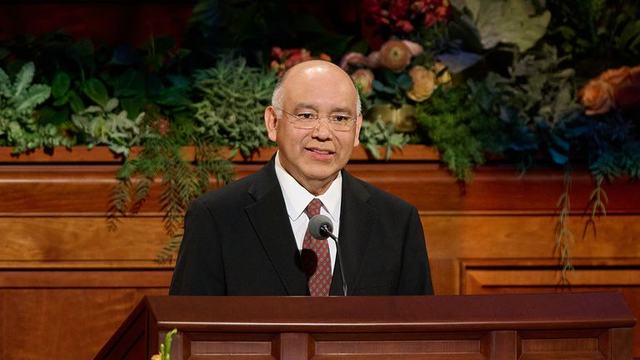
“Prove Me Now Herewith”
 Open talk in Gospel Library
Contents
Topics
Trust the Lord’s Promises Through Faithful Tithing
Elder Villanueva presents paying a full tithe as an expression of faith in the Lord’s promises. He teaches that blessings follow obedience to divine law, while reminding us that the Lord fulfills His promises in His own way and timing.
Perhaps the change that required the greatest faith and sacrifice was to honorably pay a full tithe.
Sometimes we expect the Lord’s blessings to come the way we would wish, rather than in His own way and timing.
As the Lord declared, “Who am I, saith the Lord, that have promised and have not fulfilled?”Key Points:
- Paying a full tithe can require meaningful faith and sacrifice.
- The Lord invites His people to trust His promise to open the windows of heaven.
- Blessings from God depend on obedience to the laws upon which they are predicated.
- God keeps His promises; our preferred outcomes and schedules do not determine how He fulfills them.
- The absence of a hoped-for promotion or salary increase does not mean the Lord’s promises fail.
- Reflect on a time when keeping a commandment requires you to trust the Lord despite uncertainty. What helps you move forward?
- Consider an experience in which a blessing comes differently from what you expect. How does that experience deepen your understanding of God’s care?
- Think about how your testimony of tithing develops. Which teachings, examples, or experiences strengthen it?
- Identify a time when you choose obedience before knowing the outcome. What does that choice teach you about faith in Jesus Christ?
Recognize Significant but Subtle Blessings
Elder Villanueva draws on Elder David A. Bednar’s teaching that tithing blessings are often significant but subtle. He encourages us to seek the Holy Ghost’s help in recognizing both temporal and spiritual blessings and to make a personal list of the Lord’s tender mercies.
In his address “The Windows of Heaven,” Elder David A. Bednar taught, “As we live the law of tithing, we often receive significant but subtle blessings that are not always what we expect and easily can be overlooked” (Liahona, Nov. 2013, 17).
The Holy Ghost helped me recognize many blessings:
I have developed the gift of gratitude by learning to appreciate the Lord’s hand in each of His tender mercies.
I invited that sister to write her own list of the significant yet subtle blessings the Lord had given her—blessings that are often easy to overlook.Key Points:
- Blessings associated with tithing can be easy to overlook when we focus only on a particular desired result.
- The Holy Ghost helps us recognize the Lord’s influence in our lives.
- Elder Villanueva identifies steady employment, good health, preserved possessions, educational opportunities, gratitude, and spiritual guidance among his blessings.
- The account of a sister’s long-lasting propane supply illustrates her recognition of a personal tender mercy.
- Writing a list of blessings helps us notice the Lord’s care and cultivate gratitude.
- Make a list of temporal and spiritual blessings you recognize in your life. Which examples feel appropriate to share with the congregation?
- Consider a time when prayer or the Holy Ghost helps you notice a blessing you previously overlook.
- Reflect on an ordinary provision—such as work, useful resources, or help with a decision—that becomes meaningful as you recognize the Lord’s care.
- Think about how practicing gratitude changes your response to a difficult circumstance.
- Consider whether you have an experience like those in the talk involving resources or possessions lasting longer than expected. How can you share your gratitude without implying that everyone receives the same outcome?
Put the Lord First During Financial Hardship
Elder Villanueva’s mother exemplifies trust in the Lord as she supports eight children and chooses to pay tithing despite difficult circumstances. The widow of Zarephath likewise acts on the Lord’s word through Elijah, showing that faith can require action before the promised blessing becomes visible.
Yet when the missionaries taught us the law of tithing, my mother chose to trust the Lord’s promise as recorded by Malachi:
Elijah then said, “Fear not; go and do as thou hast said: but make me thereof a little cake first, and bring it unto me, and after make for thee and for thy son” (1 Kings 17:13).
Elijah understood that blessings will come after the trial of our faith.
I am especially grateful that my mother trusted the Lord’s promises and chose to live the law of tithing regardless of our difficult circumstances.Key Points:
- Elder Villanueva’s mother places trust in the Lord while facing the demands of providing for eight children.
- The widow of Zarephath responds to Elijah’s invitation despite having only enough food for one final meal.
- The Lord sustains the widow’s meal and oil according to His promise through Elijah.
- Faith involves acting on the Lord’s word rather than waiting until every uncertainty disappears.
- A parent’s faithful example can profoundly influence a child’s testimony.
- Think of a parent, caregiver, or other faithful person whose example helps you trust the Lord. What specific action illustrates that influence?
- Reflect on a time when financial pressure tests your commitment to a commandment. What helps you respond with faith?
- Consider a moment when you feel afraid to act on spiritual counsel. How do you find courage to take the next step?
- Identify a sacrifice that draws you closer to Jesus Christ. What does it teach you about putting Him first?
- Reflect on the widow of Zarephath’s example. What experience helps you relate to her decision to act before seeing the promised provision?
See God’s Love in His Commandments
Elder Villanueva concludes by testifying that Heavenly Father knows us and understands our needs. He connects the law of tithing to God’s love and Jesus Christ’s direction of His Church, teaching that commandments help us receive divine blessings.
I bear my testimony that God is our loving Heavenly Father.
He knows each of us and is aware of our needs even before we ask (see Matthew 6:8).
I testify that Jesus Christ is the Son of the living God and that He directs His Church today.
He gives us commandments because He wants us to receive His blessings.Key Points:
- Heavenly Father’s knowledge of our needs is personal and complete.
- Jesus Christ directs His Church today.
- Commandments reflect the Lord’s desire to bless His children.
- Tithing is an opportunity to exercise trust in a loving God.
- A message about tithing can center on Heavenly Father’s love and faith in Jesus Christ rather than financial outcomes alone.
- Reflect on an experience that helps you know Heavenly Father understands your needs.
- Consider a commandment you come to recognize as an expression of God’s love. What helps your understanding grow?
- Think about how obedience strengthens your relationship with Jesus Christ.
- Identify a brief, sincere testimony you can share about the Savior, His guidance, and His care for you.
