
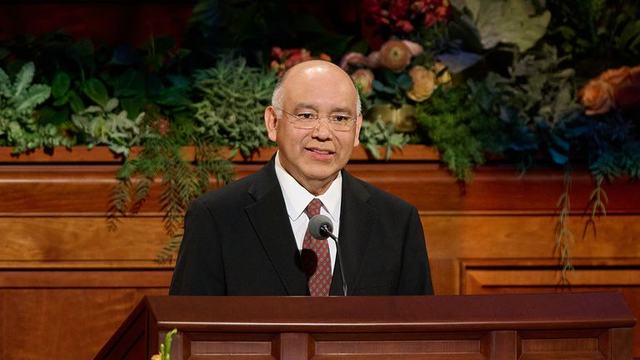
“Prove Me Now Herewith”
 Open talk in Gospel Library
Contents
Before Reading
Before reading or listening to the talk, consider the following questions:
- What does the Lord invite us to do when He says, “prove me now herewith”?
- How do your expectations influence the way you recognize the Lord’s blessings?
- What can Elder Villanueva’s mother and the widow of Zarephath teach you about exercising faith during difficult circumstances?
- What significant but subtle blessings do you notice in your life?
- How does understanding God’s love affect your willingness to keep His commandments?
Topics
Trust the Lord’s Promises Through Faithful Tithing
Elder Villanueva teaches that paying a full tithe expresses trust in the Lord’s promises. He connects the law of tithing with the revealed principle that blessings come through obedience to the laws upon which they are predicated. He also reminds us that the Lord fulfills His promises in His own way and timing, rather than according to our expectations.
“Bring ye all the tithes into the storehouse, that there may be meat in mine house, and prove me now herewith, saith the Lord of hosts, if I will not open you the windows of heaven, and pour you out a blessing, that there shall not be room enough to receive it” (Malachi 3:10).
“And when we obtain any blessing from God, it is by obedience to that law upon which it is predicated” (Doctrine and Covenants 130:20–21).
As the Lord declared, “Who am I, saith the Lord, that have promised and have not fulfilled?” (Doctrine and Covenants 58:31).
Sometimes we expect the Lord’s blessings to come the way we would wish, rather than in His own way and timing.
- What relationship does Doctrine and Covenants 130:20–21 establish between obedience and blessings?
- What does Malachi 3:10 promise to those who bring their tithes into the storehouse?
- Why does the absence of an expected promotion or salary increase not establish that the Lord fails to fulfill His promises?
- What expectations do I attach to paying tithing, and how can I become more willing to trust the Lord’s way and timing?
- What experiences help me trust that the Lord keeps His promises?
- What step can I take now to live the law of tithing with greater faith?
Recognize Significant but Subtle Blessings
Elder Villanueva draws on Elder David A. Bednar’s teaching that blessings associated with tithing are often significant, subtle, and easy to overlook. He identifies both temporal and spiritual blessings, including steady employment, preserved possessions, gratitude, and guidance from the Holy Ghost. He invites us to make a personal list that helps us recognize the Lord’s hand.
In his address “The Windows of Heaven,” Elder David A. Bednar taught, “As we live the law of tithing, we often receive significant but subtle blessings that are not always what we expect and easily can be overlooked” (Liahona, Nov. 2013, 17).
I have developed the gift of gratitude by learning to appreciate the Lord’s hand in each of His tender mercies.
I have learned to recognize the influence of the Holy Ghost when making important decisions in my life.
Have you ever asked yourselves whether the Lord has caused your personal possessions to last longer because you have faithfully lived the law of tithing?
- What temporal and spiritual blessings does Elder Villanueva identify in his own life?
- How does Deuteronomy 29:5 illustrate a blessing that people might otherwise overlook?
- How does making a list of blessings help address the concern of the sister who expects a promotion or salary increase?
- What significant but subtle blessings can I include in my own list today?
- Where do I notice the Lord helping me manage resources, recognize spiritual guidance, or develop gratitude?
- How can I regularly record tender mercies without limiting my expectations to financial blessings?
Exercise Faith When Obedience Requires Sacrifice
Elder Villanueva presents his mother’s commitment to tithing amid financial hardship as an example of trust in the Lord. He connects her faith with the widow of Zarephath, who follows Elijah’s instruction despite having very little food. These examples illustrate his teaching that blessings come after the trial of faith and that difficult circumstances do not prevent faithful obedience.
Perhaps the change that required the greatest faith and sacrifice was to honorably pay a full tithe.
Elijah then said, “Fear not; go and do as thou hast said: but make me thereof a little cake first, and bring it unto me, and after make for thee and for thy son” (1 Kings 17:13).
Elijah understood that blessings will come after the trial of our faith.
I am especially grateful that my mother trusted the Lord’s promises and chose to live the law of tithing regardless of our difficult circumstances.
- How do Elder Villanueva’s mother and the widow of Zarephath demonstrate trust in the Lord?
- What does Elijah ask the widow to do, and how does she respond?
- How does the fulfillment of the promise about meal and oil illustrate Elder Villanueva’s teaching about the trial of faith?
- In what circumstances does obedience currently require faith or sacrifice from me?
- What helps me choose faithful action when I cannot yet see how the Lord’s promises unfold?
- Whose example of faithful sacrifice strengthens my testimony, and what do I learn from that example?
See God’s Love in His Commandments
Elder Villanueva concludes by testifying that Heavenly Father knows each person and understands our needs before we ask. He affirms that Jesus Christ directs His Church and gives commandments because He wants us to receive His blessings. This testimony places the law of tithing within the broader context of God’s personal knowledge and love.
I bear my testimony that God is our loving Heavenly Father.
He knows each of us and is aware of our needs even before we ask (see Matthew 6:8).
I testify that Jesus Christ is the Son of the living God and that He directs His Church today.
He gives us commandments because He wants us to receive His blessings.
- What does Elder Villanueva teach about Heavenly Father’s awareness of our needs?
- According to the speaker, why does Jesus Christ give us commandments?
- How does the concluding testimony help explain the invitation to live the law of tithing?
- How does knowing that Heavenly Father understands my needs influence my approach to tithing?
- What experiences help me recognize commandments as expressions of God’s love?
- How can I make my obedience a more deliberate expression of trust in Heavenly Father and Jesus Christ?
